Strategy Faces MSCI Index Removal Over Its Bitcoin Hoard
Strategy's MSCI index removal, effective 30 November 2026, could strip passive demand from the world's biggest corporate bitcoin holder.
Strategy (NASDAQ: MSTR), the world’s biggest corporate holder of bitcoin, is facing an MSCI index removal that strips it from the MSCI USA Index – and, by extension, the MSCI World and MSCI All Country World indexes – at the close of 30 November 2026. MSCI confirmed the deletion on 11 November, as first reported by WSJ Markets, and the move was independently confirmed by Bloomberg.
The trigger is not a disclosure failure or an accounting scandal. It is a new MSCI eligibility rule, adopted on 15 October 2026, that excludes “non-operating companies” from its Global Investable Market Indexes – a category built for firms whose balance sheets are dominated by a single financial asset rather than an operating business, according to MSCI’s own consultation announcement. Strategy, which held roughly 850,364 bitcoin as of 8 November 2026 – bought at an average price of $75,456 per coin, for a total outlay near $64.16bn, according to reporting by cryptonews.net – is the rule’s most prominent casualty.
Why the MSCI index removal matters more than a ticker shuffle
Funds tracking MSCI’s global benchmarks hold roughly 13 million MSTR shares, around 3.1% of the company’s basic shares outstanding, according to Strategy’s own submission during the consultation process, as reported by CoinDesk. Analysts cited by Yahoo Finance and GuruFocus have put the initial index-driven selling pressure at around $2.8bn, a figure that could rise toward $8.8bn-$11bn should other major index providers adopt similar non-operating-company screens.
Crucially, removal from MSCI’s indexes does not force Strategy to sell any bitcoin, nor does it delist the shares from exchange trading, as Bitcoin Magazine has noted. What it does is quietly switch off a source of mechanical, price-insensitive buying – the rebalancing flows that passive funds generate simply because a stock is in the index, regardless of what anyone thinks it is worth.
That matters because of how Strategy funds its bitcoin purchases in the first place. The company has relied on issuing new shares at a premium to the net asset value of its bitcoin holdings – a premium sometimes called mNAV – to buy more coins. Analysts at BloFin Research, cited by CoinDesk, have flagged that losing passive index demand could compress that premium, making future equity raises less accretive and, in effect, raising the cost of the very trade that built the position.
Strategy is not alone in the reshuffle. Tokyo-listed Metaplanet was removed from the MSCI Japan Small Cap Index and Upexi from the MSCI US Micro Cap Index under the same rule change, according to The Block – evidence that MSCI’s new test is being applied as a general screen against balance-sheet-as-treasury structures, not a bespoke veto on one company.
The accounting swings behind the “non-operating” label
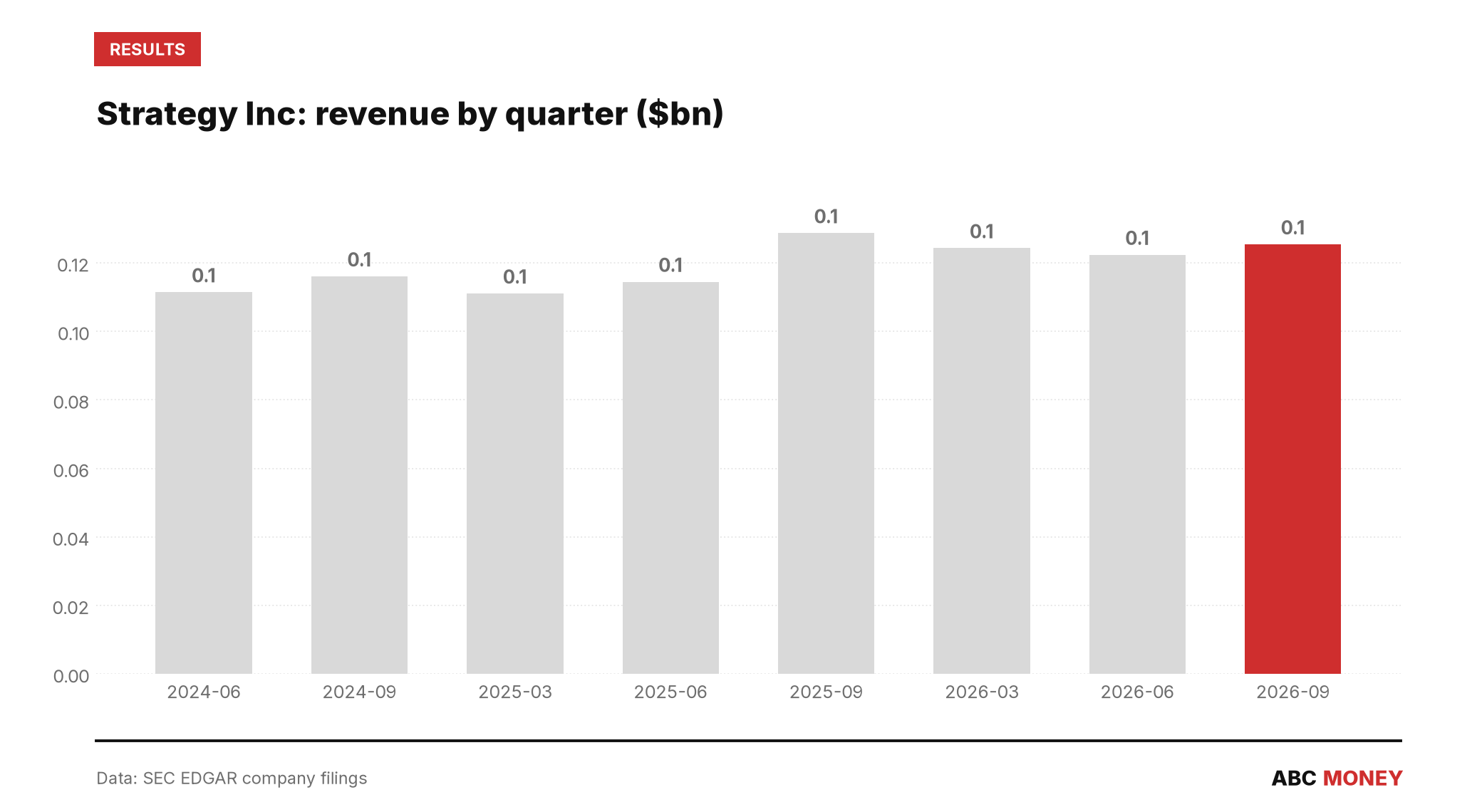
Strategy’s own quarterly filings illustrate why MSCI drew the line where it did. Net income swung from a loss of $12.54bn in the first quarter of 2026 to a loss of $8.22bn in the second quarter, then to a gain of $19.53bn in the third quarter, according to filings with the SEC – swings driven almost entirely by fair-value accounting on the bitcoin stack rather than the underlying software business. That operating business has stayed remarkably steady throughout: quarterly software and subscription revenue has sat in a narrow $111m-$128m band since mid-2024, filings show, underscoring that the market capitalisation and the volatility sit on the asset side of the balance sheet, not the business itself.
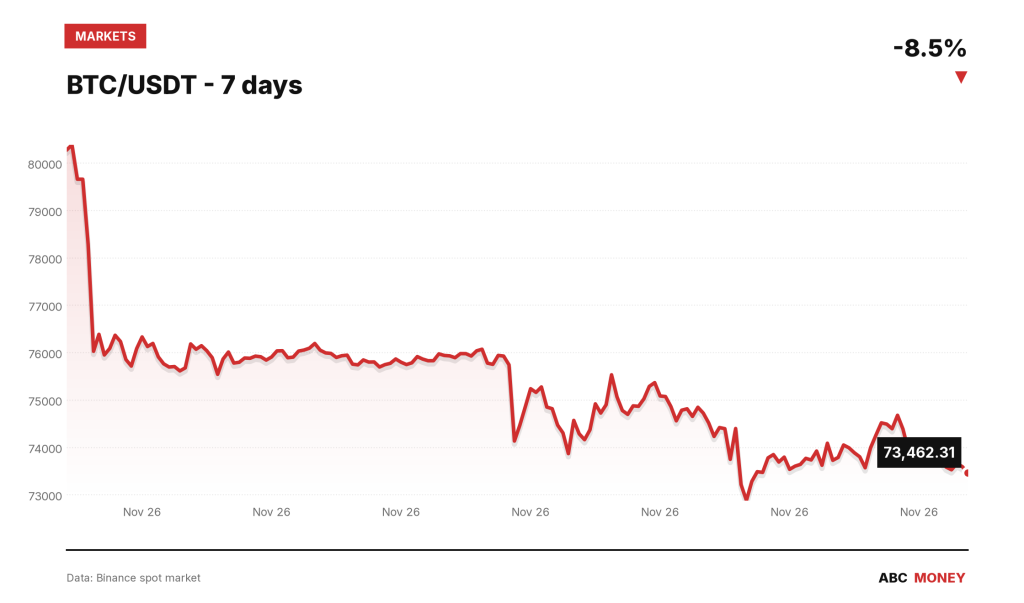
The market had already begun pricing in the change before MSCI’s confirmation. MSTR closed at $122.35 on 11 November and slipped to $120.50 in after-hours trading once the decision landed, per cryptonews.net’s reporting. By 09:00 UTC on 12 November the shares had fallen further, to $117.07 – down 4.54% on the day and 19.43% over the prior 20 trading sessions, touching a 20-day low at that same level. Bitcoin itself traded near $73,462 on Binance over the same window, down 0.8% in 24 hours and 6.55% over the preceding week, so the stock’s decline has outpaced the token it is meant to track.
Daily short-sale ratios on MSTR, tracked by FINRA, fluctuated between roughly 0.34 and 0.54 through early-to-mid November without any obvious spike tied to the MSCI news – suggesting this is a story about index mechanics and financing cost, not a bet by traders borrowing shares to sell. Broader credit and rates markets backed that reading: the 10-year Treasury yield sat at 4.88% and high-yield spreads at 3.34% on 9 November, both little changed from prior readings tracked by the Federal Reserve Bank of St. Louis, pointing to a company-specific event rather than a shift in risk appetite.
MSCI’s framework was not inevitable. The provider first floated excluding digital-asset treasury firms with crypto holdings above half their assets in late 2025, shelved that plan in January 2026 after industry pushback – a reprieve that sent MSTR shares up 6% at the time – before returning in October with the broader non-operating company test that ultimately caught Strategy anyway. Whether rival index compilers follow MSCI’s lead by the next scheduled reviews is now the detail institutional holders are watching most closely.
This article is for information only and is not investment advice or a recommendation to buy or sell any asset. Markets move quickly; figures are correct as sourced at the time of writing. Always do your own research before making financial decisions.