PNC launches stablecoin payment pilot with Coinbase
PNC's new stablecoin payment pilot with Coinbase lets clients receive USDC and auto-convert to dollars - part of a wider bank-crypto wave.
In this article 3 sections
PNC Financial Services Group (PNC) has gone live with a stablecoin payment pilot built with Coinbase, letting eligible corporate and institutional clients receive funds in Circle’s USDC and have them automatically converted into US dollars, the bank announced on 9 November 2026.
The mechanism is deliberately narrow for now: clients taking part can accept incoming USDC payments, which the bank’s systems then sweep into dollars without the client having to touch a crypto wallet or exchange directly. Tom Lang, PNC’s head of treasury management products and operations, described the launch as a way “to test stablecoin functionality in collaboration with clients,” language echoed across PANews’s reporting of the deal and consistent with how Reuters framed the rollout as a limited-scale pilot rather than a full commercial product.
That framing matters. PNC is not announcing a stablecoin of its own, nor a wholesale push into crypto custody. It is plugging a well-established digital-dollar token into its existing treasury rails, using Coinbase as the technical bridge, and watching what happens.
Not PNC’s first stablecoin step
The pilot extends a relationship that already runs in both directions. PNC clients have had access to crypto trading through Coinbase’s “Crypto-as-a-Service” infrastructure, and separately, PNC provides conventional banking services to Coinbase itself, according to reporting from PANews. The new pilot adds a payments layer on top of that existing plumbing rather than building something from scratch.
PNC’s own research gives a sense of why the bank is moving carefully rather than rushing into a full launch. Treasury-management research published by the bank found interest in stablecoins accelerating among corporate treasurers, but only 17% said they were ready to adopt the technology today – a gap Lang has attributed to a lack of clarity about operational mechanics rather than outright resistance, per PNC’s own insights research. A pilot that automates the conversion step for clients is a reasonably direct answer to that specific complaint: it removes the need for a treasurer to hold or manage stablecoins at all.
Part of a bigger bank-crypto wave
PNC is not acting alone. Coinbase chief executive Brian Armstrong has said the exchange has started live pilots on stablecoins, custody and trading with several of the largest US banks, including JPMorgan, Citigroup and Bank of America, according to a report carried by MEXC News. Seen in that light, the PNC pilot looks less like a standalone scoop and more like one data point in a broader pattern: stablecoin rails are becoming standard-issue infrastructure for large-bank treasury operations rather than a niche experiment confined to crypto-native firms.
That context is worth holding onto, because it reframes what would otherwise read as a single bank’s product announcement. The interesting question is less “will PNC’s pilot succeed” than how many of its peers end up running the same experiment in parallel, and whether clients actually use it once it is available.
Market reaction, and the numbers behind it
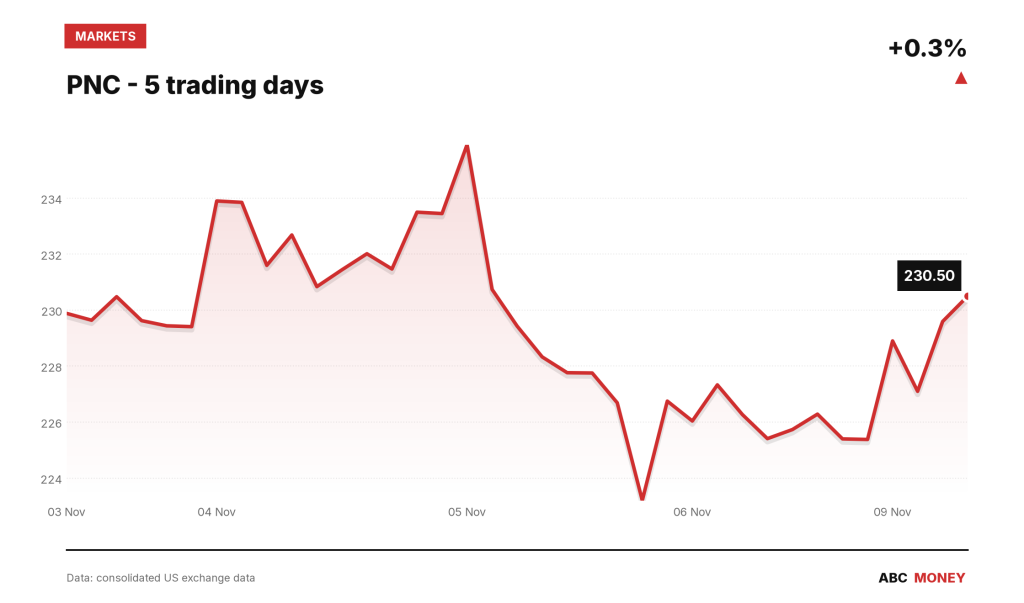
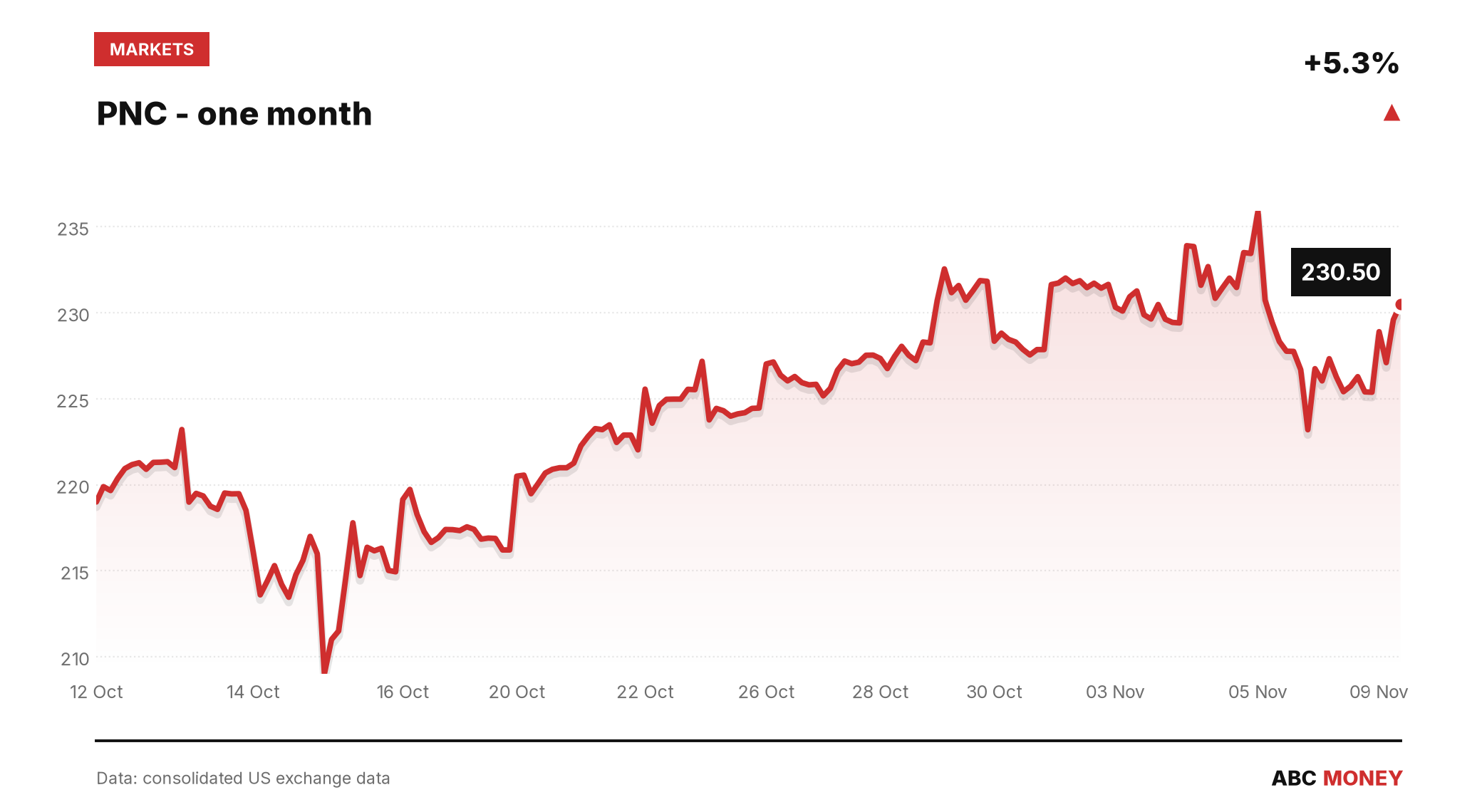
PNC shares closed 2.08% higher on the day, changing hands at $230.43, having climbed 6.26% over the prior 20 trading days against a 20-day range of $216.21 to $235.91, according to consolidated US exchange data. Trading volume ran at roughly two-thirds of its 20-day average, suggesting the move reflected a broad market tailwind as much as any single headline.
Short interest – the share of daily trading volume accounted for by bets that the stock will fall – has stayed in a fairly tight band through late October and early November, ranging between roughly 0.49 and 0.62 according to FINRA’s daily short-sale volume data, with no obvious spike around the announcement. That is consistent with a market treating the pilot as incremental news rather than a catalyst worth repositioning around.
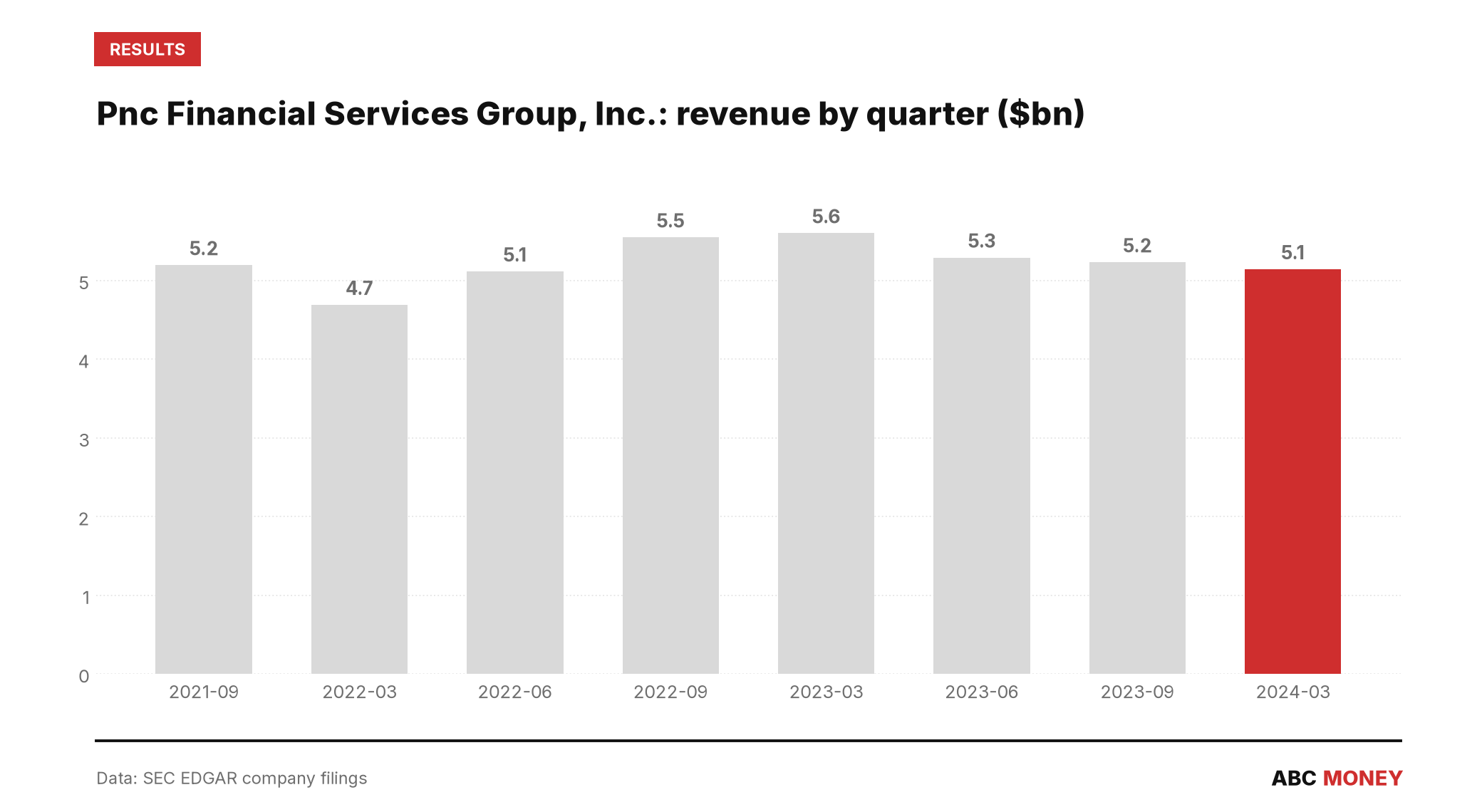
The bank’s underlying financial engine, for context, remains a conventional one: PNC reported net income of $2.081bn and diluted earnings per share of $4.97 for the third quarter of 2026, according to its most recent quarterly filing with the SEC. A stablecoin pilot, however well it performs, sits a long way from moving numbers of that size – which is exactly why the market’s muted reaction makes sense.
What happens next is less about PNC’s share price than about take-up. The bank has not said how many clients are enrolled in the pilot or set a timeline for a broader rollout, and Coinbase has not disclosed comparable detail about its parallel work with other large banks. For corporate treasurers watching from the sidelines, the practical test will be whether receiving a stablecoin payment through PNC feels meaningfully different from receiving a wire – and whether that difference is worth adopting before the rest of the market does.
This article is for information only and is not investment advice or a recommendation to buy or sell any asset. Markets move quickly; figures are correct as sourced at the time of writing. Always do your own research before making financial decisions.