Cisco Revenue Forecast Lifted Again to $75.8bn on AI Boom
Cisco's revenue forecast for fiscal 2027 just rose for the second time in three months, as hyperscaler AI networking orders keep climbing.
In this article 4 sections
Cisco Systems (NASDAQ: CSCO) has raised its revenue forecast for fiscal 2027 for the second time in three months, telling investors it now expects sales of between $74.8 billion and $75.8 billion – up from the $72.2 billion-$73.4 billion range it set as recently as August. The new figures sail past the FactSet consensus of roughly $72.99 billion, and the pattern – guide up, beat, guide up again – is becoming Cisco’s signature as artificial intelligence spending works its way through corporate and hyperscale data centres.
Alongside the revenue lift, Cisco pushed its fiscal 2027 adjusted earnings-per-share guidance to $5.47-$5.53, comfortably above the roughly $5.10 analysts had pencilled in. For the current quarter, the company guided to revenue of $18.0 billion-$18.2 billion. The Wall Street Journal framed it plainly: an outlook raised on soaring revenue and profit, not a one-quarter wonder.
A second raise, not a one-off beat
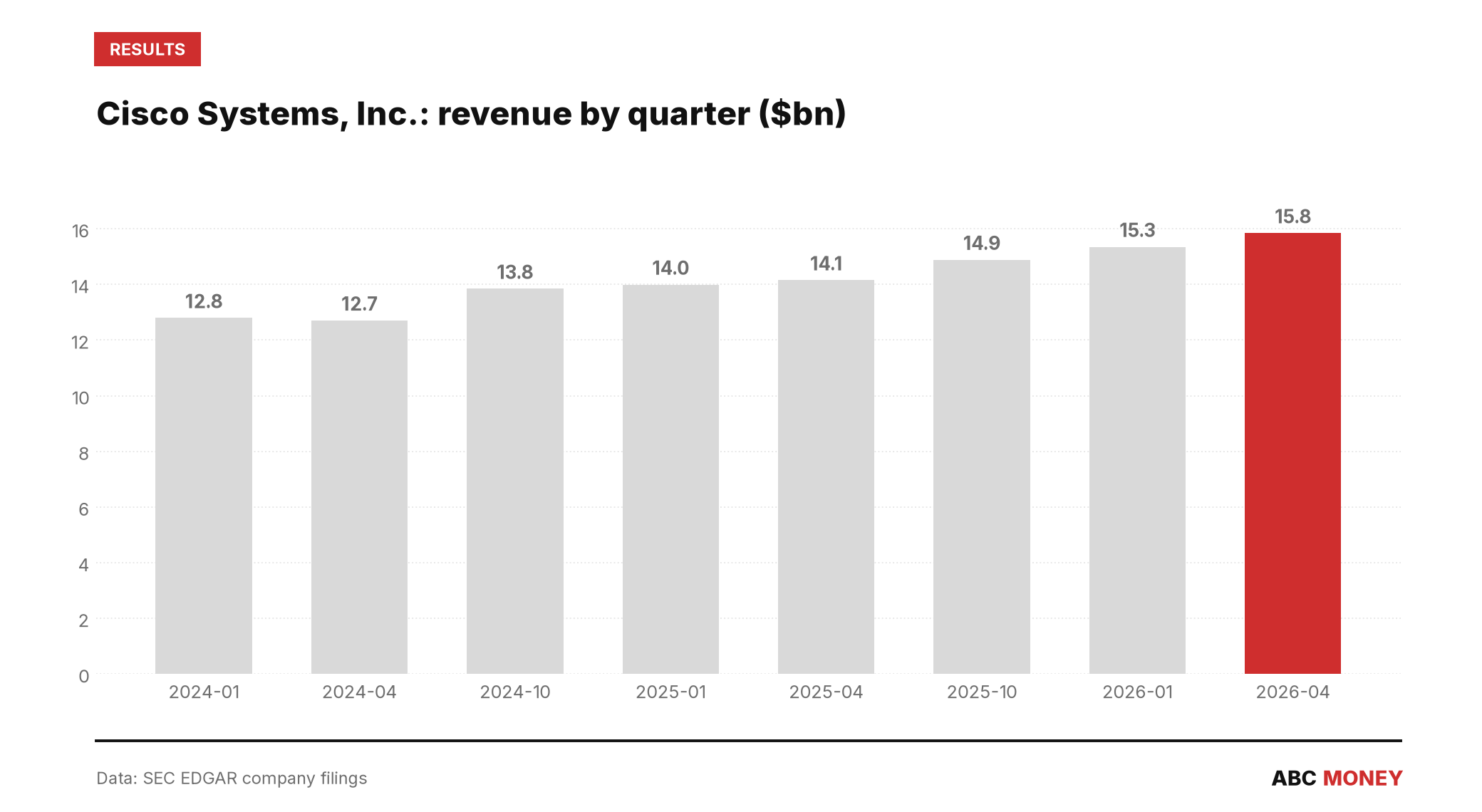
What makes this notable is the sequencing. Cisco’s networking business has been accelerating for several quarters – quarterly revenue has climbed from $12.79 billion in the quarter ended January 2024 to $15.84 billion in the quarter ended April 2026, according to figures filed with the Securities and Exchange Commission. The quarter just reported, the first of fiscal 2027, came in at $18.5 billion, up 24% year on year and above the top end of the guidance Cisco had given back in August.
Rather than treat that beat as a reason to hold steady, management chose to raise the full-year range again. Reuters reported that the upgrade reflects strong demand for Cisco’s AI networking equipment and cybersecurity tools, and Bloomberg independently confirmed the new range sits above the prior outlook’s ceiling of $73.4 billion.
The hyperscaler number that matters
The clearest tell on where this demand is coming from is Cisco’s forecast for AI infrastructure orders from hyperscale cloud customers – the handful of giant data-centre operators that buy networking gear by the data-hall. That figure was raised to $9 billion for fiscal 2027, up from $7.5 billion just three months ago, as first reported by The Globe and Mail. It is the clearest evidence in the release that Cisco views this as a structural shift in networking spend rather than a temporary surge tied to one or two large customers.
Chief executive Chuck Robbins described the trend in blunter terms, calling it the early stages of a “multi-year networking supercycle” in Cisco’s earnings release filed with the SEC. That is a deliberate choice of words: supercycles, by definition, are not meant to fade after a quarter or two, and Cisco is now asking investors to underwrite that view with a second consecutive guidance increase.
Consensus gap and the market’s read
Benzinga’s tally of analyst estimates put the pre-announcement consensus at roughly $73.02 billion, meaning even the low end of Cisco’s new $74.8 billion-$75.8 billion range clears where Wall Street had been sitting. For a company of Cisco’s size – mid-teens billions in quarterly revenue – a guidance range shift of this magnitude is unusually large, and it came with no change in the macro backdrop that might otherwise explain it: the 10-year Treasury yield sat at 4.88% on 9 November, barely different from the prior session, according to Federal Reserve data.
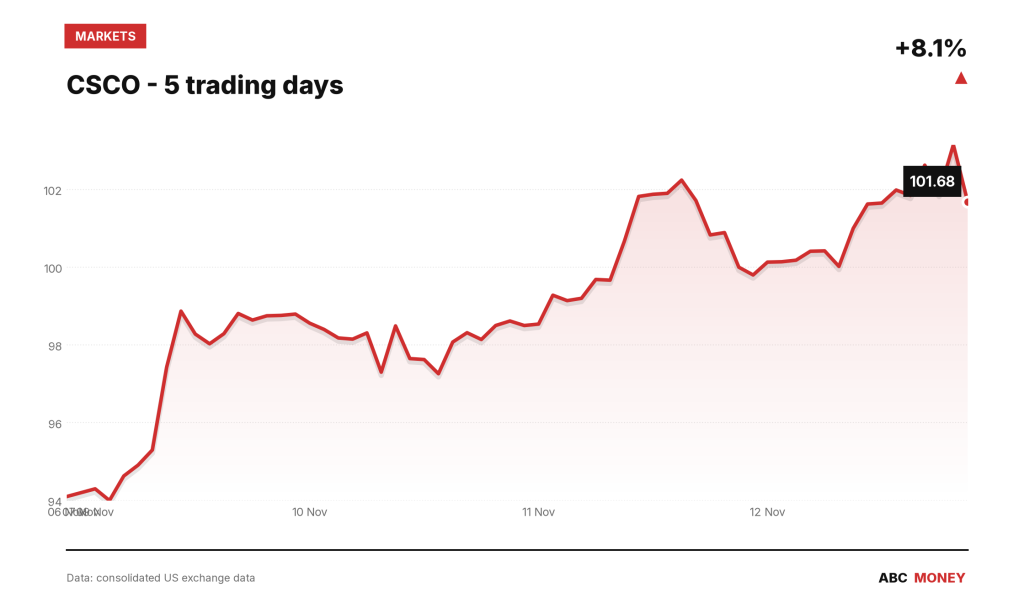
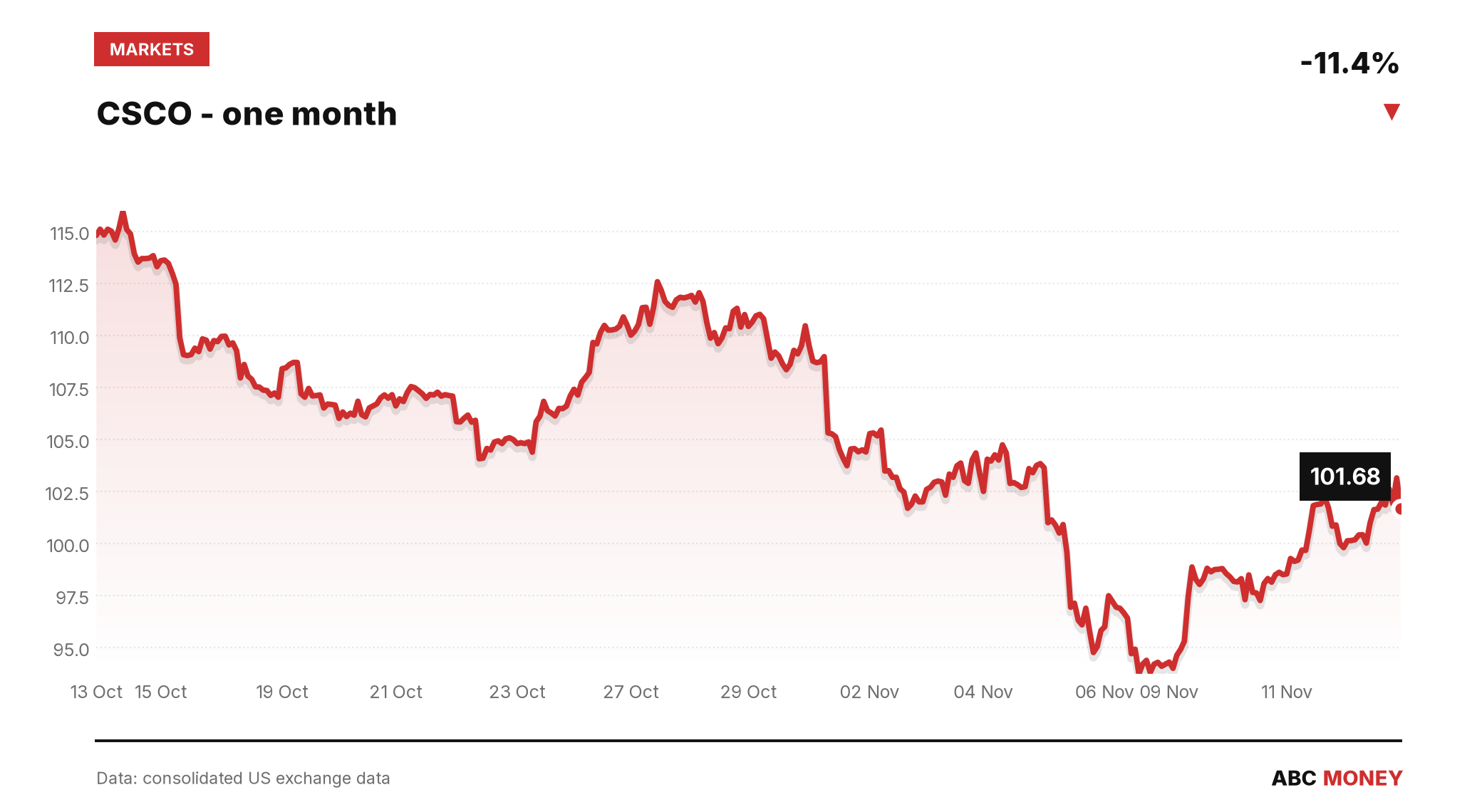
Cisco shares closed at $102.07 as of 22:00 UTC on 12 November, up 0.44% on the day but still down 2.78% over the preceding 20 trading days, having traded as high as $112.58 and as low as $93.73 in that window, with volume running at 2.37 times the 20-day average – a sign that plenty of investors were repositioning around the print. Short-sale activity, which tracks the proportion of daily trading volume tied to bets against the stock, showed no unusual build-up beforehand: FINRA’s daily short-volume data put the ratio between roughly 0.27 and 0.47 over the ten sessions leading into the announcement, consistent with ordinary two-way trading rather than a crowded short position unwinding on the news.
What the raise implies for the rest of the year
Cisco’s own numbers suggest the company expects the AI networking order book to keep compounding through fiscal 2027 rather than plateau after this quarter’s guide. With Q2 revenue guidance already set at $18.0 billion-$18.2 billion and the hyperscaler AI order forecast moving up by $1.5 billion in a single quarter, the next data points investors are watching will be whether that $9 billion hyperscaler figure holds – or rises again – when Cisco next reports, and whether the broader networking upgrade cycle it describes extends to enterprise customers beyond the largest cloud operators.
This article is for information only and is not investment advice or a recommendation to buy or sell any asset. Markets move quickly; figures are correct as sourced at the time of writing. Always do your own research before making financial decisions.