AMD Closes $8.2bn World Labs Deal, Hires Fei-Fei Li
AMD's World Labs acquisition closes at $8.2bn in stock, with Fei-Fei Li joining as chief scientist. Here's what the valuation jump reveals.
In this article 4 sections
Advanced Micro Devices (NASDAQ: AMD) has completed its takeover of World Labs, the AI research outfit founded by Dr Fei-Fei Li, in an all-stock transaction the chipmaker values at roughly $8.2bn. The AMD World Labs acquisition brings Li herself into the business as executive vice president and chief scientist, reporting directly to chief executive Lisa Su, according to AMD’s completion announcement on 16 November 2026.
The press release frames it as adding “a world-class model team” to AMD’s push into AI infrastructure for what it calls the open ecosystem – part of a broader effort to build out the software and research muscle to sit alongside its Instinct chips, which compete with Nvidia’s accelerators.
A valuation that nearly doubled in ten months
The more interesting number sits a few months earlier in the calendar. Bloomberg reported in January 2026 that World Labs was in funding talks at a valuation of around $5bn. By the time AMD’s definitive agreement landed in September and closed this month, the price tag had risen to roughly $8.2bn – a jump of more than 60% in under a year for a company that only shipped its first commercial product, a 3D world-model tool called Marble, relatively recently.
World Labs itself is barely two years old. It launched in September 2024 with a $230m seed round led by Li, who is widely known in AI circles as the “godmother of AI” for her early work on image-recognition datasets, and went on to raise a cumulative $1.23bn across two funding rounds before AMD came calling, according to data compiled by StartupHub.ai.
That trajectory – seed-funded lab to $8.2bn acquisition in roughly 26 months – says as much about how feverishly large chipmakers are bidding for scarce AI research talent as it does about World Labs’ own commercial traction. AMD is paying in its own stock rather than cash, which means former World Labs shareholders become AMD shareholders: a transaction structure that dilutes existing AMD investors slightly – their proportional ownership shrinks as new shares are issued – but preserves AMD’s cash balance for other priorities, including the capital-intensive business of building AI chips at scale.
The paperwork says Friday the 13th, not Monday the 16th
AMD’s public relations machine dated the completion release 16 November, but the underlying mechanics moved two days earlier. A share-issuance disclosure shows AMD issued 14,978,322 common shares to former World Labs stockholders to settle the deal, with the transaction actually closing on 13 November 2026, according to a disclosure reported by Rallies.ai. The $8.2bn purchase price remains “subject to adjustment,” standard language in stock-for-stock deals where the final value can shift with AMD’s own share price between signing and closing.
It’s a minor wrinkle rather than a story in itself, but it’s a reminder that “completion” announcements are marketing events timed for maximum visibility, while the legal and financial reality of a deal closing often happens quietly beforehand through SEC filings.
Shares under pressure as the deal lands
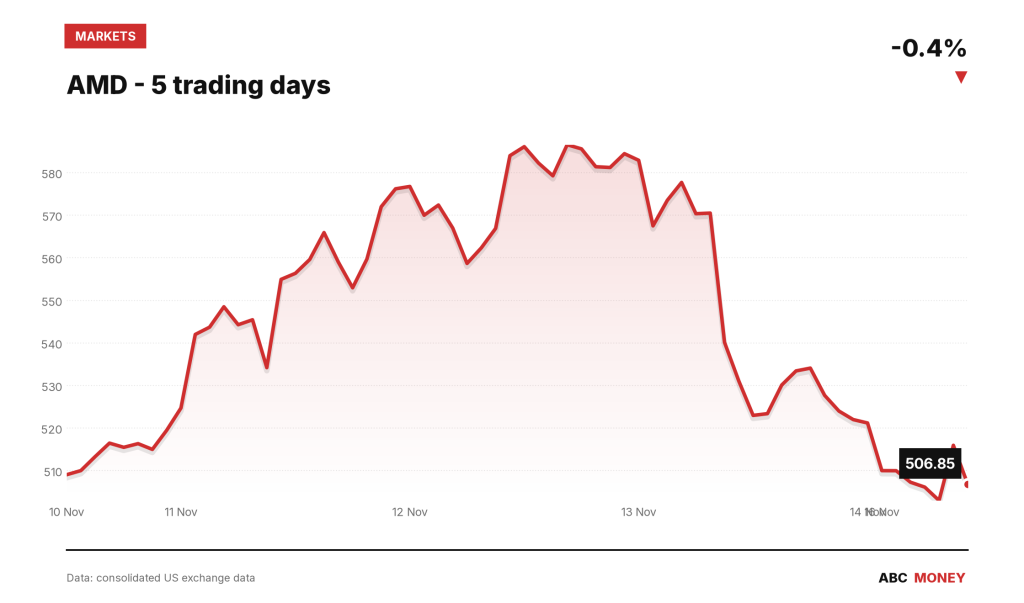
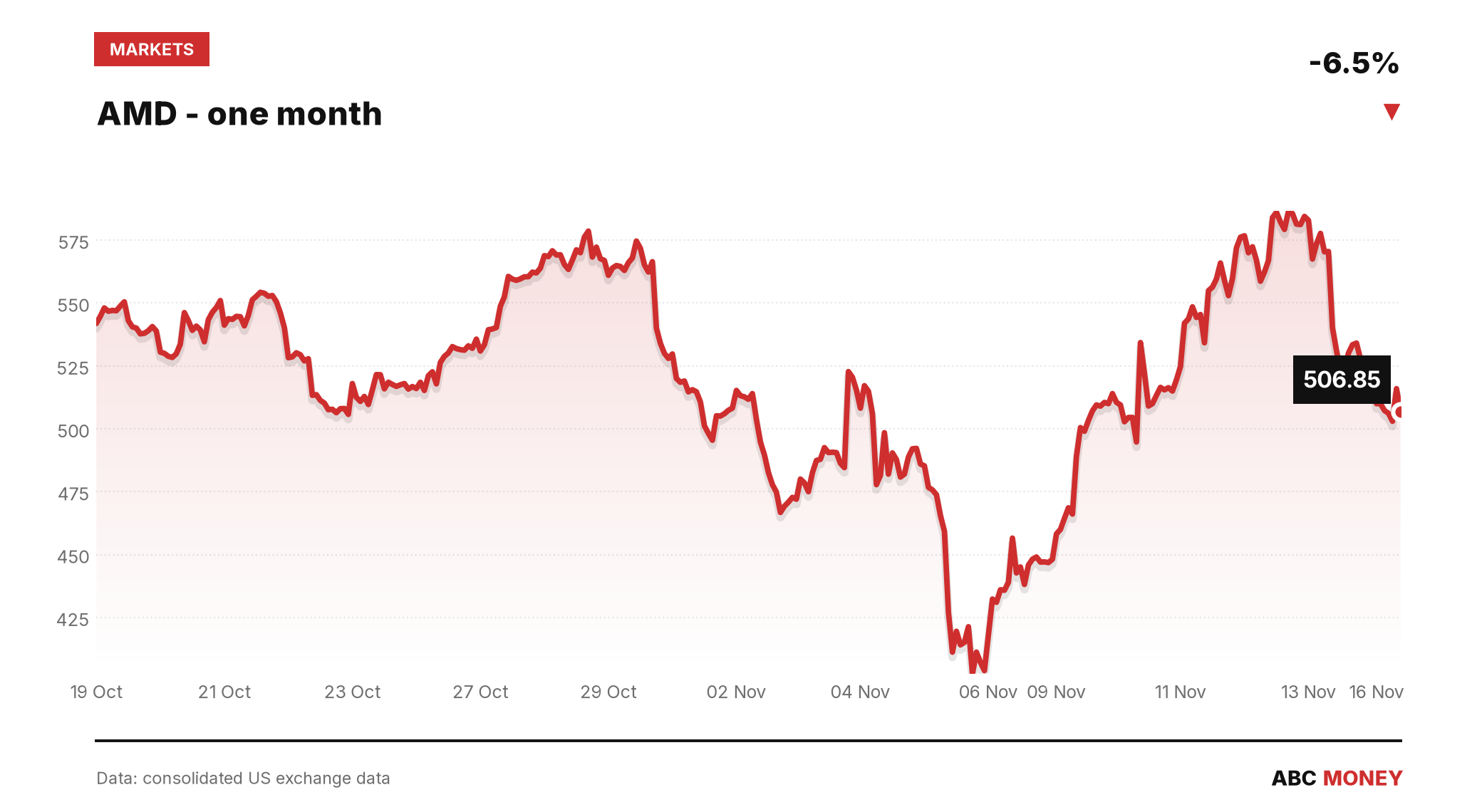
AMD stock closed at $506.25 as of 3pm UTC on 16 November, down 2.87% on the day and 4.51% over the preceding 20 trading sessions, with volume running at roughly 62% of its 20-day average – a fairly muted reaction for an acquisition of this size, suggesting the market had largely priced in the deal since September’s announcement. The shares have traded in a wide band over the past month, from a high of $586.56 to a low of $402.51.
Short-selling activity in AMD stock, measured by FINRA’s daily short-sale ratio – the share of total trading volume attributable to short sales, where traders bet the price will fall – crept higher into the actual closing date. The ratio rose from 0.378 on 2 November to 0.591 on 13 November, the day the shares were issued, according to FINRA data. That’s a meaningful increase but not an extreme one, and it sits well within ranges FINRA data shows for large-cap tech names generally; it points to some hedging or scepticism around deal terms rather than a broad bet against the stock.
AMD’s numbers give it room to pay in equity
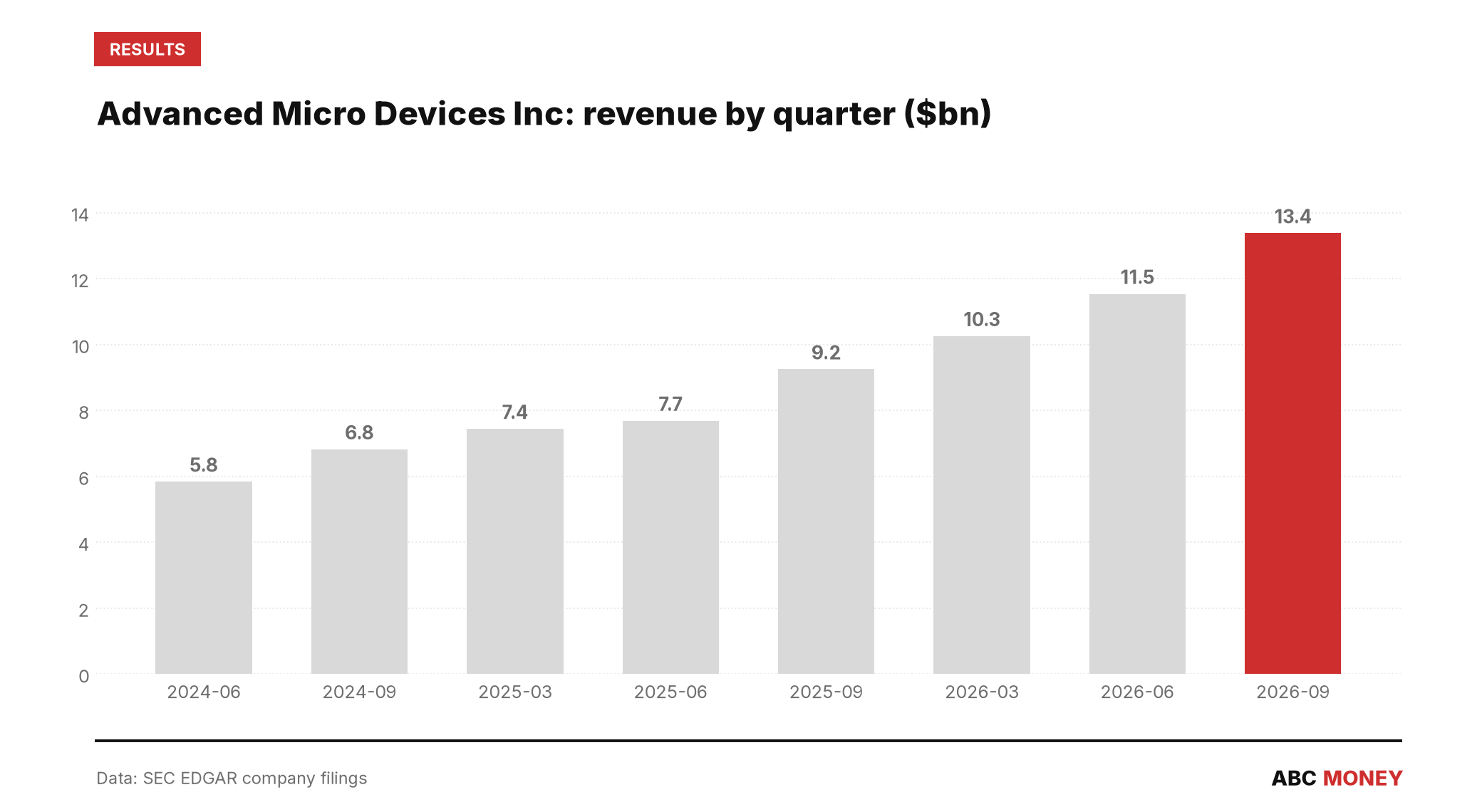
The acquisition lands at a moment when AMD’s underlying business has been accelerating sharply. Quarterly revenue has climbed from $5.84bn in the second quarter of 2024 to $13.38bn in the third quarter of 2026, according to the company’s own filings with the SEC. Net income over the same run has risen from $265m to $2.43bn, with diluted earnings per share reaching $1.46 in the most recent quarter, up from $0.16 two years earlier.
That growth has pushed AMD’s trailing price-to-earnings ratio to around 110.79 times, according to GuruFocus, with one of its valuation models suggesting the stock trades well above fair value on that metric. A rich share price is precisely the kind of currency that makes an all-stock acquisition cheaper in practice: AMD can hand over equity worth $8.2bn without touching its cash reserves, so long as sellers and the market continue to value those shares highly.
That backdrop sits alongside a broader shift in the rate environment. The 10-year US Treasury yield rose to 5.10% in mid-November, up from 4.98%, according to Federal Reserve data – a move that tends to weigh more heavily on high-multiple growth stocks like AMD than on the broader market, since higher yields make distant future profits less attractive relative to safer fixed income.
For now, the integration task falls to Li and her team. AMD has framed the World Labs deal as central to building AI infrastructure for what it calls the “open ecosystem” – language that signals an intent to compete with Nvidia not just on chips, but on the software and model layer that sits above them. Whether that bet justifies the step-up from a $5bn fundraising conversation in January to an $8.2bn completed sale in November is a question the market, rather than the press release, will ultimately answer.
This article is for information only and is not investment advice or a recommendation to buy or sell any asset. Markets move quickly; figures are correct as sourced at the time of writing. Always do your own research before making financial decisions.