Applied Materials Beats on Q4 Earnings – Shares Fall Anyway
Applied Materials earnings beat forecasts on revenue and profit, but AMAT shares fell nearly 4% - here's why a record quarter didn't move the stock higher.
In this article 3 sections
Applied Materials (NASDAQ: AMAT) delivered the kind of quarter chip-equipment bulls dream about: record revenue, record profit, and guidance that cleared Wall Street’s bar. The Applied Materials earnings report, released after the US market close on 12 November 2026, showed fiscal fourth-quarter revenue of $10.41bn, up 53% on the same period a year earlier, alongside GAAP earnings per share of $3.40 and adjusted earnings of $4.16, both the highest in the company’s history, according to the company’s own filing.
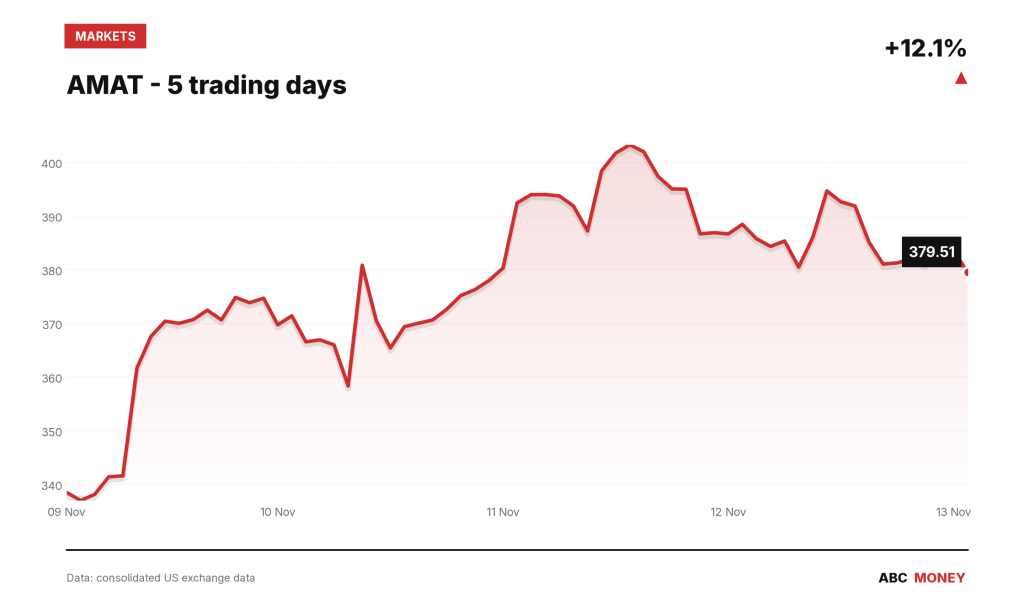
Investors shrugged. Shares slid to $380.95 in the session around the print, a fall of roughly 3.6%, and even a modest after-hours bounce to $382.85 left the stock below its $395.08 prior close, per Investing.com’s tracking of the move. By the following morning the stock was changing hands at $380.05, down 1.31% on the day and trading on volume some 1.5 times its 20-day average – a sign that plenty of money was repositioning, not just drifting.
A beat, but a narrow one
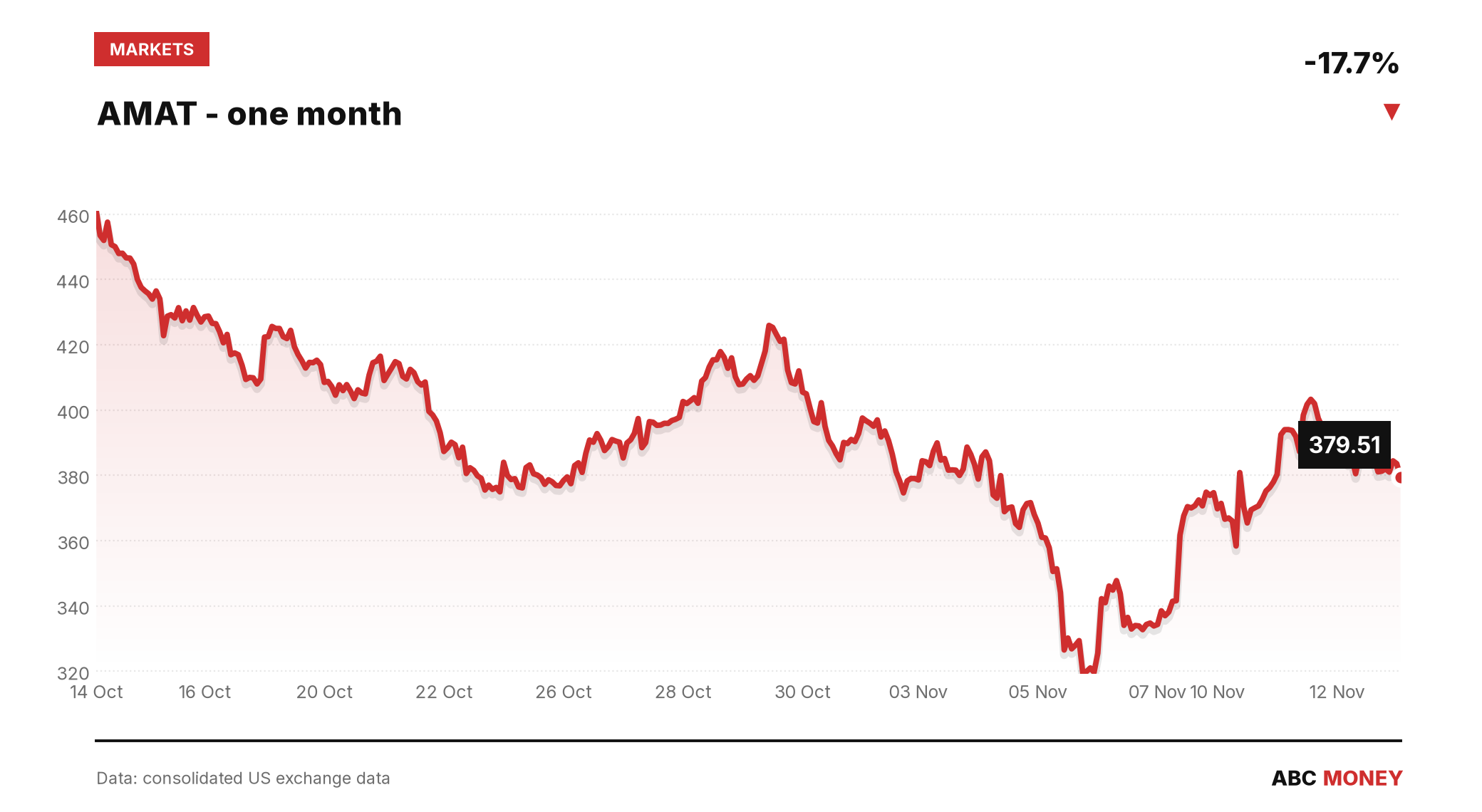
The gap between a headline-grabbing quarter and a falling share price comes down to arithmetic. Revenue of $10.41bn came in only about 1% ahead of the roughly $10.30bn analysts had pencilled in, while adjusted earnings per share beat estimates of $4.05 by around 3%, according to figures reported by TheStreet. Those are real beats, but they are thin ones by Applied Materials’ own recent standards, and for a stock that had rallied hard into the print on assumptions of an AI-fuelled upgrade cycle, “good” was never quite going to be good enough.
The full fiscal year told the same story in bigger type: revenue of $34.45bn, GAAP earnings per share of $12.62 and adjusted earnings per share of $12.89, all records. Guidance for the first quarter of fiscal 2027 pointed to revenue of around $11.1bn, above what analysts had been modelling, according to CoinCentral. On paper, this was not a quarter that should have sent the stock lower.
Why the market marked it down anyway
Context matters here. Applied Materials had already climbed roughly 48% year-to-date heading into the print, according to the same CoinCentral reporting, which means a decent amount of AI-driven optimism was baked into the share price before a single number came out. A beat that only edges past consensus by low single digits, against that kind of run-up, reads to traders less as confirmation and more as “is that it?”
The timing didn’t help. CoinCentral also reported that chip-equipment names were rattled on the same day by news of a leadership exit at Nvidia (NASDAQ: NVDA), adding a sector-wide jitter to a stock that was already due a reaction of its own. Rates were unhelpful too: the 10-year Treasury yield rose to 4.98% on 10 November from 4.88% previously, part of a broader move that tends to weigh on high-multiple technology and semiconductor names just as earnings season tests their valuations, per data from the Federal Reserve Bank of St. Louis.
Positioning data points the same way. The proportion of Applied Materials’ daily trading volume tied to short sales – bets that the stock will fall, where sellers borrow shares they don’t own – climbed from 0.187 on 3 November to 0.387 on 11 November, the session before the results landed, according to FINRA’s daily short-sale data. That build-up suggests traders were already hedging against disappointment, or simply trimming exposure, well before the numbers came out.
What the quarter actually showed
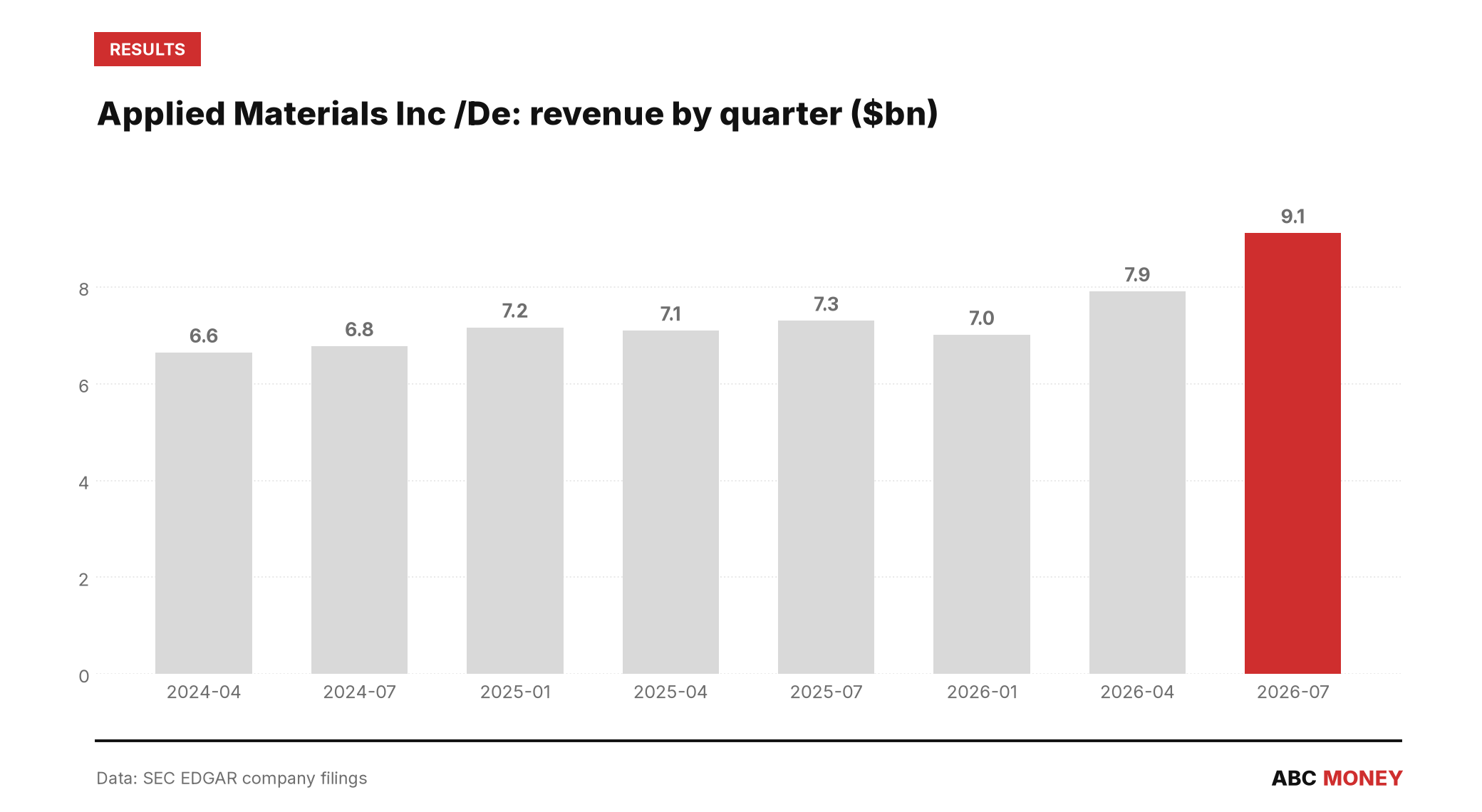
None of this undoes the substance of the report. Revenue has climbed in six of the last seven quarters tracked in the company’s own filings, from $6.65bn in the quarter ended April 2024 to $9.12bn by July 2026 and now $10.41bn, a trajectory that reflects genuine, sustained demand for the tools that make advanced chips rather than a one-quarter sugar rush. Net income across that stretch has ranged from roughly $1.2bn to $2.8bn a quarter, and the most recent period’s profitability sits comfortably within that band – this was not an accounting trick or a one-off item flattering the headline figure.
The gap, then, isn’t between a good quarter and a bad one. It’s between a market that had already priced in something close to perfection from the artificial-intelligence buildout, and a company that delivered a strong but not extraordinary beat into that pricing. Applied Materials’ management used its earnings call to lay out demand trends across the quarter, details that will matter more for the shape of fiscal 2027 than the first-day share reaction, according to the call transcript published by Nasdaq.
For now, the stock sits well above where it started the year, and investors tracking the chip-equipment sector will be watching whether the Q1 FY2027 guide of around $11.1bn holds up as the quarter unfolds, and whether the rates backdrop that pressured the shares around this print eases or tightens further into the new year.
This article is for information only and is not investment advice or a recommendation to buy or sell any asset. Markets move quickly; figures are correct as sourced at the time of writing. Always do your own research before making financial decisions.