Circle’s Q3 2026 Results Mask an 8% Reserve-Income Drop
Circle Q3 2026 results beat on revenue and profit, but the core reserve-interest business shrank 8% year-on-year. Here's what the headline numbers hide.
In this article 3 sections
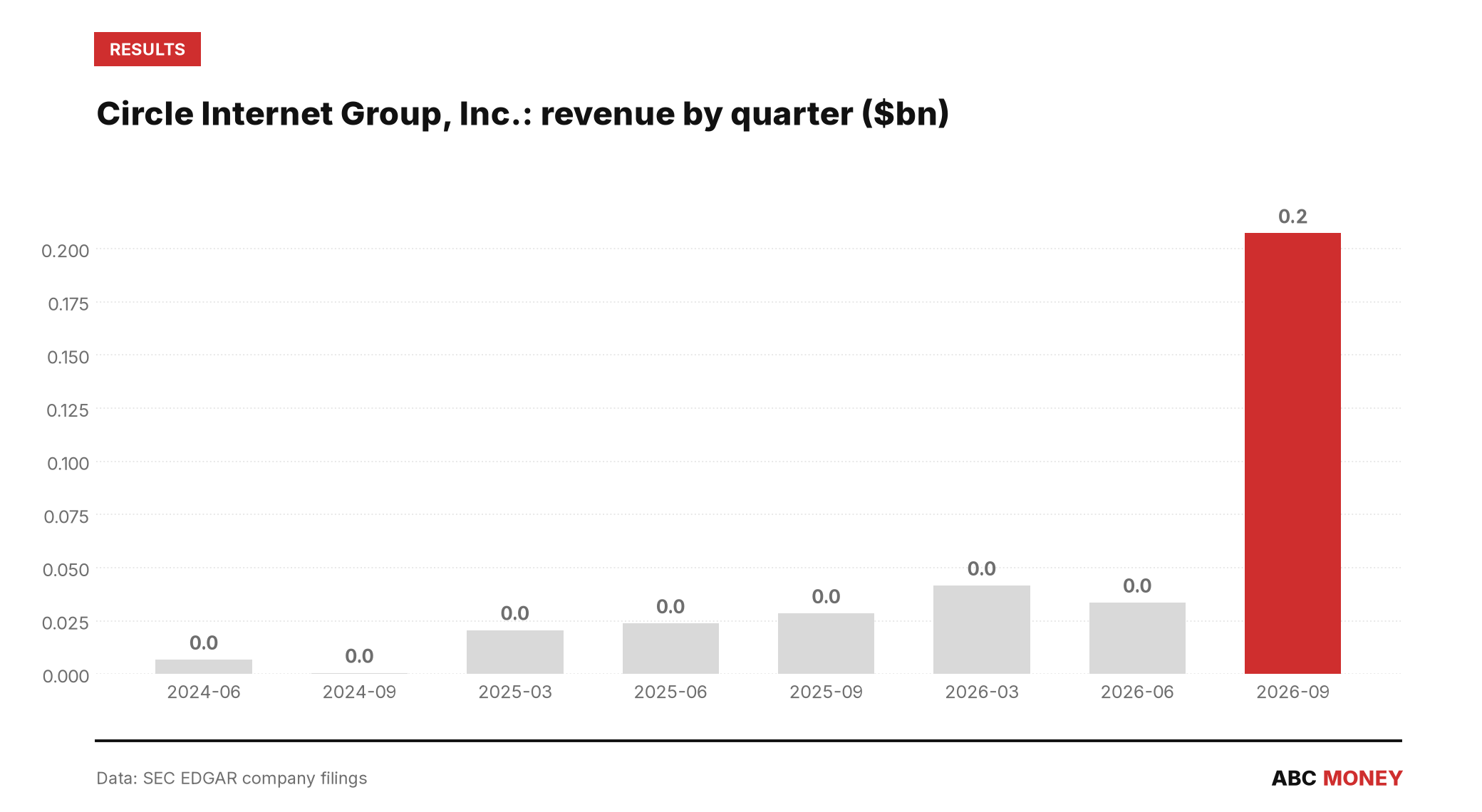
Circle’s Q3 2026 results, published on 4 November, read like an unambiguous beat: $865m in total revenue and reserve income, up 17% year-on-year, and net income of $226m, up 5%. Average USDC in circulation reached $73.3bn, up 8%, while onchain transaction volume for the stablecoin issuer’s flagship token nearly doubled a modest base, rising 49% to $13.9 trillion. Those four numbers are accurate and tie out to Circle Internet Group’s (NYSE: CRCL) own 10-Q filing. What the press release does not foreground is that the business generating most of that growth isn’t the one investors have spent two years pricing in.
The presale did the heavy lifting
Circle’s core, recurring income comes from interest earned on the reserves backing USDC – essentially a money-market return on the dollars and Treasury bills held against every token in circulation. That reserve income actually fell 8% year-on-year to $658m, as the Reserve Return Rate – the yield Circle earns on those reserves – dropped 61 basis points (a basis point is one-hundredth of a percentage point) to 3.5%, according to Gurufocus’s reading of the earnings release. That’s the opposite direction to the headline revenue line.
What filled the gap was a one-off: Circle completed the genesis mint of its new ARC network token during the quarter, and the associated presale generated roughly $182m in revenue. As first reported by FinanceFeeds, that single item exceeds the entire $125.1m year-on-year increase in total revenue – meaning that, strip it out, and Circle’s top line would have been flat to lower against the comparable quarter a year earlier, when net income came in at $214m on prior-year filings. Diluted earnings per share for the quarter came to $0.84, versus $0.64 a year earlier.
A quiet headcount cut on the same day
Circle also disclosed a 5% reduction in its workforce alongside the results, a detail that did not feature in the top-line release but was picked up by Yahoo Finance. Paired with a revenue story that leans heavily on a non-recurring token sale, the cuts sit awkwardly alongside chief executive Jeremy Allaire’s framing of the quarter around institutional momentum – SAP integration, an expanded Visa stablecoin prefunding arrangement, and a widened Binance partnership, as recounted in the company’s own release. The Circle Payments Network, the firm’s cross-border settlement rail, reached $41.3bn in annualised total payment volume during the quarter, one of the few genuinely organic growth figures in the release.
Circle is also putting capital to work beyond its core stablecoin franchise. The company has agreed to acquire Tazapay, a Singapore-based B2B cross-border payments platform, for $400m paid in Class A common stock, with the deal expected to close in 2027, according to Investing.com Australia’s reporting on the earnings slides. Paying in stock rather than cash avoids drawing down reserves, but it does mean existing shareholders absorb some dilution – the issuance of new shares that reduces each existing shareholder’s proportional stake – once the deal closes.
The market’s muted reaction
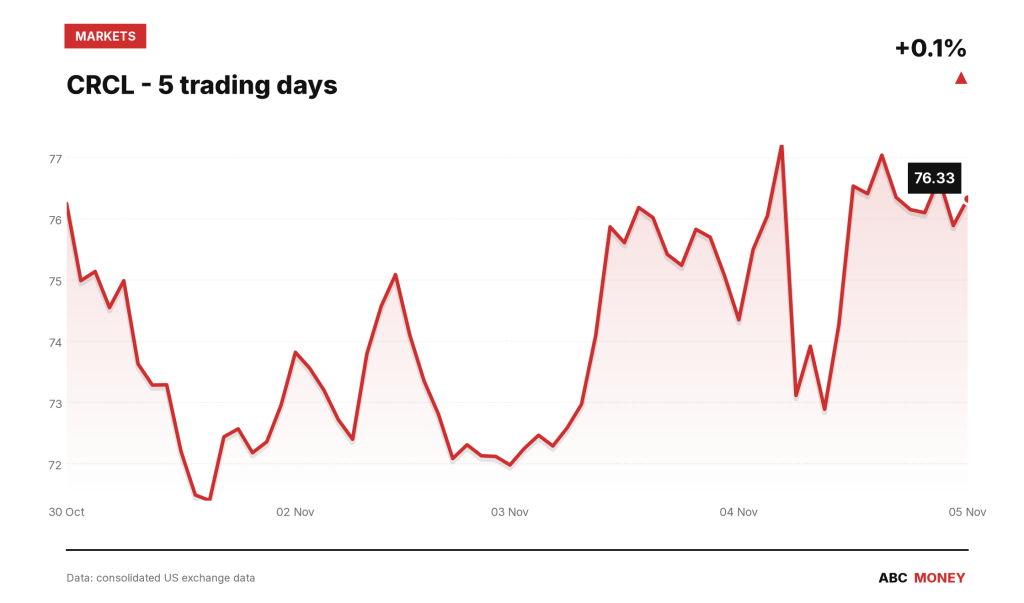
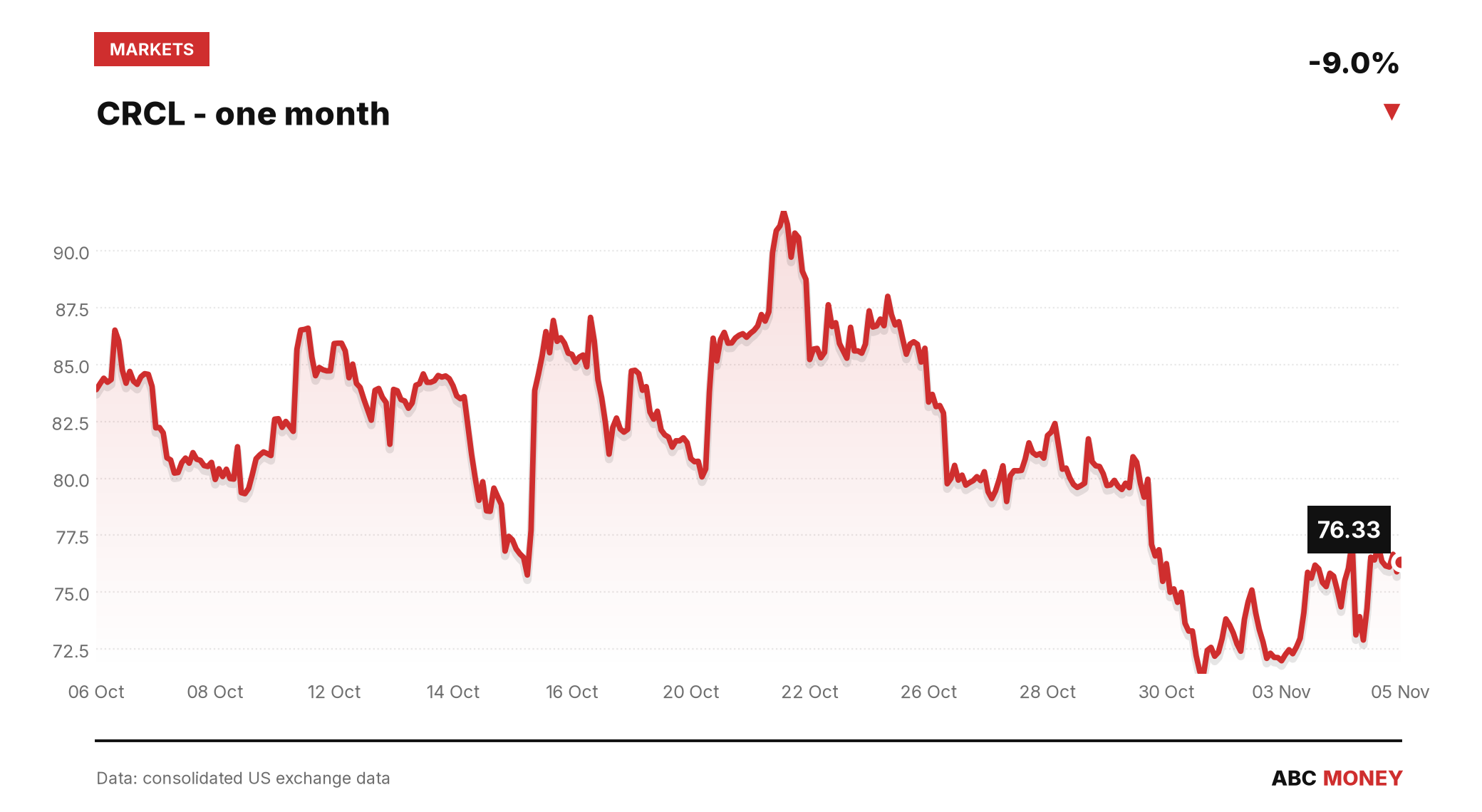
Shares initially rose around 3% on the earnings beat, per Investing.com, but that pop had largely faded by the following session: CRCL closed at $76.26, down 0.2% on the day and 1.33% over the preceding 20 trading days, with trading volume only modestly above its 20-day average. The stock has traded in a $71.40-$91.75 range over that stretch. FINRA’s daily short-sale data – the share of trading volume executed by investors betting the price will fall – show no spike around the results, holding in a steady 0.50 to 0.60 range through late October and into November, suggesting the market isn’t treating the reserve-income softness as a reason to pile into bearish positions, at least not yet.
The macro backdrop offers a partial explanation for why reserve income is under pressure in the first place. The 10-year Treasury yield stood at 4.95% on 3 November, barely changed from 4.91% a week earlier, while the 2-year sat at 4.61%, according to Federal Reserve data. Circle’s reserves are invested largely in short-dated government securities, so the yield Circle captures tracks the front end of the curve closely; a Reserve Return Rate drifting to 3.5% implies the mix of reserve assets, not just market rates, is doing some of the work.
None of this unwinds the quarter’s genuine progress – USDC’s circulation and transaction volume both grew, and the payments network is scaling. But a results release built around a 17% revenue jump and a 5% net income increase invites a reader to assume the core franchise is accelerating, when the filings show its most important income stream is shrinking. Circle’s next test will be whether reserve income stabilises once the ARC presale cycles out of the comparison – a question the company’s fourth-quarter filing, expected in early 2027, should start to answer.
This article is for information only and is not investment advice or a recommendation to buy or sell any asset. Markets move quickly; figures are correct as sourced at the time of writing. Always do your own research before making financial decisions.