Texas Pacific Land posts record Q3 results, stock still down for month
Texas Pacific Land results for Q3 2026 hit records on revenue and net income, beating forecasts even as the stock remains down for the month.
In this article 3 sections
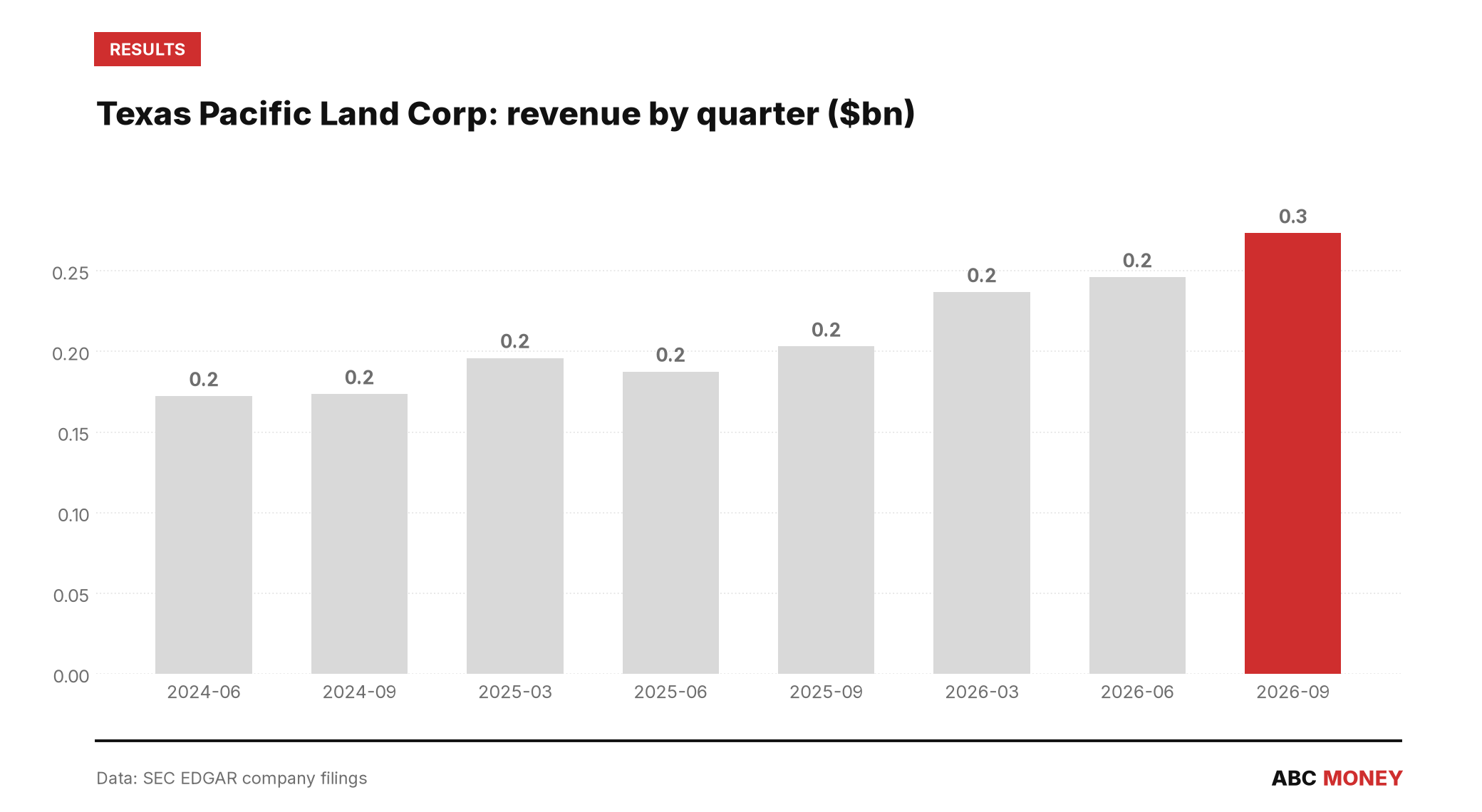
Texas Pacific Land Corp (NYSE: TPL) reported record quarterly Texas Pacific Land results for the three months to 30 September, with revenue of $273.4 million and net income of $167.4 million, comfortably ahead of what analysts had pencilled in. The company’s own release framed it plainly: records for revenue, net income and free cash flow, plus a record for oil and gas royalty revenue, which came in at $167.3 million on the back of record production.
Diluted earnings per share landed at $2.42, built on figures confirmed in the 10-Q filed with the SEC the same day as the earnings release. That beat the Zacks consensus of $2.35 a share on revenue of $264 million heading into the print, according to Yahoo Finance.
Texas Pacific Land owns roughly 873,000 surface acres plus mineral and royalty interests across West Texas and New Mexico’s Permian Basin, collecting payments whenever operators drill, produce, or move water across its land – a business model that scales with Permian activity without TPL itself bearing drilling risk. The growth case for the quarter was straightforward: revenue rose 34.6% year-on-year, net income climbed roughly 38% from the $121.2 million booked in the same quarter of 2025, and the company’s oil and gas royalty line simply kept climbing as production across its acreage hit new highs.
Why the per-share numbers look odd against last year
Readers scanning TPL’s quarterly history will notice diluted EPS appears to have collapsed since late 2025 – from north of $5 a share in every quarter of 2024 and 2025 to roughly $2 in 2026. That is not an earnings problem. TPL carried out a three-for-one stock split, with a record date of 12 December 2025 and shares distributed on 22 December 2025, tripling the share count and mechanically dividing per-share figures by three. On a like-for-like basis, the underlying profit growth tells the real story: net income has risen in every quarter this year, from $142.9 million in the first quarter to $153.9 million in the second and now $167.4 million in the third.
Nine months into the year, TPL has booked net income of $464.2 million and diluted EPS of $6.73, according to the republished results on Stockhouse – a run rate that, if sustained, would mark one of the strongest years in the company’s history as a public royalty company.
The stock told a different story going in
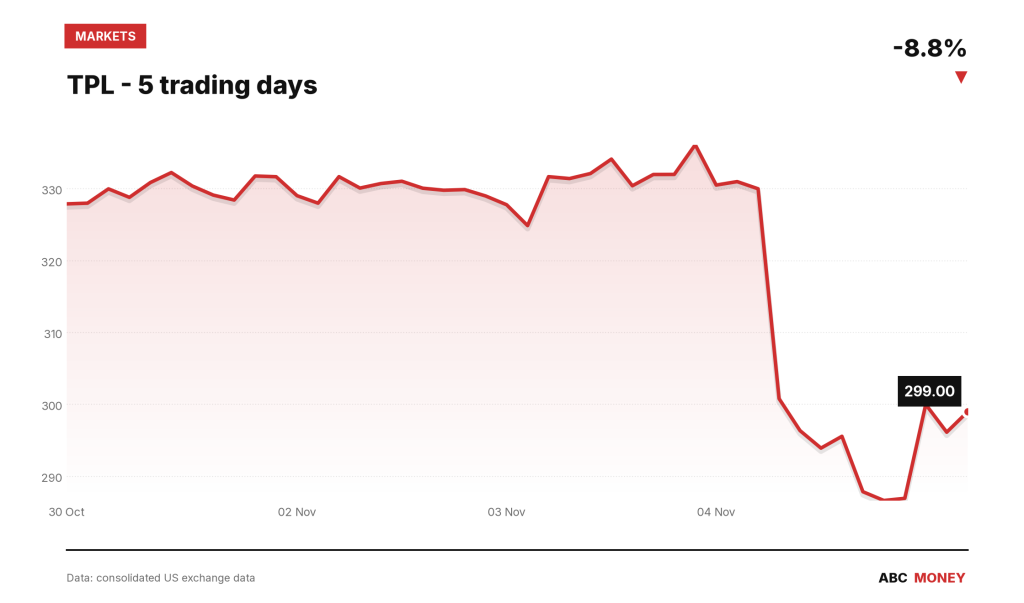
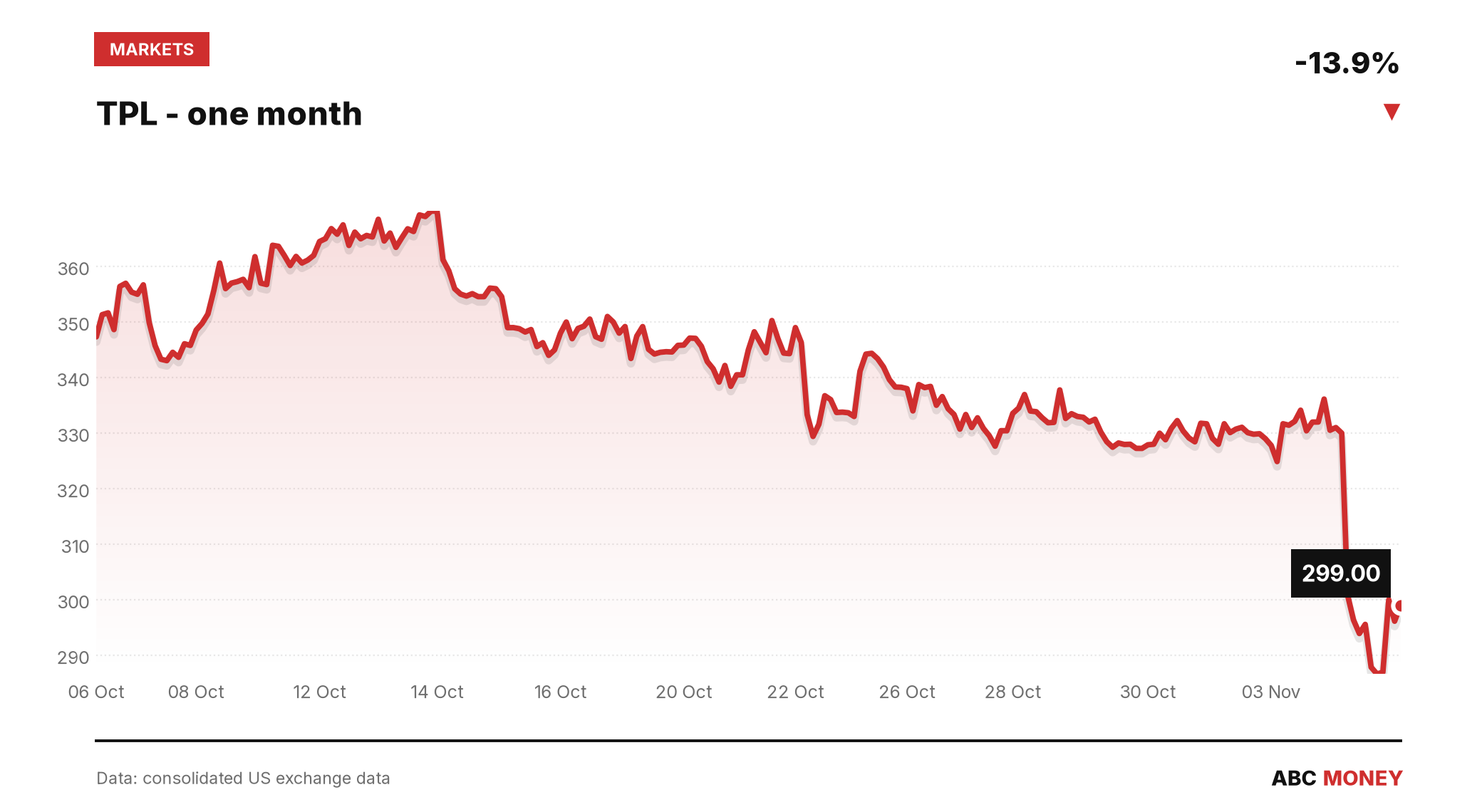
The numbers landed against a backdrop of recent share weakness that made the beat more striking. TPL closed up 1.73% on the day of the report at $298.9956, but that still leaves the stock down 15.67% over the preceding 20 trading days, having traded as low as $286.64 and as high as $354.57 in that window. Trading volume on the day ran at roughly 3.26 times the 20-day average, a sign that the market was digesting the print in size rather than drifting through it.
Part of that pre-earnings slide coincided with TPL’s pursuit of a corporate redomestication from Delaware to Texas, a structural move that was playing out alongside the normal run-up to results, as Gurufocus reported ahead of the announcement. Separately, independent coverage of the results themselves, including from TipRanks, corroborated the headline revenue and net income figures without raising any discrepancies.
Rates backdrop and positioning
The report also landed into a macro environment that matters for how investors value a royalty business with no drilling costs of its own. The 10-year US Treasury yield stood at 4.95% on 3 November, up slightly from 4.91% the prior session, according to data from the Federal Reserve Bank of St. Louis. Higher long-term yields tend to compress the valuations investors are willing to pay for steady cash-generating assets like TPL’s royalty stream, since future payouts are discounted more heavily – one plausible reason the market had already marked the shares down heading into a quarter that, on paper, beat expectations.
FINRA’s daily short-sale volume ratio for TPL – the share of each day’s trading volume attributable to short sales, where investors sell borrowed shares betting the price will fall – sat at 0.736 on 3 November, within the range it has occupied through late October, suggesting the pre-earnings decline was not obviously driven by a surge in bearish positioning.
What happens next for TPL likely hinges less on the quarter just reported than on two threads already in motion: the pace of Permian production growth feeding its royalty base, and the progress of its proposed shift from Delaware to Texas incorporation, which shareholders and filings will continue to track in the months ahead.
This article is for information only and is not investment advice or a recommendation to buy or sell any asset. Markets move quickly; figures are correct as sourced at the time of writing. Always do your own research before making financial decisions.