Nebius Q3 2026 earnings beat forecasts, shares still fall 9%
Nebius Q3 2026 earnings beat on revenue and EBITDA, with guidance for 2027 breakeven - yet shares fell over 9% on capex concerns.
In this article 3 sections
Nebius Group N.V. (NASDAQ: NBIS) delivered blowout Q3 2026 earnings on 12 November, with revenue up 571% year-on-year and a swing into positive adjusted profitability – yet the shares fell more than 9% on the day as investors fixated on the capital spending required to sustain that growth.
The Amsterdam-listed AI cloud company, built from the remains of Russia’s Yandex, reported third-quarter revenue of $980.8 million, against $146.1 million a year earlier, according to the company’s own release and confirmed by CNBC. Adjusted EBITDA – earnings before interest, tax, depreciation and amortisation, stripped of one-off items – came in at $465.8 million, compared with a $5.2 million loss in the same quarter last year, a reversal that marks the clearest signal yet that Nebius’s infrastructure buildout is starting to generate returns rather than just absorb cash.
The bottom line told a similar story, if not yet a fully clean one. The GAAP net loss from continuing operations narrowed to $37.5 million, or $0.13 a share, from $119.6 million, or $0.50 a share, a year earlier – still a loss, but a much smaller one set against revenue that is now running at roughly seven times last year’s pace.
Guidance points to 2027 breakeven, but at a cost
Management’s forward guidance was the headline investors had been waiting for: Nebius told shareholders it expects $12 billion to $13 billion in revenue for 2027 and a pre-tax breakeven by the end of that year, as reported by MarketScreener. That would represent a step-change from the roughly $3.9 billion annualised run-rate implied by the latest quarter, and it is the kind of number that would normally send a growth stock higher rather than lower.
The catch is what it takes to get there. Capital expenditure hit $7.30 billion in the quarter alone, up from $955.5 million a year earlier, according to Rolling Out – a scale of spend that dwarfs the company’s current profitability and underlines just how capital-intensive the AI infrastructure race has become. To help fund it, Nebius raised $5.75 billion in debt financing during the quarter, per CNBC, adding leverage to a balance sheet that is effectively betting the house on continued demand for GPU cloud capacity.
A sell-the-beat reaction
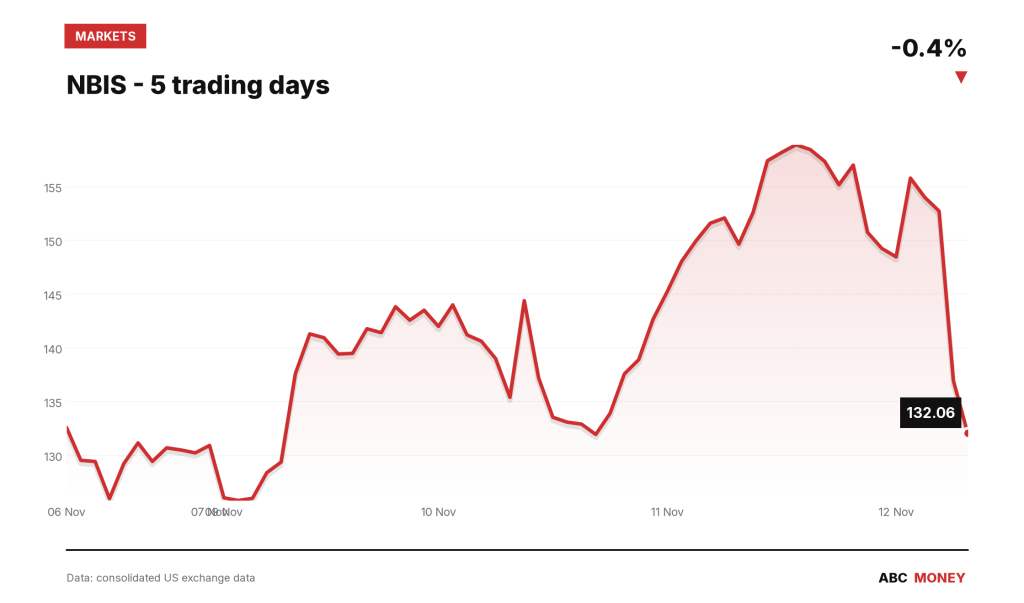
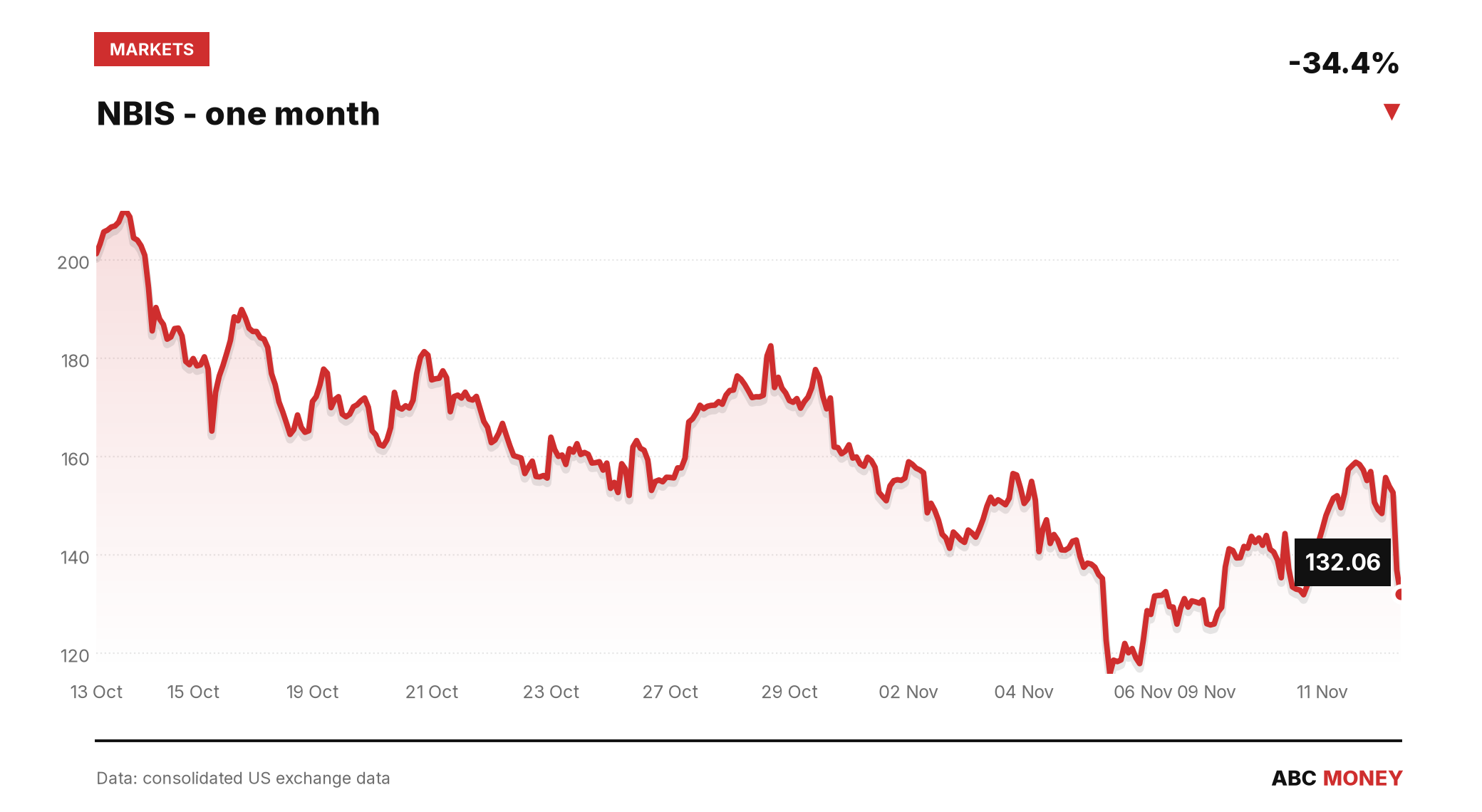
The share price move is the part of the story that will puzzle casual readers most: a company beating estimates on both revenue and profitability, while guiding to a credible breakeven date, and still getting marked down. Shares traded around $137.01 as of 12 November, down roughly 9% on the day and down 14.5% over the preceding 20 trading sessions, having touched a 20-day high of $182.59 earlier in that window.
Some of that move looks like simple mean reversion. Nebius had jumped more than 15% to $154.69 the day before its own results, riding a wave of optimism after strong numbers from rival cloud operator CoreWeave, according to Rolling Out. CoreWeave and another AI infrastructure peer, IREN, had already lifted sentiment across the sector following a sharp selloff the previous month, as CNBC noted – meaning Nebius walked into its own print with the bar for a positive surprise set unusually high. Investors appear to have used the actual numbers as an opportunity to take profits on that rally rather than to extend it, and Investing.com reported the stock falling over 10% in premarket trading despite the beat.
Positioning data add a little texture. FINRA’s daily short-sale figures show the proportion of Nebius trading volume tied to short sales – bets that the stock will fall – climbing from 0.346 on 9 November to 0.544 on 11 November, the session before results, suggesting some traders were leaning against the stock even before the capex figures landed. Set against a backdrop of still-elevated US borrowing costs, with the 10-year Treasury yield at 4.88% on 9 November according to FRED, capital-hungry, still loss-making growth names like Nebius face a less forgiving market for scale-first strategies than they did a year or two ago.
The longer arc
Judged against its own recent history, Nebius’s turnaround is striking. The company’s 20-F filing with the SEC shows a net loss of $641.4 million for the 2024 financial year; by 2025, that had flipped to net income of $82.5 million, a swing that predates the current quarter’s AI infrastructure boom but set the template for it. One technical wrinkle worth flagging: Nebius later restated its full-year 2024 revenue to $91.5 million from the $117.5 million originally reported, after deconsolidating its former Toloka data-labelling business – a bookkeeping adjustment rather than a change to the underlying growth trajectory.
For now, the market’s verdict is less about whether Nebius can grow – it plainly can – and more about whether it can fund that growth without diluting shareholders further or loading the balance sheet with debt it cannot service if AI demand cools. The company’s next scheduled test of that proposition will be whether the $12-13 billion 2027 revenue guide, and the pre-tax breakeven target attached to it, survive contact with the next few quarters of capital spending disclosures.
This article is for information only and is not investment advice or a recommendation to buy or sell any asset. Markets move quickly; figures are correct as sourced at the time of writing. Always do your own research before making financial decisions.