Northrop Grumman Lands $1.6bn PAC-3 Rocket Motor Order
Northrop Grumman has won a $1.6bn PAC-3 rocket motor order to scale missile production, even as its shares slide on Washington spending fears.
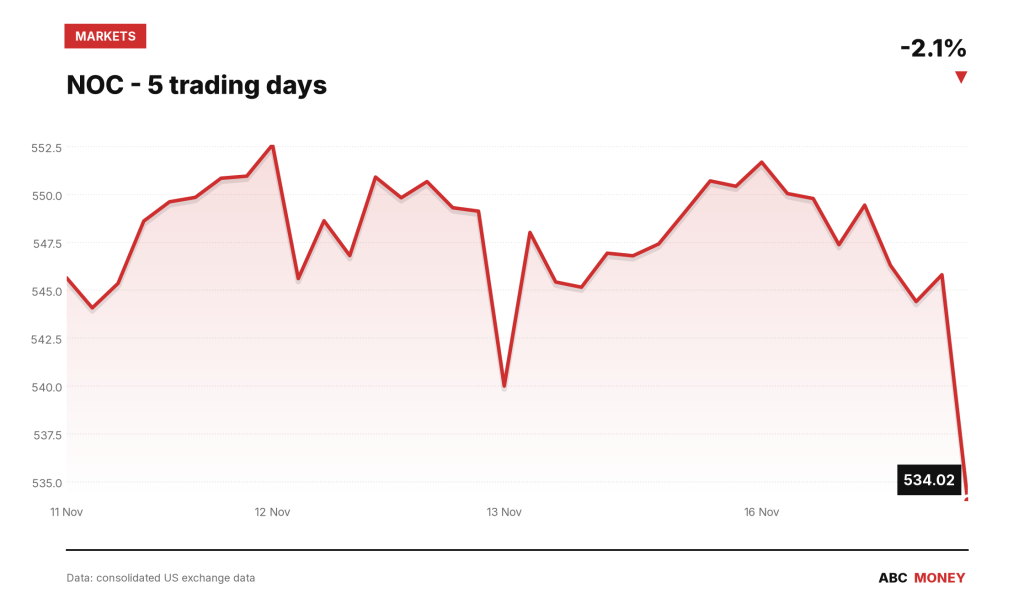
Northrop Grumman (NYSE: NOC) has been awarded a $1.6bn order to scale up production of the solid rocket motors that power the US Army’s PAC-3 Missile Segment Enhancement (MSE) interceptor, the company said this week. It is the latest instalment of a PAC-3 rocket motor order that traces back to an August framework agreement, and it lands at an odd moment: Northrop’s shares have spent November sliding toward their lowest levels in 20 days, even as the order book for its munitions business keeps growing.
The contract covers rocket motors and ignition safety devices built into Lockheed Martin’s PAC-3 MSE interceptor – the workhorse of US and allied Patriot air-defence batteries – and is part of a wider $1.6 billion award Northrop detailed in a release this week, building on the roughly $3bn in agreements it struck with the Pentagon and Lockheed in August. Reporting on the August deal has occasionally blurred the detail: Inside Defense notes the “more than $3 billion” figure actually split across two separate multiyear agreements – about $2bn for PAC-3 MSE and a further tranche for the THAAD interceptor programme – rather than a single PAC-3-specific deal. That nuance doesn’t change the substance of this week’s number: the $1.6bn order itself is confirmed directly by the company and echoed by Investing.com‘s independent reporting of the same figure.
Tripling output at a West Virginia plant
The mechanics of the order are concrete rather than aspirational. Northrop builds the PAC-3 MSE’s dual-pulse rocket motor at its Allegany Ballistics Laboratory in Rocket Center, West Virginia, and intends to triple production there, according to WV MetroNews. That sits alongside capacity Northrop says it has already added since 2021: rocket motor output has doubled at its Utah sites, nearly tripled at Allegany Ballistics, and risen 25% at its Elkton, Maryland facility. The company has framed the broader push as an effort to take PAC-3 MSE output from around 600 interceptors a year to roughly 2,000, a scale-up first flagged by Defence-Blog. Northrop describes the work as supporting the Department of War’s Acquisition Transformation Strategy – the Pentagon’s push to shorten the gap between ordering munitions and delivering them to units in the field.
Chief executive Kathy Warden has previously linked the August agreements to that same goal, telling Defence-Industry.eu that the framework would strengthen US and allied integrated air and missile defence through faster production and delivery of critical munitions. Patriot interceptors have been in persistent short supply since Ukraine’s air defences began drawing heavily on Western stockpiles, and PAC-3 MSE – the variant capable of hitting ballistic missiles as well as aircraft and cruise missiles – has been the tightest link in that chain.
A contract win that didn’t move the share price
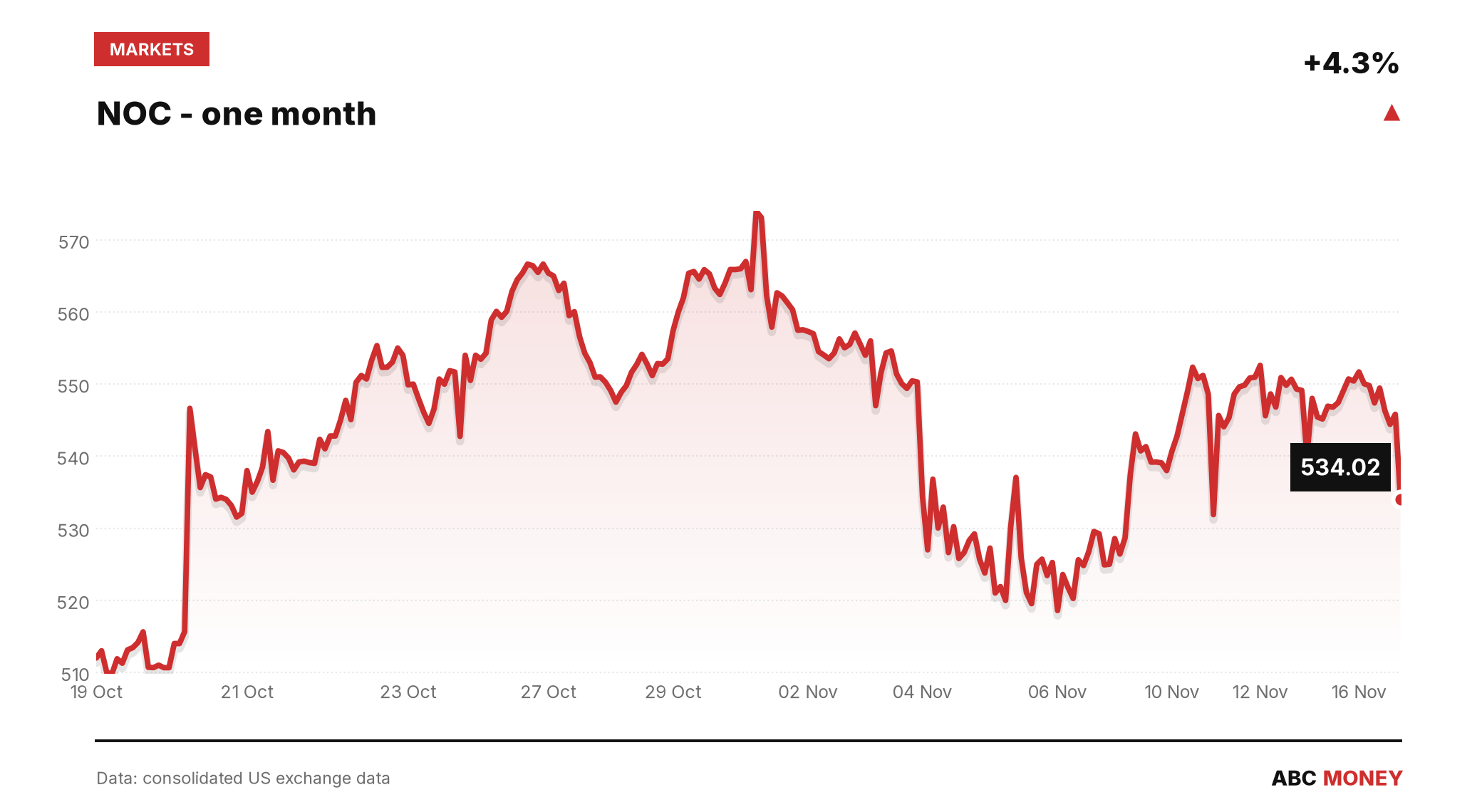
None of this has stopped the stock drifting lower. Northrop closed at $534.02 on 16 November, down 2.91% on the day and 5.57% over the preceding 20 trading days, with volume running 1.3 times its 20-day average – a sign plenty of investors were repositioning, not just a handful. Shares have ranged between $518.58 and $574 over that stretch, a long way from the record high of $774 struck on 3 March, a level Schaeffer’s Research flagged as a trendline the stock has repeatedly failed to reclaim.
The weakness looks sector-wide rather than company-specific. The Motley Fool pointed out that Northrop fell 4.5% on 4 November alone on no company-specific news at all, attributing the move to investor worry that a Democratic-controlled Congress following the midterms could squeeze Pentagon budgets. That reading sits alongside a firmer rates backdrop: the 10-year Treasury yield rose to 5.1% on 12 November from 4.98% previously, according to Federal Reserve data, a move that tends to weigh on long-duration industrial names whose cash flows are valued years into the future – defence primes among them.
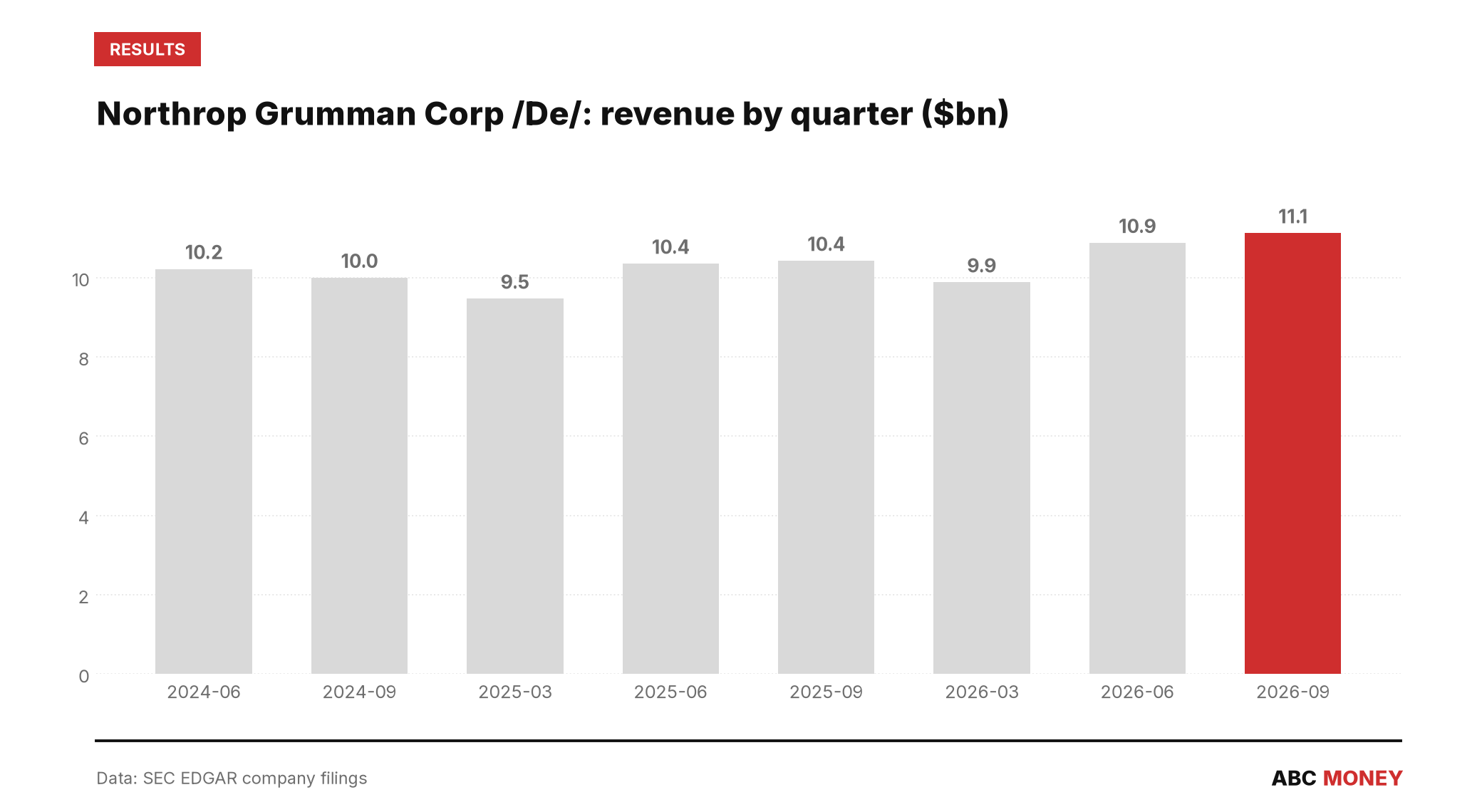
The underlying numbers argue against a demand problem. Northrop’s third-quarter revenue reached $11.12bn, up from $10.42bn a year earlier, with net income of $1.124bn and diluted earnings per share of $7.89, both ahead of the equivalent quarter in 2025, according to its quarterly filing. Revenue has climbed in each of the past three quarters on record, and the order pipeline behind PAC-3 and THAAD production suggests that trajectory has further to run regardless of how Washington’s budget politics play out.
What happens next for the stock may hinge less on propulsion contracts than on appropriations. Investors are watching how Congress’s new composition shapes the next defence budget cycle, alongside further detail from Northrop on delivery timelines for the tripled PAC-3 MSE output it has promised the Pentagon.
This article is for information only and is not investment advice or a recommendation to buy or sell any asset. Markets move quickly; figures are correct as sourced at the time of writing. Always do your own research before making financial decisions.