Livsayis FDA Approval Hands Regeneron a New Neurology Franchise
The Livsayis FDA approval gives Regeneron its first siRNA drug and first neurology medicine, treating generalized myasthenia gravis with four doses a year.
In this article 3 sections
The Livsayis FDA approval landed on 18 November 2026, clearing Regeneron Pharmaceuticals (NASDAQ: REGN) to sell its first small interfering RNA drug and its first medicine for a neurological disease. The treatment, cemdisiran, is approved for generalized myasthenia gravis (gMG) in adults who test positive for anti-acetylcholine receptor antibodies, a biomarker that identifies most patients with the autoimmune condition, as Reuters reported.
Myasthenia gravis causes the immune system to attack the connection between nerves and muscles, leaving patients with fluctuating weakness that can affect breathing, swallowing and vision. Livsayis works by blocking complement component C5, a protein the immune system uses to help destroy that nerve-muscle junction, which in turn limits the downstream damage. Regeneron’s own announcement frames it as the only gMG treatment dosed subcutaneously just four times a year, a dosing interval the company says sets it apart from rival complement inhibitors that typically require far more frequent injections or infusions, according to Regeneron’s investor relations release.
Why the Livsayis FDA approval matters beyond one drug
For a company built on monoclonal antibodies – Eylea for eye disease, Dupixent for allergic and inflammatory conditions – a working siRNA medicine is a platform validation as much as a product launch. siRNA drugs silence the genetic instructions for making a target protein rather than mopping it up after it’s made, and getting one through the FDA for the first time gives Regeneron a second modality to build around. Pairing that with its first entry into neurology opens a therapeutic area the company had not previously commercialised, and management will be watched for how quickly it tries to extend the same C5-silencing approach to other complement-driven diseases.
None of this was a bolt from the blue. The regulator had accepted cemdisiran’s application under priority review in mid-2026 with a target decision date of November, so Thursday’s clearance landed on the schedule investors had already been tracking. The underlying efficacy data were not new either: detailed results from the Phase 3 NIMBLE trial, showing what Regeneron describes as rapid and sustained disease control maintained across three-month dosing intervals, were published in The Lancet and presented at a medical conference back in April 2026, giving clinicians and investors months to digest the numbers before the approval made them commercially relevant.
The market’s reaction, and the numbers behind it
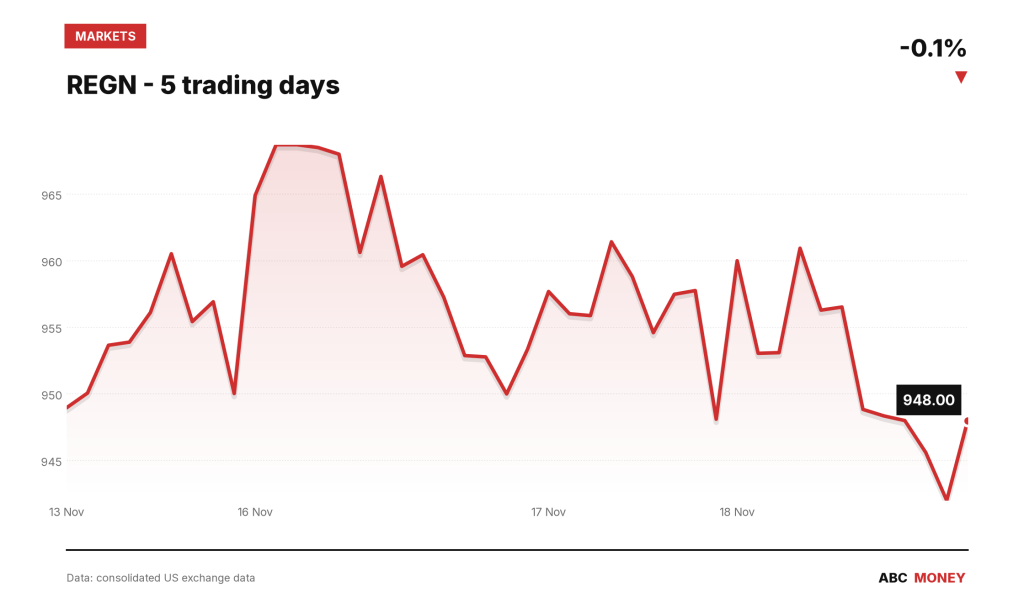
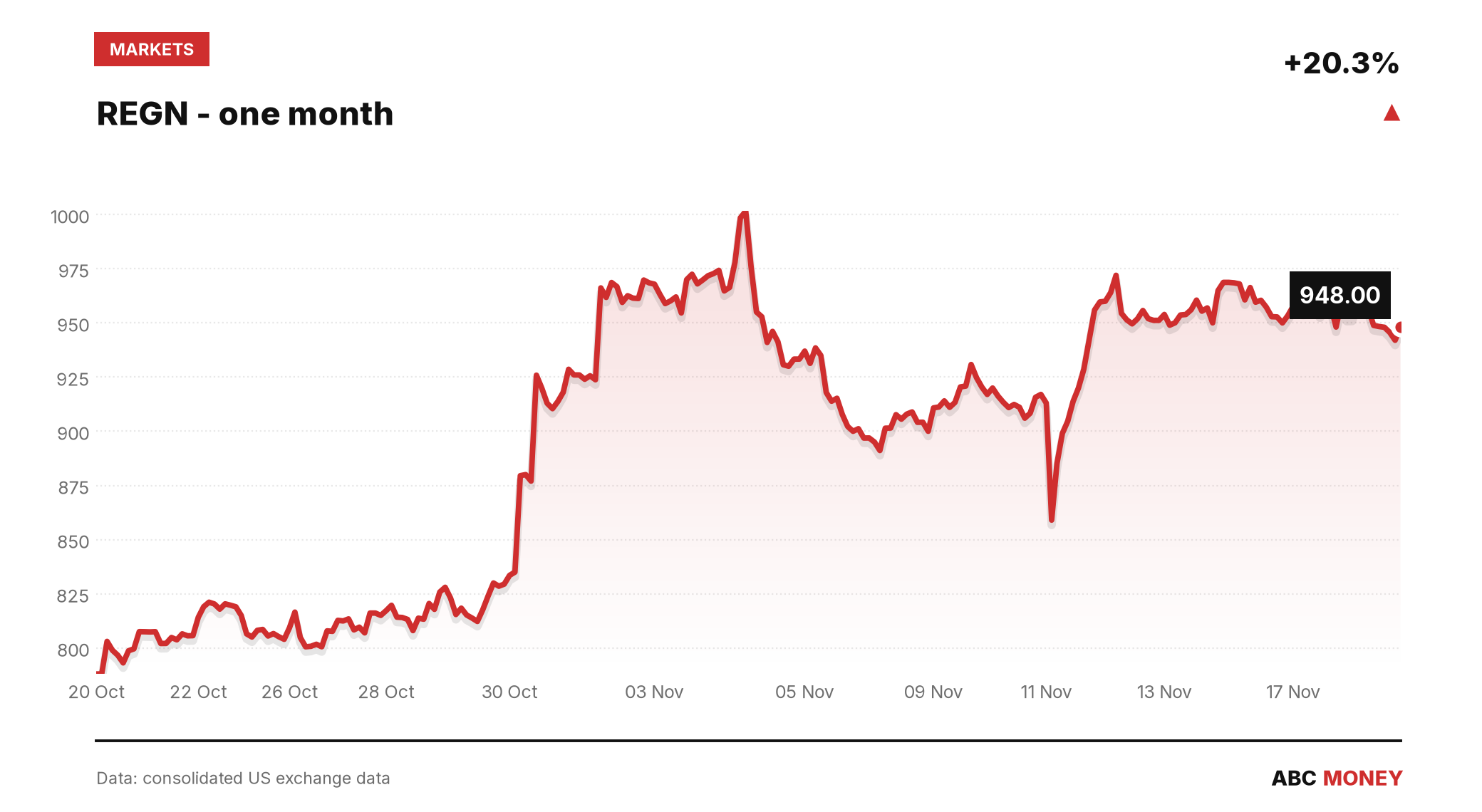
REGN shares closed at $948.00 on 18 November, down 0.87% on the day but up 15.92% over the preceding 20 trading sessions, putting the stock within range of its 20-day high of $1,001.60 and well above its 20-day low of $812.24. Trading volume on the day sat slightly below the 20-day average, suggesting the approval – well-flagged by the priority-review timeline – did not trigger a scramble among traders so much as confirm a move already under way.
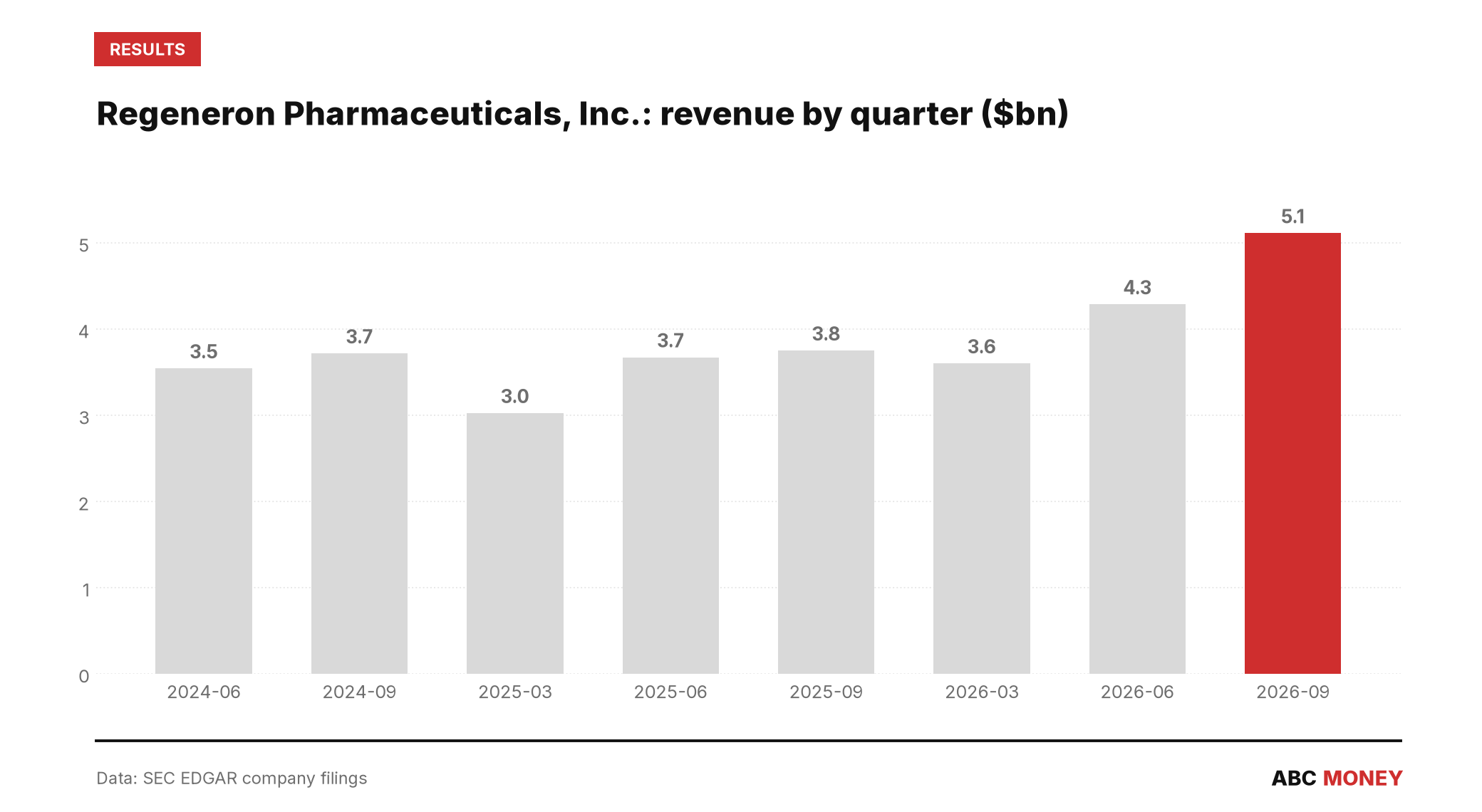
The approval also arrives as Regeneron’s quarterly numbers accelerate. Third-quarter 2026 revenue came in at $5.1158 billion, up from $4.2907 billion the prior quarter, with net income of $1.9487 billion and diluted earnings per share of $18.45, according to the company’s quarterly filing with the SEC. Livsayis won’t move that revenue line meaningfully in the near term – new drug launches typically ramp slowly as physicians build prescribing habits and insurers finalise coverage – but it gives Regeneron a product to point to as evidence that growth isn’t solely dependent on Eylea and Dupixent, its two long-standing pillars.
Three Regeneron insiders – George L. Sing, Marion McCourt and Andrew J. Murphy – filed Form 4 disclosures with the SEC within a few minutes of one another late on 18 November, the same day the approval was announced. Form 4s report changes in insiders’ holdings and are filed routinely; the timing here coincides with the news but the filings themselves don’t indicate whether the activity was a reaction to it. Separately, short interest in REGN – the share of daily trading volume attributable to short sellers, who borrow and sell stock betting the price will fall – stood at a ratio of 0.459 on the day of the approval, within the 0.344-to-0.539 band it had occupied over the prior fortnight, according to FINRA’s short-sale volume data. Nothing in that pattern points to bearish positioning ahead of the decision.
What comes next
The immediate questions for investors are commercial ones: how Regeneron prices Livsayis relative to existing complement inhibitors for gMG, how quickly payers agree to cover a four-times-a-year regimen, and how fast neurologists move patients onto a less frequent dosing schedule. Regeneron’s pitch is that convenience itself is a selling point in a chronic disease where treatment burden drives drop-off; whether that translates into prescriptions will show up in the company’s next few quarterly filings rather than in this week’s share-price move.
This article is for information only and is not investment advice or a recommendation to buy or sell any asset. Markets move quickly; figures are correct as sourced at the time of writing. Always do your own research before making financial decisions.