PDD Holdings earnings beat hides a revenue miss, shares jump 8%
PDD Holdings earnings beat Q3 forecasts on profit, but revenue missed estimates as shares jumped 8% - the numbers behind the move.
In this article 4 sections
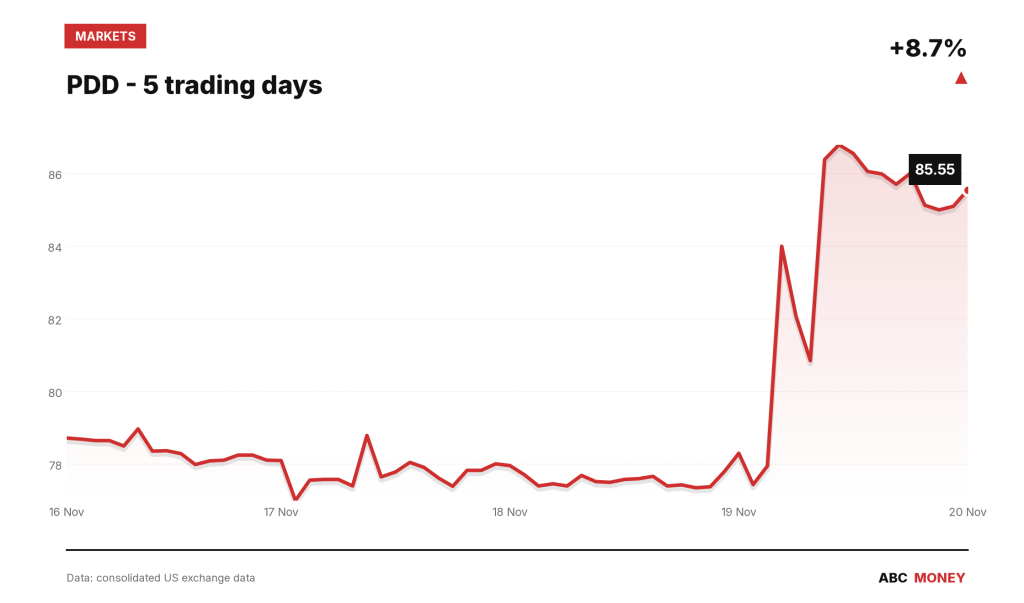
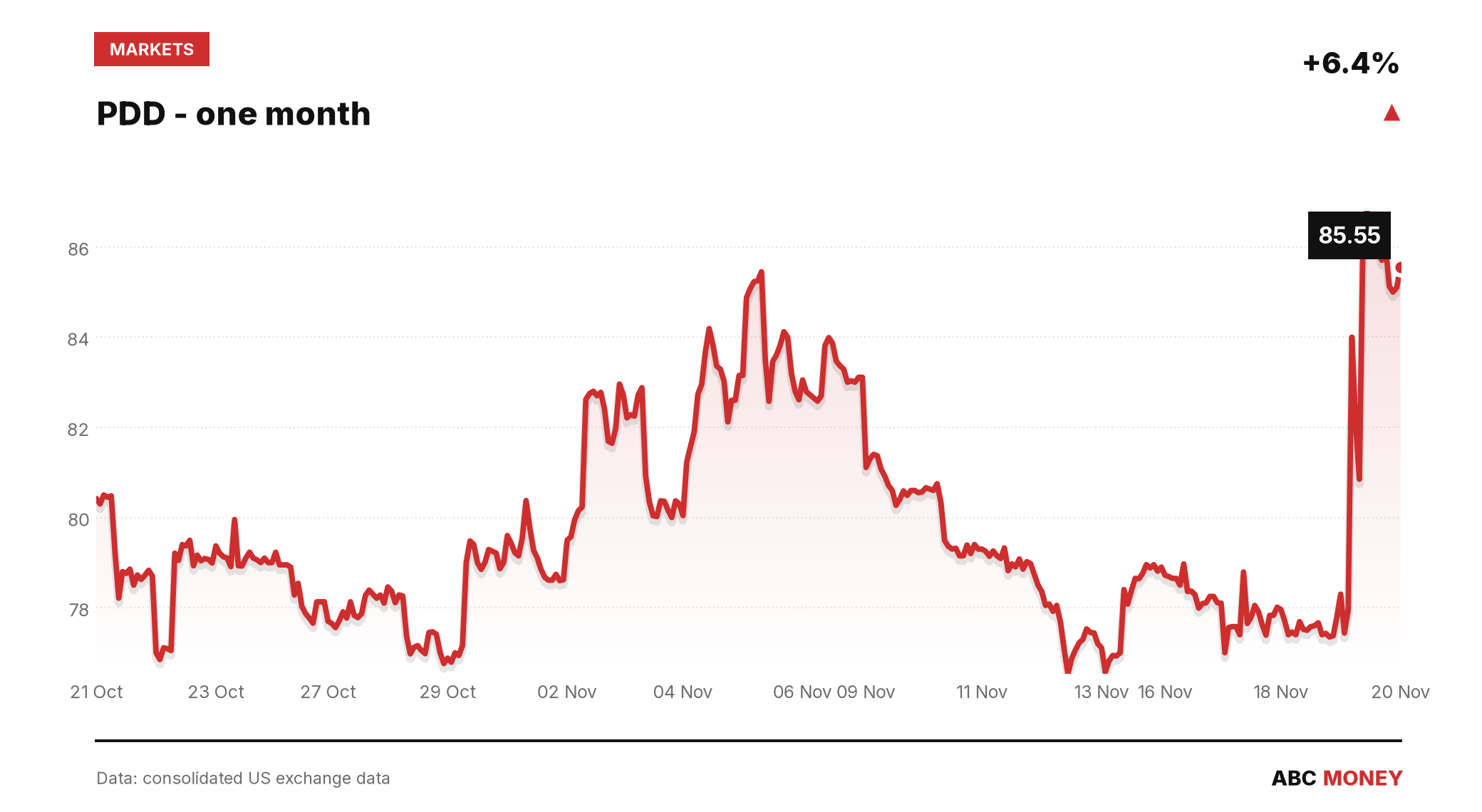
PDD Holdings Inc. (NASDAQ: PDD), the Nasdaq-listed parent of Pinduoduo and Temu that trades in the US as a sponsored American Depositary Receipt (a certificate representing shares of a foreign company, allowing US investors to hold and trade them locally), delivered a PDD Holdings earnings beat for the third quarter of 2026 that sent its shares up roughly 8% – even as the headline revenue number came in well short of what analysts had pencilled in.
Non-GAAP diluted earnings per ADS (adjusted profit that strips out one-off items such as share-based compensation) came to RMB21.04, or $3.14, against a Zacks consensus estimate of $2.77, a surprise of more than 13%. Investors cheered, and the stock’s intraday move went as high as a 12.17% gain to $86.87 before settling. By the time US markets closed out the session that followed, shares had jumped around 8% on the day, part of a 7.47% rise over the preceding 20 trading days, with volume running at 2.76 times the 20-day average – a clear sign the market was repositioning hard around the print, not drifting on thin trade.
The PDD Holdings earnings beat that wasn’t really growth
Here is the part the share-price pop obscures: PDD’s profit beat was built on holding earnings roughly flat, not growing them. The company’s own filed results show non-GAAP EPS of RMB21.04 per ADS versus RMB21.08 in the same quarter a year earlier – essentially unchanged. Net income attributable to shareholders was RMB29.5bn ($4.4bn), against RMB29.3bn in Q3 2025. The “beat” was a beat against a Wall Street bar set too low, not evidence of fresh earnings momentum.
Revenue tells a blunter story. Total revenue for the quarter was RMB108.3bn, flat year-on-year against the same RMB108.3bn figure a year earlier, and well below the RMB115.21bn analysts had expected. In dollar terms that’s $16.16bn versus a $17.30bn estimate – a miss of more than a billion dollars at the top line, even as the bottom line surprised to the upside.
Where the shortfall is actually coming from
The weakness sits squarely in PDD’s largest segment. Transaction services revenue – the commissions and fees the company earns from merchants on its marketplace and on Temu – fell to roughly RMB48.5bn from RMB54.9bn a year earlier, according to earnings-call commentary reported by GuruFocus. That decline points to continued pressure on Temu-related volumes and marketplace take rates, rather than a one-quarter blip.
Management’s response, flagged on the earnings call, was to extend a previously announced RMB100bn programme of supply-chain and merchant support through the third quarter of 2026, according to the same GuruFocus account of the call. That spending is explicitly designed to prop up the merchant ecosystem Temu and Pinduoduo depend on, and it is the reason near-term margins remain under pressure even in a quarter where adjusted profitability beat forecasts. It is a trade-off: PDD is choosing to subsidise its supply chain rather than let margins run unchecked, a stance that has defined its strategy for several quarters now.
The longer profit trend is already downward
Zoom out and the picture gets more sobering still. PDD’s full-year net income fell to RMB97.84bn in the year ended December 2025, down from RMB112.43bn the year before, according to the company’s 20-F annual filing lodged with the SEC in April 2026. Diluted earnings per share fell in step, from RMB19.00 to RMB16.50 across the same two years, per the prior year’s 20-F filing. A single quarter’s adjusted EPS beat doesn’t reverse that trajectory; it simply shows the decline has, for now, stopped accelerating.
Not a short squeeze
One question worth asking after any sharp single-day pop is whether it was driven by short sellers (investors who had bet the price would fall) scrambling to close out losing positions – a short squeeze. The daily short-sale volume data doesn’t support that reading here. The share of PDD’s daily trading volume accounted for by short sales ran between roughly 0.3 and 0.68 over the two weeks into the earnings date, with no unusual build-up immediately beforehand. This looks like a genuine repricing on the numbers themselves, not positioning unwinding.
What comes next for PDD hinges on whether the RMB100bn merchant-support spend starts to show up in stabilised transaction-services revenue, or whether the segment keeps sliding even as adjusted profit holds up. That will be the thing to watch when the company next reports, rather than another headline beat-or-miss verdict against a Wall Street consensus that this quarter proved to be a fairly blunt instrument.
This article is for information only and is not investment advice or a recommendation to buy or sell any asset. Markets move quickly; figures are correct as sourced at the time of writing. Always do your own research before making financial decisions.