CoreWeave bond purchase: co-founder bets $30m on default risk
CoreWeave's $30m bond purchase by co-founder Brian Venturo puts fresh scrutiny on the AI cloud firm's near-16% debt yields.
In this article 3 sections
Brian Venturo, co-founder and chief strategy officer of CoreWeave (CRWV), has made a $30m bond purchase in the AI cloud computing company’s own distressed debt – a wager that it can keep paying its creditors rather than a vote of confidence in its share price.
Venturo disclosed the purchase in a letter published last week, saying he bought the notes personally and intends to hold them to maturity, according to FourWeekMBA, which cited his letter directly. The notes in question are CoreWeave’s 9.75% senior unsecured bonds maturing on 1 October 2031 – debt that has been trading at roughly 80 cents on the dollar, implying a yield to maturity of close to 16%, far above where CoreWeave itself has said it is willing to borrow.
The purchase was first reported by Bloomberg, according to Barron’s/Yahoo Finance, and has since drawn attention less for the dollar amount – modest next to CoreWeave’s balance sheet – than for what it says about how the market is pricing the company’s debt.
A bet on solvency, not on the stock
A bond yielding near 16% is not a sign of a healthy issuer. Yields that high usually signal that the market wants heavy compensation for the risk the borrower might not pay in full, or on time. CoreWeave’s wider note stack – spanning tranches maturing between 2030 and 2031 – has been trading at yields ranging from roughly 14.1% to 15.8%, according to the Motley Fool, a level more associated with stressed credits than with a company reporting revenue growth of 168% year-on-year.
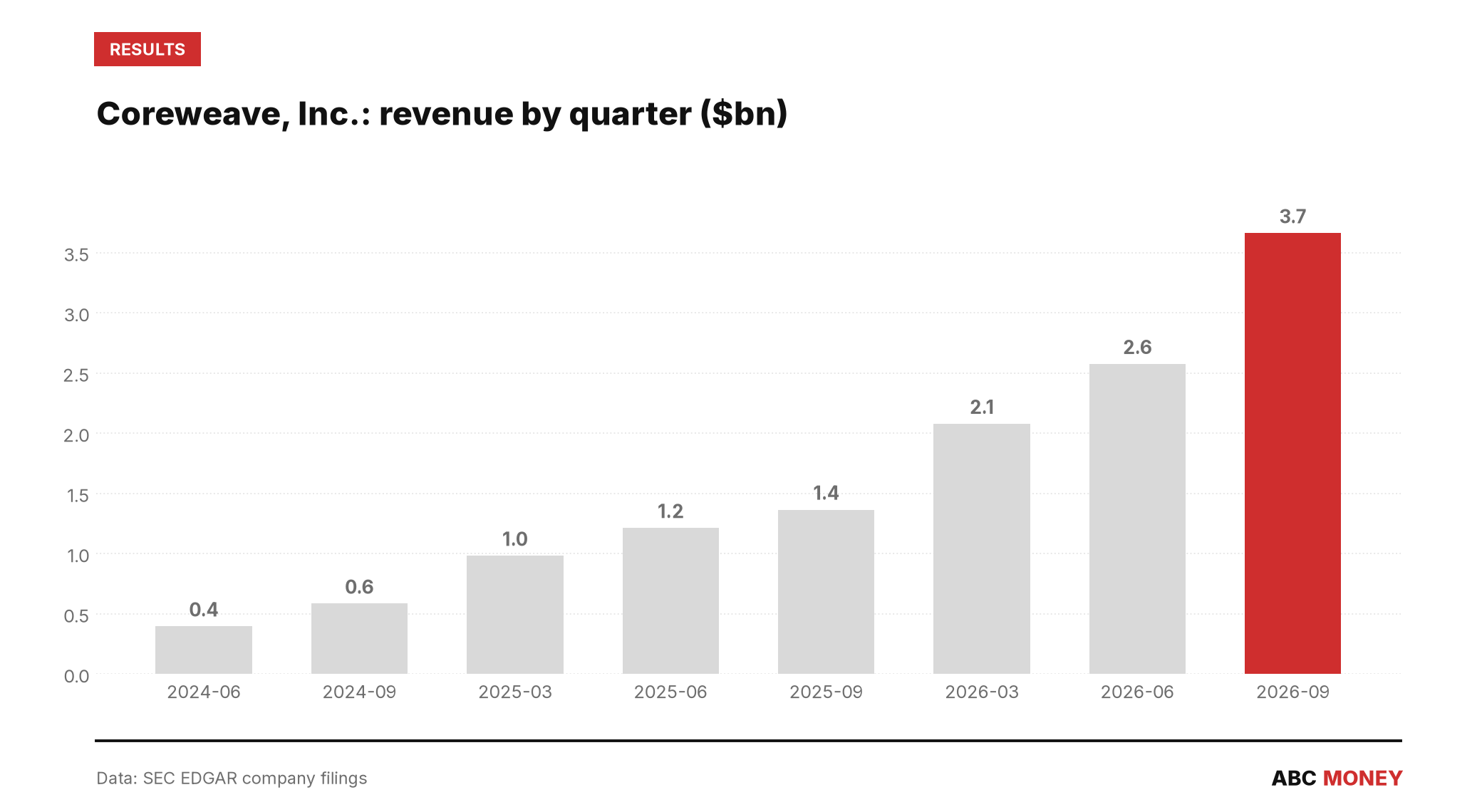
That growth is real. CoreWeave’s quarter ended 30 September 2026 produced revenue of $3.66bn, against a net loss of $709m, according to its 10-Q filed with the SEC. The company has posted a net loss in every quarter on record in the fact set reviewed here, even as revenue has climbed from $395m in the quarter ended June 2024 to last quarter’s figure – a trajectory that explains both the bulls’ enthusiasm and the bond market’s caution. Growth this fast, funded this heavily by debt, is exactly the combination credit investors worry about.
Why the company itself won’t buy this debt
CoreWeave has already told investors it does not plan to issue more unsecured bonds at current yields. On its third-quarter earnings call, management said it would instead finance expansion through customer prepayments, delay-draw term loans and operating cash flow, according to a transcript carried by Benzinga. The company expects roughly $9bn in customer prepayments and deposits over the following three months, per reporting from the TIKR Blog – effectively using its own clients as a funding source rather than paying double-digit coupons to bondholders.
That context sharpens what Venturo actually did. He bought, at a discount, debt that his own company has signalled it finds too expensive to issue more of. Framed that way, the purchase reads less as “the founder is all-in on CoreWeave” and more as “the founder thinks the company will avoid a default severe enough to wipe out bondholders” – a narrower, though still meaningful, claim.
Set against the selling
The purchase also sits awkwardly beside the co-founders’ own trading record. Venturo and his fellow co-founders have sold more than $3.3bn combined in CoreWeave shares since the company’s March 2025 initial public offering, with Venturo’s own share sales exceeding $1.2bn, according to data cited by KuCoin News. A $30m bond purchase does not undo that arithmetic; it simply means one founder has redirected a sliver of his proceeds into a different part of the same company’s capital structure.
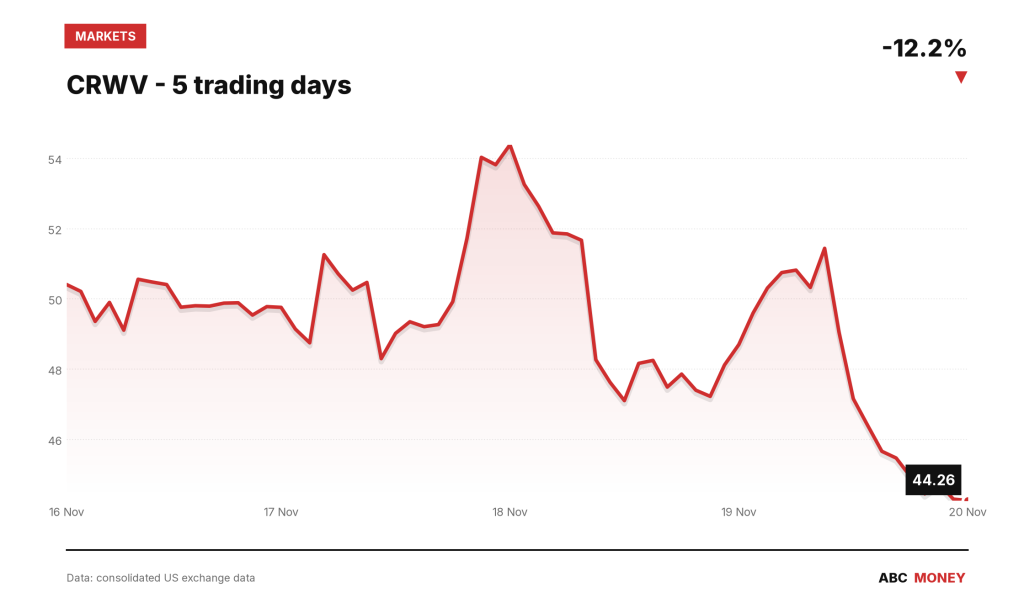
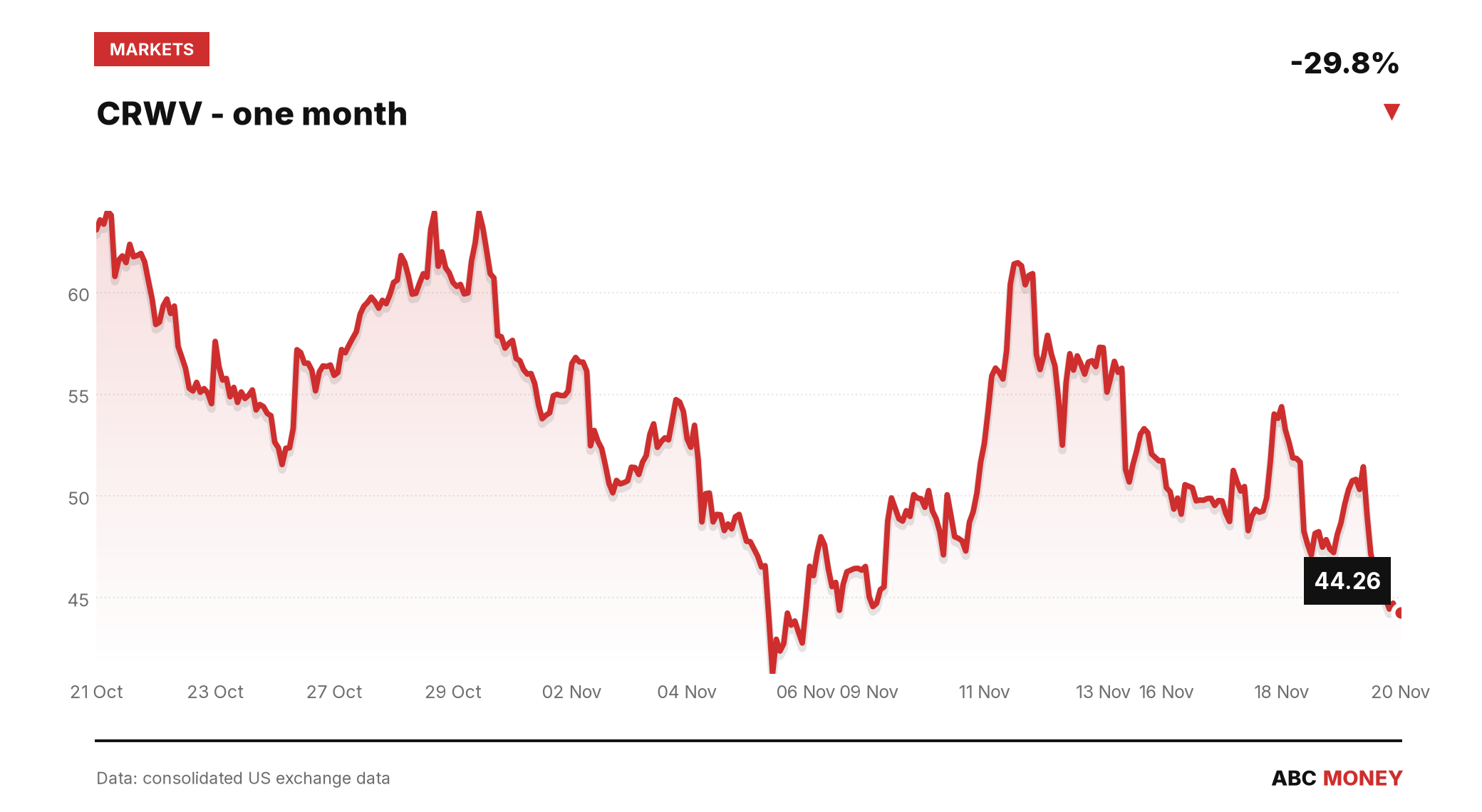
The shares have had a rough run regardless. CRWV closed at $44.34, down 4.45% on the day and 23.09% over the preceding 20 trading days, having traded as high as $61.47 and as low as $41.26 over that span, with volume running roughly in line with its recent average. Bearish positioning has also been building: FINRA’s daily short-sale data show the short-sale ratio – the share of daily trading volume attributable to short sales, where traders borrow and sell stock betting on a decline – rising from 0.394 on 13 November to 0.593 on 19 November, via FINRA.
None of this resolves the underlying question the bond market is asking: whether CoreWeave’s revenue growth can outrun its debt load before the next wall of maturities arrives. Venturo’s purchase is a data point in that debate, not an answer to it. The company’s shift toward customer prepayments and delay-draw facilities, laid out on its latest earnings call, will be the more telling test of whether it can finance its data-centre build-out without returning, cap in hand, to a bond market currently pricing its risk at nearly 16 cents on every dollar borrowed.
This article is for information only and is not investment advice or a recommendation to buy or sell any asset. Markets move quickly; figures are correct as sourced at the time of writing. Always do your own research before making financial decisions.