Qnity Electronics Meridian acquisition hits $840m, all-cash
The Qnity Electronics Meridian acquisition adds adhesives maker Epoxy Technology for $840m cash, as shares recover from an 8.9% slide.
In this article 3 sections
The Qnity Electronics Meridian acquisition is now a signed, dated thing: Qnity Electronics, Inc. (NYSE: Q) has agreed to pay $840m in cash for the electronics arm of Meridian Adhesives Group, a business built around specialty adhesives used in chip packaging and thermal management. The target includes Epoxy Technology, Inc., Epoxies Etc. and Pacific Adhesive Systems, and will be folded into Qnity’s Interconnect Solutions segment once the deal closes.
Qnity is funding the purchase from cash on hand plus incremental borrowings under its existing revolving credit facility – no new equity, so no dilution (the issuing of new shares that shrinks existing holders’ slice of the company) for current shareholders. The company expects the transaction to close in the first quarter of 2027, pending the usual closing conditions and clearance under the Hart-Scott-Rodino antitrust waiting period, according to a release from Meridian’s side of the transaction.
What Qnity is actually buying
Meridian’s electronics business is modest in size next to Qnity’s own revenue base – roughly $100m of sales expected in 2026, with double-digit growth forecast for 2027 inside what the company reckons is a $1.2bn addressable market, per StockTitan’s reporting on the deal. The strategic logic is about capability, not scale: Qnity says the acquisition extends its reach into advanced packaging, thermal management and optical and photonics applications – the connective-tissue materials that bind semiconductor chips to the circuits around them. In its own announcement, Qnity described the deal as “expected to be immediately accretive” to adjusted gross margin, adjusted EBITDA margin and adjusted earnings per share – the standard sell-side shorthand for a deal that pays for itself from day one rather than diluting near-term profitability.
The seller is instructive too. Meridian Adhesives Group is majority-owned by private equity firm American Securities, which bought the business from Arsenal Capital Partners back in 2022. A financial sponsor carving out and selling a single division four years into ownership is a familiar pattern – portfolio pruning rather than distress – and it puts Qnity in the position of buyer of choice for a business its prior owners evidently judged was worth more inside a strategic semiconductor-materials company than inside a broader adhesives group.
A rebound, not a rally
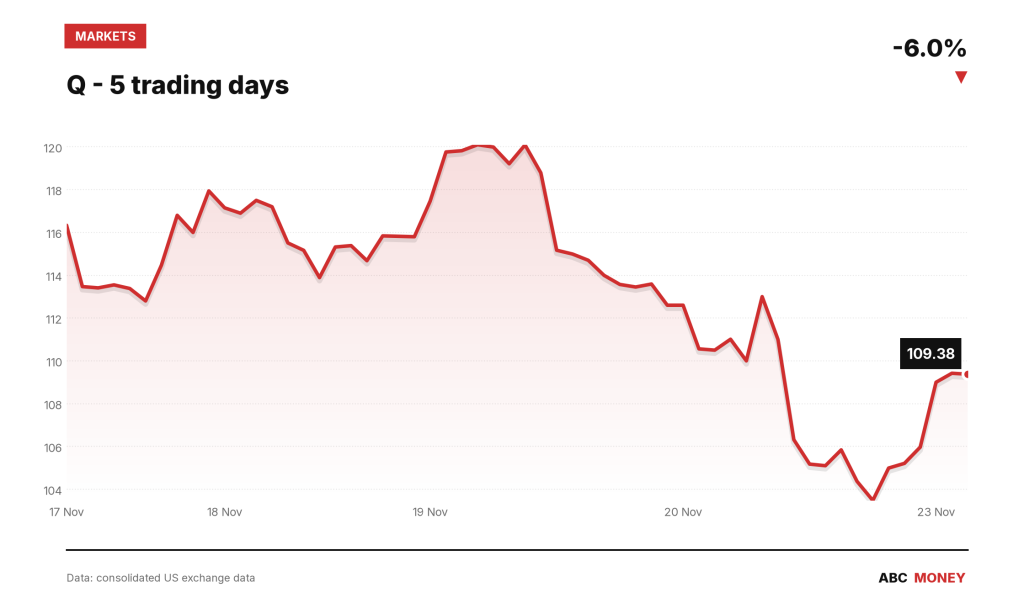
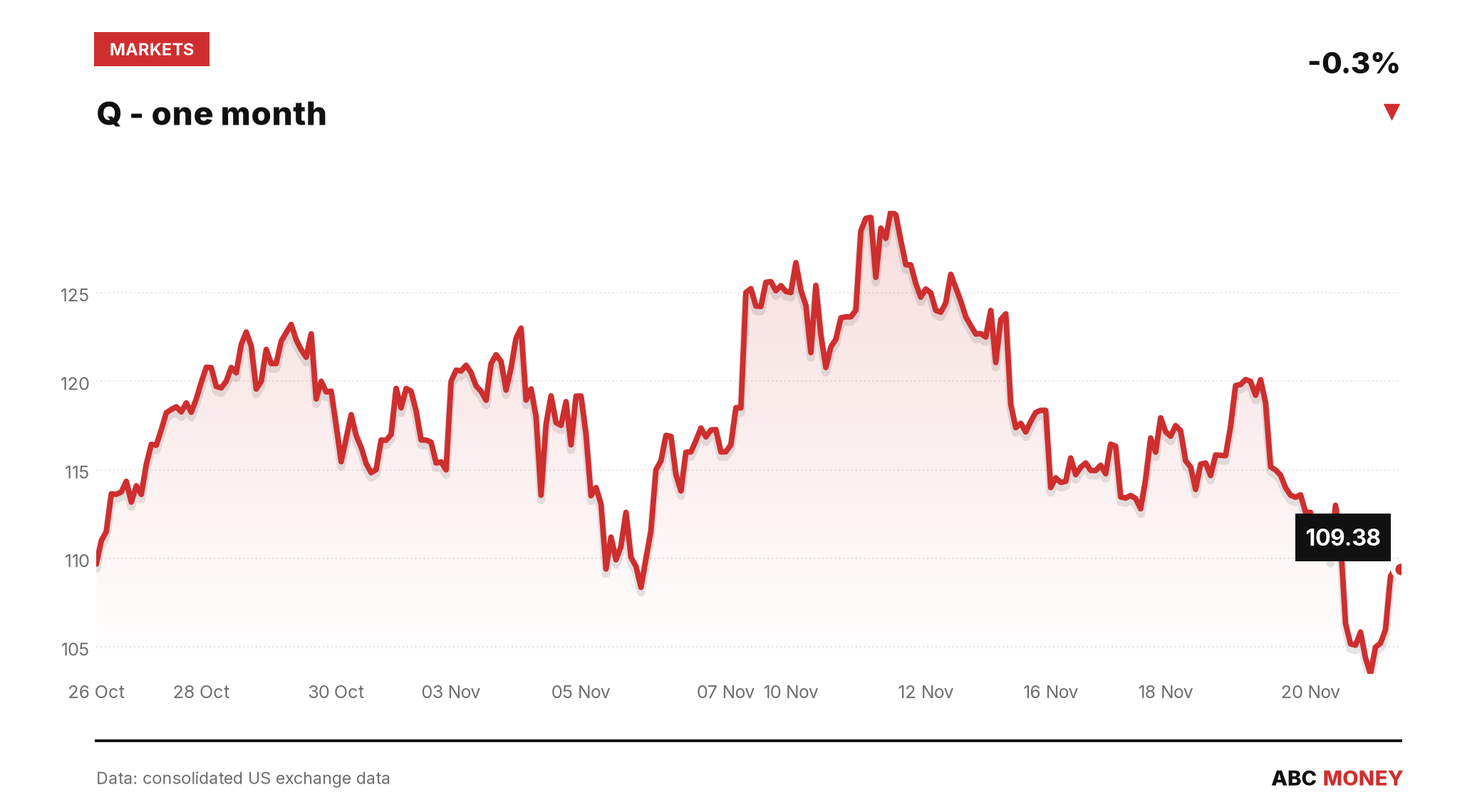
The market’s first reaction looked like relief rather than euphoria. Qnity shares traded at $109.38 as of midday on 23 November, up 4.8% on the day, against a backdrop in which the stock had fallen 7.7% over the preceding 20 trading days and touched a 20-day low of $103.48. The timing matters: Qnity shares had dropped sharply – by 8.94% – in the session immediately before the acquisition news broke, according to reporting via dpa-AFX. Trading volume ran about 32% above its 20-day average, consistent with a stock working through a genuine repricing event rather than drifting on thin volume. Put together, Monday’s bounce looks less like the market cheering a transformative deal and more like a partial unwind of a prior slide – still down on the month even after the pop.
Daily short-sale data from FINRA offer a little texture here: the proportion of Qnity’s trading volume attributable to short sales ran as high as 44% in mid-November before easing back to around 33% by 20 November – elevated but not the kind of extreme reading that typically precedes a short squeeze (a rapid price spike forcing short-sellers, who have bet against the stock, to buy back shares and cover their positions). The pullback in short activity suggests some of the bearish positioning had already unwound before the Meridian news landed.
Why analysts had already trimmed targets
The acquisition arrives against a backdrop of cooling sell-side enthusiasm. Mizuho cut its price target on Qnity to $135 from $160 around the same news cycle, though it kept an Outperform rating, according to MarketScreener. That followed an earlier cut from $180 to $160 on 1 October, which Mizuho attributed to pressure from high exports of China-finished products and the drag of higher interest rates on demand, per a report via Markets Insider. In other words, the stock’s weakness predates this week’s deal by nearly two months.
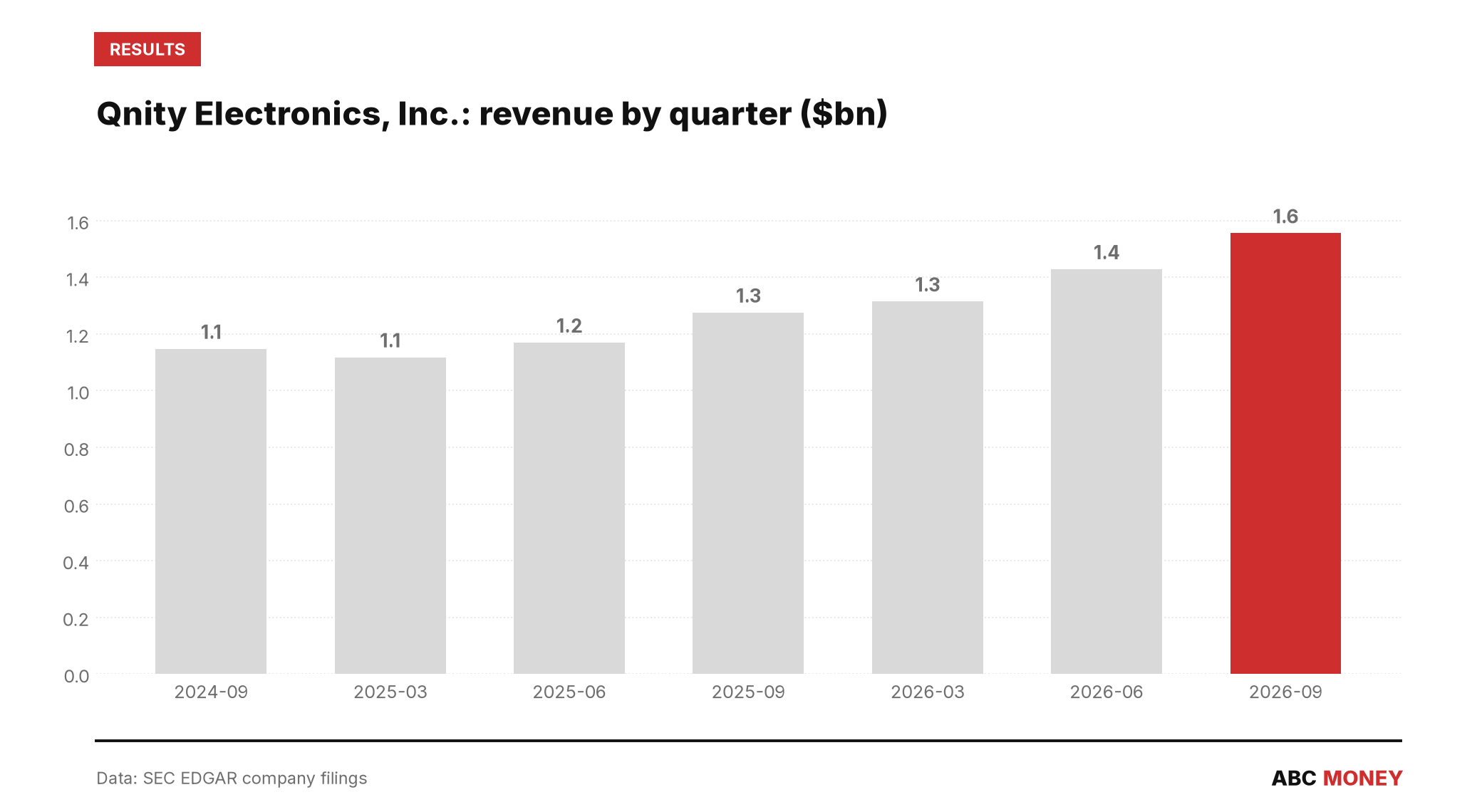
The underlying business, for what it’s worth, has kept growing. Qnity’s most recent quarterly filing showed revenue of $1.556bn for the quarter ended 30 September 2026, up roughly 22% from the $1.276bn reported a year earlier, with diluted earnings per share of $0.87 – down from $1.01 in the same period last year, a decline consistent with rising costs eating into otherwise expanding top-line growth.
The next marker for investors to watch is straightforward: Hart-Scott-Rodino clearance and the targeted first-quarter 2027 close. Whether Meridian’s electronics arm delivers on the double-digit 2027 growth Qnity is paying for will be the first real test of whether this week’s $840m cheque was well spent.
This article is for information only and is not investment advice or a recommendation to buy or sell any asset. Markets move quickly; figures are correct as sourced at the time of writing. Always do your own research before making financial decisions.