MSCI’s Strategy Index Removal Shakes Bitcoin Treasury Stocks
MSCI's Strategy index removal takes effect 30 November, forcing passive funds to sell ~13m MSTR shares. Here's what the new screening rule really changes.
In this article 4 sections
MSCI’s Strategy index removal becomes official at the close of trading on 30 November 2026, when the index provider deletes Strategy (MSTR) from the MSCI USA Index and strips Metaplanet (3350.T) from its MSCI Japan Small Cap Index, according to MSCI’s own investor-relations release. The two companies are the first casualties of a rule MSCI finished writing just six weeks earlier, and the mechanics of that rule matter more than the headline.
Strategy shares closed at $79.50 on 21 November, down 2.21% on the day and 40.67% over the preceding 20 trading days, with volume running at more than double its 20-day average, according to market data cited by Fool.com. The stock has traded as high as $145.35 and as low as $77.94 in that same stretch – a reminder that the index decision landed on a share price already under pressure, not a calm one.
What the Strategy index removal actually targets
This isn’t a bitcoin-specific carve-out. MSCI tried that once already: an October 2025 proposal to exclude any company holding more than 50% of its assets in digital currencies drew over 250 objections and was shelved in January 2026, according to Fool.com. MSCI came back in August with something broader and finalised it on 15 October 2026: a “non-operating companies” screen based on balance-sheet ratios rather than asset type, as The Block reported at the time. Strategy happens to fail it because its balance sheet is now overwhelmingly bitcoin rather than software revenue – but the screen itself would catch any firm with a similarly thin operating business sitting underneath a large financial asset position, crypto or otherwise.
Strategy didn’t take the new rule quietly. In a consultation letter to MSCI, the company called the revised proposal “a pretextual and flawed variation on its prior one”, arguing the methodology was retrofitted to reach the same outcome MSCI had already been forced to abandon. The letter also noted that Strategy alone accounts for roughly 87% of the market value affected across every name on the exclusion list – a detail that undercuts any framing of this as a broad-based policy and sharpens it into something closer to a company-specific exclusion wearing a general rule’s clothing.
The money that actually has to move
Strategy estimated that funds tracking MSCI’s Global Investable Market Indexes hold roughly 13 million MSTR shares, equal to 3.1% of its basic shares outstanding, based on figures reported by Decrypt. Those are the shares passive funds must sell, or stop holding, once the deletion takes effect – not because any investor has made a judgment on bitcoin, but because the index they’re built to replicate no longer includes the name. Strategy itself has put the resulting selling pressure at around $2.8 billion; JPMorgan’s estimate runs considerably higher, at up to $8.8 billion, if other index providers eventually adopt a similar screen, according to figures compiled by Cryptopolitan. That gap between the two numbers is really a bet on contagion: whether this stays an MSCI-only event or becomes the template other providers copy.
On that question, the near-term evidence cuts against a rapid spread. S&P Dow Jones Indices has not adopted anything resembling MSCI’s non-operating-company screen, which leaves open the possibility that Strategy could still qualify for the S&P 500 at some point, per Fool.com’s reporting. MSCI also placed Ethereum treasury company SharpLink on a new public watchlist this round rather than deleting it outright, a softer first step that suggests even MSCI is moving case by case rather than sweeping the whole treasury-company cohort out at once, according to reporting syndicated via AOL.
A balance sheet that swings on bitcoin, not the business
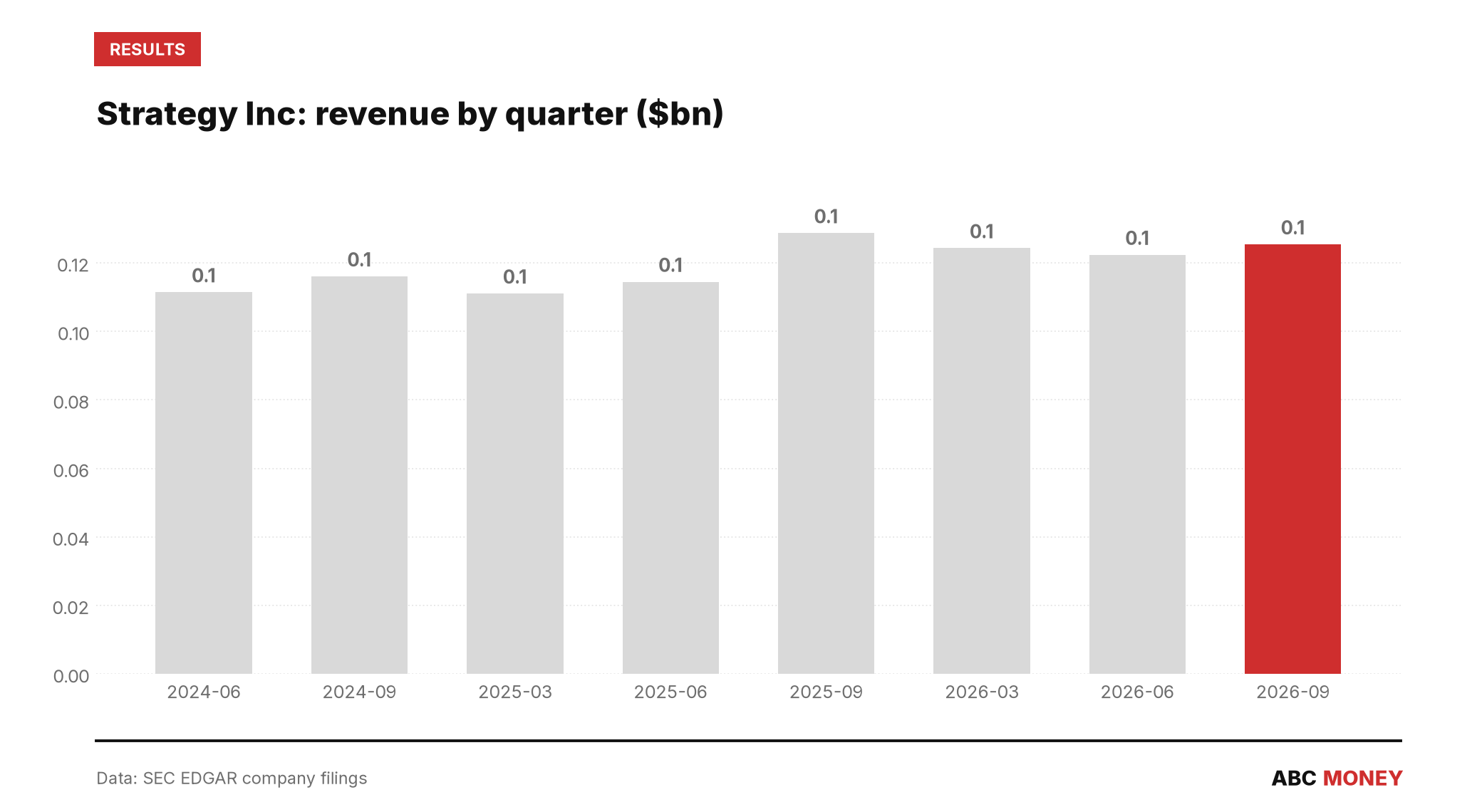
Strategy’s own numbers illustrate why an index committee would look twice at its accounts. Net income swung from a loss of $12.54 billion in the first quarter of 2026 to a profit of $19.53 billion in the third quarter, a reversal driven almost entirely by fair-value accounting on its bitcoin holdings rather than any change in its software operations, according to the company’s quarterly filing with the SEC. Quarterly revenue from the actual software business has sat in a tight $111 million-to-$129 million band since mid-2024 – the kind of flat, modest top line that looks almost incidental next to swings in net income measured in the tens of billions. That mismatch between a huge, volatile balance sheet and a small, steady operating business is precisely what MSCI’s new screen was built to catch.
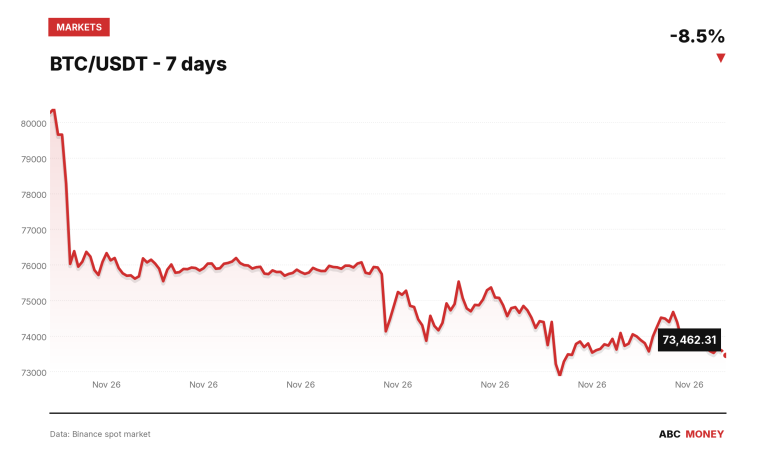
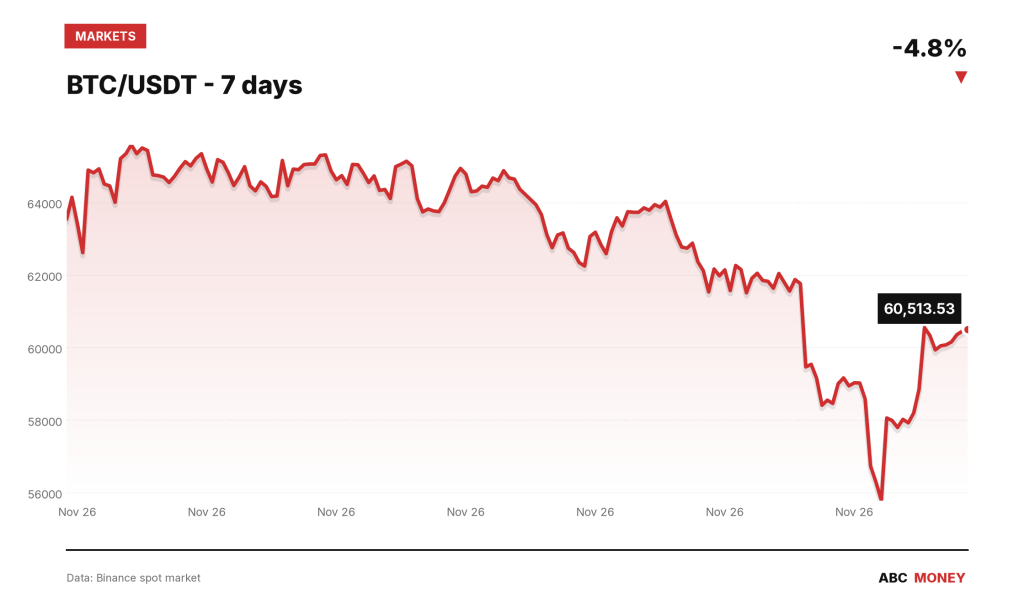
Trading data adds a little texture without changing the story much. The share of daily MSTR volume attributed to short sales – bets that the stock falls – bounced between roughly 28% and 43% through the back half of November, according to FINRA’s daily short-sale data, which doesn’t point to a one-directional squeeze so much as a market genuinely unsure which way the index news nets out. Bitcoin itself traded at $60,482.82 on Binance as of 21 November, down 11.39% over the prior week, providing the broader crypto drawdown against which Strategy’s own decline has unfolded, per Binance spot market data.
What happens on 30 November
The practical deadline is simple enough to write on a calendar: the deletions take effect at the close of trading on 30 November 2026, and whatever rebalancing passive funds need to do against that 13-million-share figure will largely happen around that date. The more open question – whether S&P, FTSE Russell or other providers eventually borrow MSCI’s non-operating-company logic – won’t resolve on any fixed schedule, and nothing in Strategy’s own filings forces it to sell a single bitcoin in response. For now, the index event is a liquidity story for passive money, not a verdict on the underlying asset.
This article is for information only and is not investment advice or a recommendation to buy or sell any asset. Markets move quickly; figures are correct as sourced at the time of writing. Always do your own research before making financial decisions.