Sunday Money: Tyson Foods Shares Jump 12% as Markets Tumble
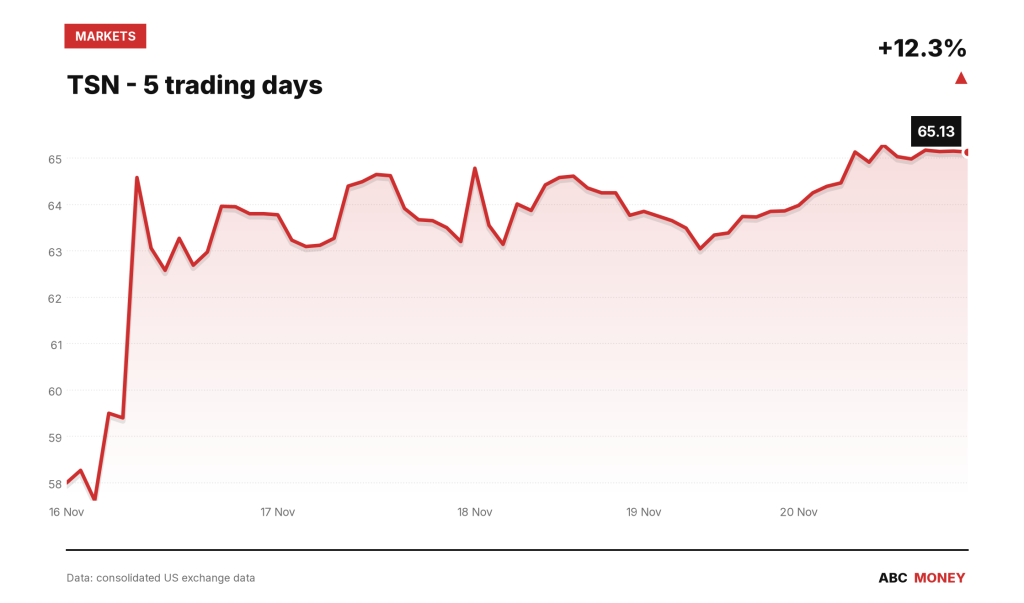
Sunday Money: Tyson Foods shares surged 12.29% in a week that otherwise savaged the S&P 500, Nasdaq, bitcoin and more.
In this article 4 sections
Tyson Foods shares did something almost nobody else managed this week: they went up, and by a lot. The meatpacker behind Jimmy Dean sausages and more chicken nuggets than anyone cares to count closed the week 12.29% higher at $65.13, making it the best-performing large stock on the US market even as the broader indices were taking a beating that felt closer to a market correction than a wobble. There’s no dramatic corporate story behind it – no takeover bid, no blockbuster earnings beat splashed across the wires – just a classic defensive rotation. When investors get nervous, they tend to buy the companies that sell food people need regardless of what the economy is doing, and sell the companies levered to speculative growth. This week, that instinct paid off handsomely for Tyson holders.
Tyson Foods shares lead a week that punished almost everything else
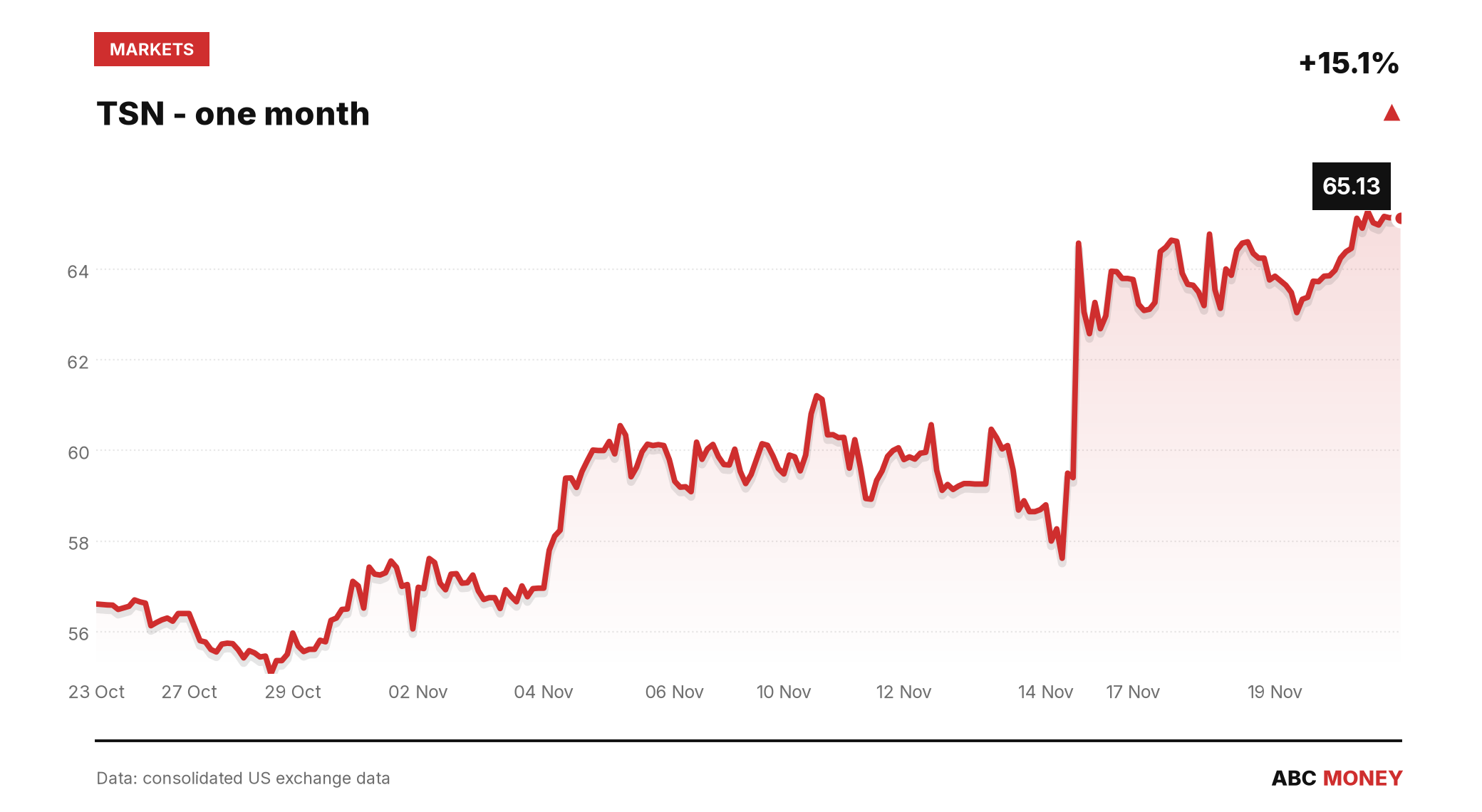
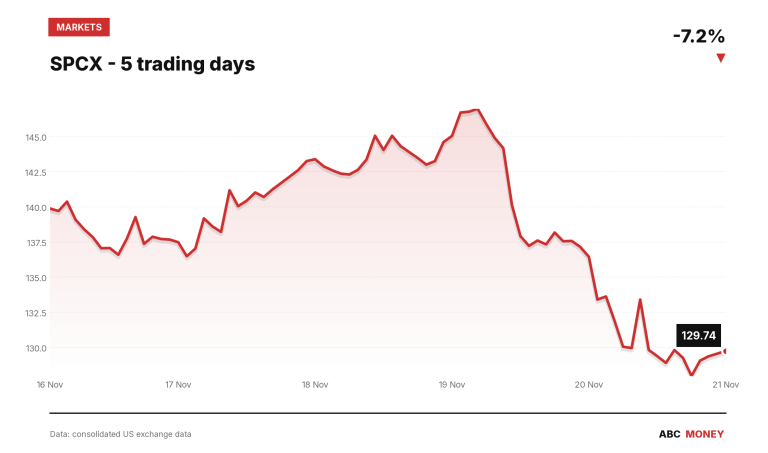
Context matters here. The S&P 500 (tracked via the SPY ETF) fell 7.22% over the week to 697.49, the Nasdaq 100 (QQQ) dropped a sharper 8.32% to 617.72, and the Dow (DIA) slid 7.17% to 485.60. Those are not routine weekly moves – they’re the kind of drawdown that shows up a handful of times a year, and they make Tyson Foods’ 12.29% gain look even more striking by comparison. Fellow food names rode the same defensive wave: Hormel Foods (NYSE: HRL) added 5.93% to close at 23.45, a reminder that when growth stocks wobble, the shelf-stable stuff suddenly looks a lot more interesting to fund managers.
Four more stories from a bruising week
Okta (NASDAQ: OKTA), the identity-management software firm, bucked the tech sell-off to rise 10.21% to 197.50 – one of the few software names to post a gain in a week when the Nasdaq itself fell more than 8%. Pdd Holdings (NASDAQ: PDD), the Chinese e-commerce group behind Temu, climbed 6.31% to 83.69, extending a run this outlet covered earlier this month when an earnings beat masked a softer revenue line.
On the other side of the ledger, Nebius Group (NASDAQ: NBIS) was the week’s hardest-hit large stock, down 23.18% to 84.43 – a brutal slide for the cloud-computing and AI infrastructure group. Strategy Inc (NASDAQ: MSTR), the bitcoin-holding company formerly known as MicroStrategy, fell 22.74% to 79.40, compounding pressure this site flagged recently after index provider MSCI moved to strip it from a widely tracked benchmark. Both losses sit alongside a rough week for the underlying coin itself, which only compounded the selling.
Crypto corner
Digital assets had little shelter to offer this week. Bitcoin (BTC) fell 9.55% against the dollar to $59,107.33, according to Binance spot market data, dragging ether (ETH) down 8.56% to $1,666.58. Solana (SOL) held up relatively better but still lost 3.50%, closing at $69.21. The pattern mirrored equities almost exactly: anything priced on future growth and risk appetite got marked down hard, while the steadier, cash-generative end of the market – Tyson Foods among them – was where the money hid.
The week in numbers
- -8.32%: the Nasdaq 100’s weekly fall, its sharpest of the three major US indices.
- 12.29%: Tyson Foods’ gain, the single best return among large US stocks this week.
- 5.04%: the 10-year US Treasury yield, barely down from 5.07% a week earlier, according to Federal Reserve Bank of St. Louis data – a sign bond markets stayed remarkably calm even as equities convulsed.
Elsewhere in the background data, the 2-year Treasury yield slipped to 4.76% from 4.80%, the gap between 10-year and 2-year yields widened slightly to 0.29 percentage points according to Federal Reserve data, and WTI crude oil edged up to $89.53 a barrel from $89.24. None of it screamed panic the way equities and crypto did – which is its own kind of story. Whatever spooked growth stocks and bitcoin this week didn’t show up in the bond market or at the petrol pump, at least not yet.
That’s the week that was: a sharp reminder that sausages and software don’t always move together, and that defensive names can still have their moment even when – especially when – everything else is wobbling. Pour something warming, put your feet up, and we’ll see what next week brings.
This article is for information only and is not investment advice or a recommendation to buy or sell any asset. Markets move quickly; figures are correct as sourced at the time of writing. Always do your own research before making financial decisions.