Rocket Lab lifts Neutron launch price before first flight
Rocket Lab's Neutron launch price has risen to $70m from $55m before the rocket has flown once - a sign of a tightening space-launch market.
In this article 4 sections
Rocket Lab (NASDAQ: RKLB) has done something few companies would dare: it has put up the price of a product it has never actually delivered. The Neutron launch price now stands at $70m a mission, up from $55m, according to the company’s own third-quarter earnings release filed with the Securities and Exchange Commission – and Neutron has yet to leave the pad.
That is not a typo or a marketing flourish. Neutron, the medium-lift rocket Rocket Lab has billed as its answer to SpaceX’s Falcon 9, has been pushed back repeatedly and is now not expected to fly before 2027, after engineers found a manufacturing defect in a carbon-fibre fuel tank, as The Register reported in October. Normally a slipping timetable is when customers start asking for discounts, not when the seller raises the sticker price.
Backlog grows faster than the rocket
The reason the price increase has stuck is demand. Rocket Lab says it booked more than $515m of new Neutron contracts in the third quarter alone, taking the rocket’s backlog to 16 missions before its debut, according to figures published by Rocket Lab’s investor relations team. New customers signing up now, including satellite operator Muon Space for a pair of dedicated launches, are being slotted in for 2029 and 2030 – not because Rocket Lab wants a long queue, but because the queue is already that long.
Space.com reported that the first 16 Neutron flights are effectively sold out at the old price, with fresh bookings only available for missions in the 2030s. For a company that has not yet proven its rocket can reach orbit, that is an unusual position of strength.
Where SpaceX fits in
The pricing power traces back, in part, to SpaceX’s own success. Falcon 9 is increasingly booked up by SpaceX’s Starlink satellite constellation, which now consumes roughly 79% of the rocket’s launch capacity, according to analysis from Tradingpedia. SpaceX is also expected to stop selling shared rideshare missions on Falcon 9 after 2028, squeezing out smaller satellite operators who previously relied on cheap, shared slots. That is creating a gap in the market that Neutron – still unflown – is being pre-sold into.
Rocket Lab’s chief executive, Peter Beck, has been careful not to frame Neutron purely as a SpaceX challenger. He told investors the rocket could be run “extremely profitably” even if it never displaces Falcon 9 outright, according to Stocktwits – a reminder that Rocket Lab’s bet is as much on a structurally tighter launch market as it is on beating any one rival head-on.
The numbers behind the optimism
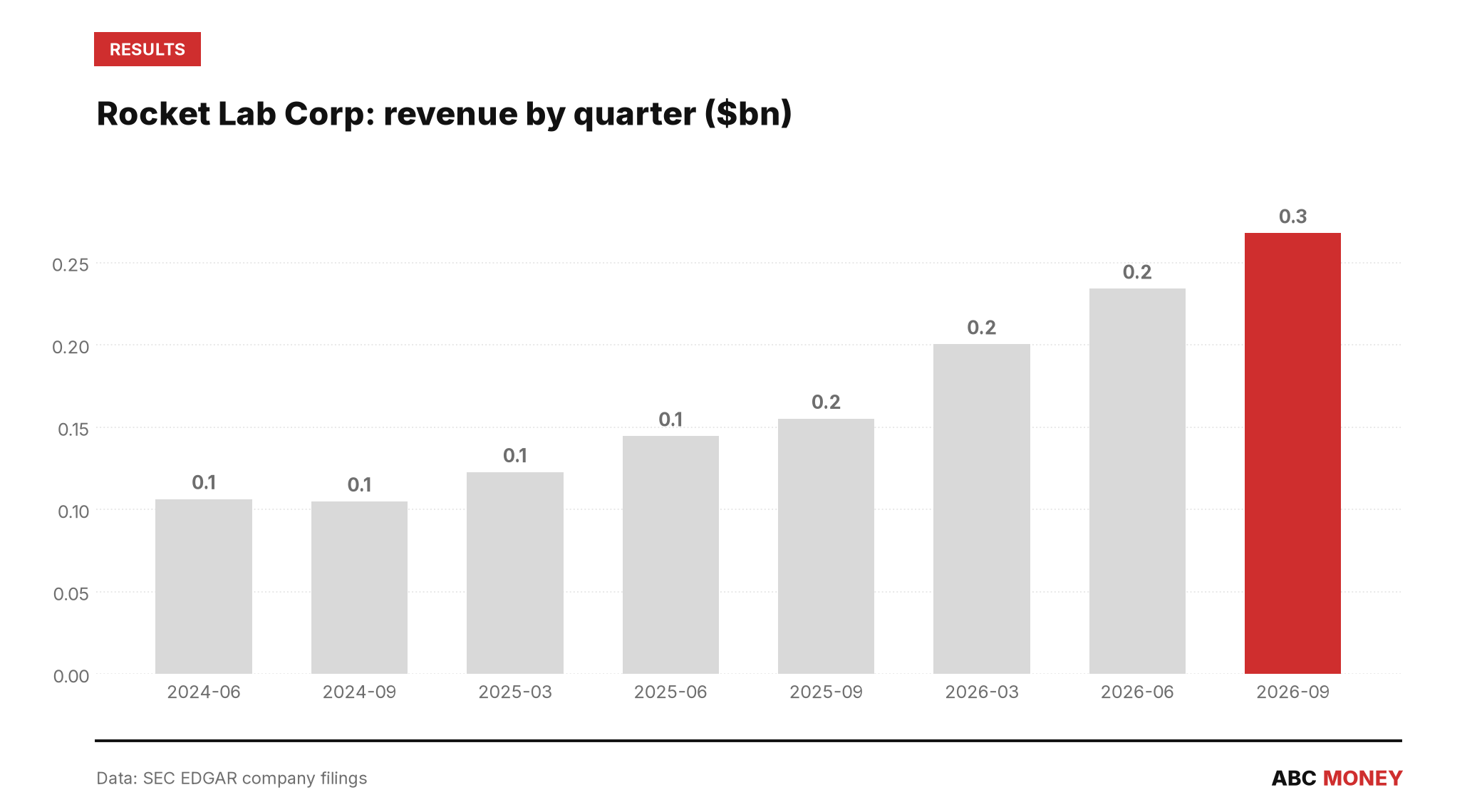
The backlog story sits against a business that is scaling quickly but still losing money. Third-quarter revenue, covering the period to 30 September 2026, came in at $267.8m, up from $155.1m a year earlier – growth of roughly 73%, based on figures in the company’s quarterly filing. The net loss, however, widened to $79.7m from $18.3m in the same quarter last year, a reminder that scaling a launch business – building Neutron, expanding Electron production, and running a satellite-components arm – remains expensive.
Wall Street’s reaction has been mixed in direction but consistent in theme. Morgan Stanley kept an Overweight rating on the stock even as it trimmed its price target, citing the Neutron backlog as the long-term case, according to BigGo Finance. Separately, five brokerages cut their price targets even as the shares rallied around 50% over recent weeks, with the same backlog cited as the reason bulls were staying in, per Benzinga. That is the shape of a stock where analysts are more confident about the destination than the valuation required to get there.
A volatile tape around the news
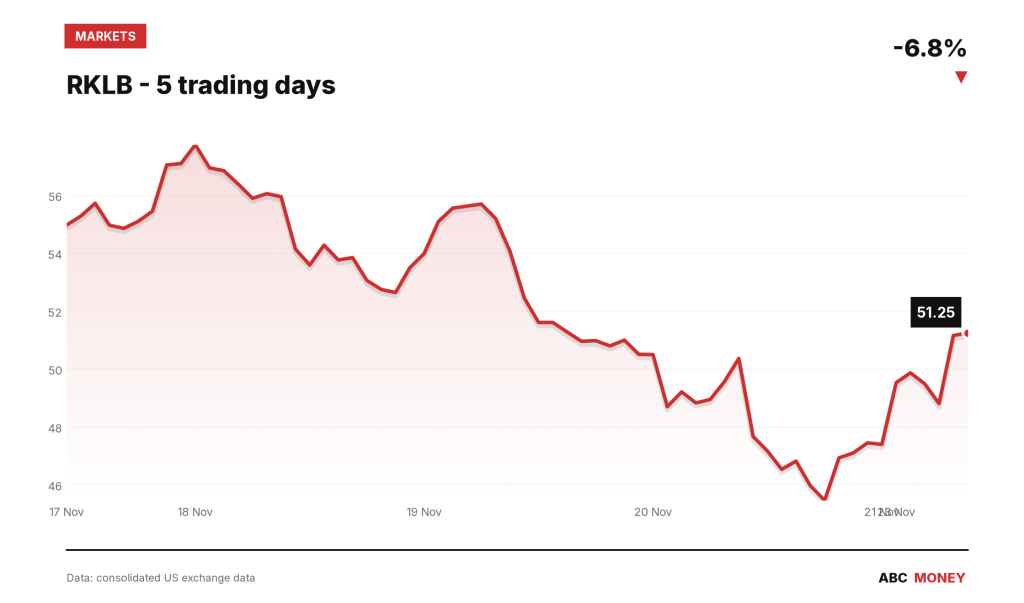
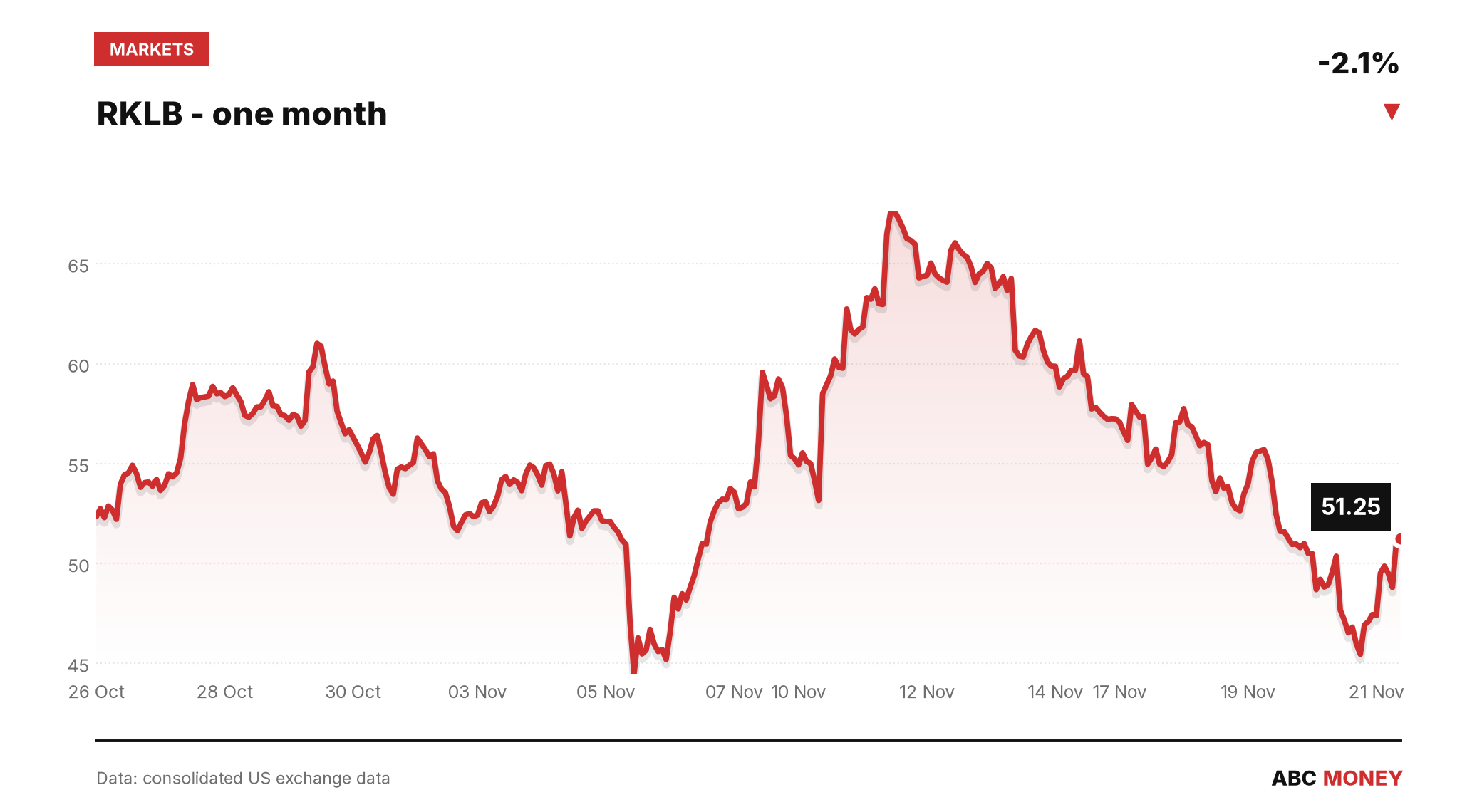
Rocket Lab shares closed at $50.51 as of 23 November, up 7.24% on the day but still down 6.72% over the prior 20 trading sessions, having swung between $44.48 and $67.64 in that window – a reminder that the stock has been trading on sentiment as much as on fundamentals. Some of that day’s move followed separate comments from the company’s finance chief about strong demand for the smaller Electron rocket, which Benzinga said drove pre-market gains of close to 9.5%. Trading volume on the day was running at only about 13% of its 20-day average, suggesting the move was concentrated rather than broad-based.
None of that resolves the central tension facing Neutron: a rocket with a six-figure backlog in dollar terms and a sold-out manifest stretching into the next decade, built by a company that still has to prove the thing can fly at all. The next marker worth watching is simple – whether Neutron actually leaves the ground in 2027, and whether the $70m price holds once it does.
This article is for information only and is not investment advice or a recommendation to buy or sell any asset. Markets move quickly; figures are correct as sourced at the time of writing. Always do your own research before making financial decisions.