Tesla Emag Acquisition Filing Is Narrower Than It Looks
The Tesla Emag acquisition filing with German regulators covers specific product lines, not the whole machine-tool maker. Here's what's actually changing hands.
In this article 4 sections
The Tesla Emag acquisition filing lodged with Germany’s antitrust watchdog last month is not quite what its own headline suggests. Tesla, Inc. (TSLA) has indeed submitted plans to Germany’s Bundeskartellamt concerning Emag, a Baden-Württemberg machine-tool maker with more than 150 years of history, as first reported by Reuters. But the regulator’s own case list describes the move as a “Vermögenserwerb” – an asset acquisition – not a takeover of the Emag group as a whole, according to filing details reported by mlq.ai.
That distinction matters. Buying a company means absorbing its balance sheet, its debts, its full workforce and whatever else comes with it. Buying assets out of it means cherry-picking the bits you want and leaving the rest behind. The Bundeskartellamt logged the case as B5-132/26 on 23 November 2026, and the scope it describes is specific: manufacturing systems for precision production, electrochemical machining of metal parts, and laser processing – plus roughly 220 Emag employees expected to move across to Tesla, per a report from teslamag.de. Financial terms have not been disclosed, and stockanalysis.com notes the initial report offered no detail on price or strategic rationale either.
What Tesla actually wants
The likelier explanation is less about German industrial muscle in general and more about one project in particular: Optimus, Tesla’s humanoid robot. Emag’s manufacturing lines – precision gear-cutting, electrochemical machining, laser processing – are exactly the sort of kit needed to build robot joints and actuators in-house rather than buy them from third-party suppliers. Teslamag.de’s reporting frames the deal as fitting a pattern: Tesla has repeatedly acquired technical capability from German engineering firms over the years, typically absorbing a capacity or a product line rather than an entire corporate structure. Emag, which has reportedly been in financial difficulty, looks like a supplier whose specific tooling Tesla wanted enough to carve it out of a struggling parent.
None of that is confirmed by Tesla itself – the company has not issued its own statement on rationale – but it is the reading that best fits the shape of the filing: a narrow product and headcount scope rather than a clean corporate acquisition.
The regulatory clock
Under German merger control, the Bundeskartellamt has one month from a complete filing to wave a deal through in a first-phase review; if it decides the deal needs closer scrutiny, it can open an in-depth review with up to five months to reach a final decision, per stockanalysis.com’s summary of the process. With the case logged on 23 November 2026, a first-phase clearance would plausibly land in late December, though nothing prevents the regulator from extending into deeper review if it has concerns about market concentration in precision manufacturing equipment – an unlikely but not impossible outcome given how niche the asset pool is.
A rounding error for Tesla’s balance sheet
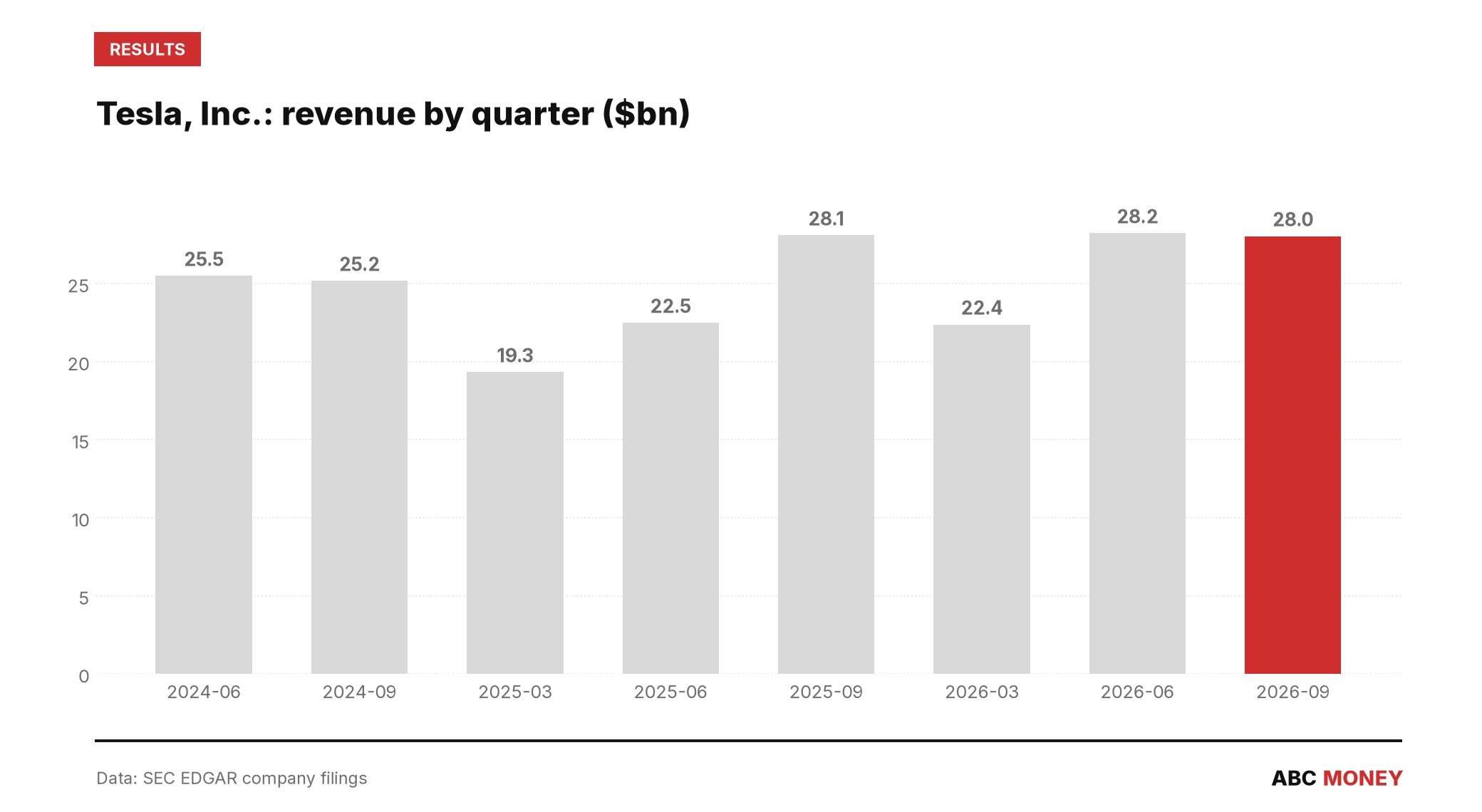
Whatever Emag’s assets cost, it is very unlikely to register as a material event against Tesla’s own numbers. The company’s quarterly revenue has run between roughly $19.3bn and $28.2bn over the past two years, with the most recent quarter to 30 September 2026 posting $28.046bn in revenue and $787m in net income, according to Tesla’s 10-Q filing with the SEC. A deal built around 220 staff and a handful of product lines sits well within the range of bolt-on spending Tesla can fund from operating cash without troubling investors for new disclosure beyond the antitrust notice itself.
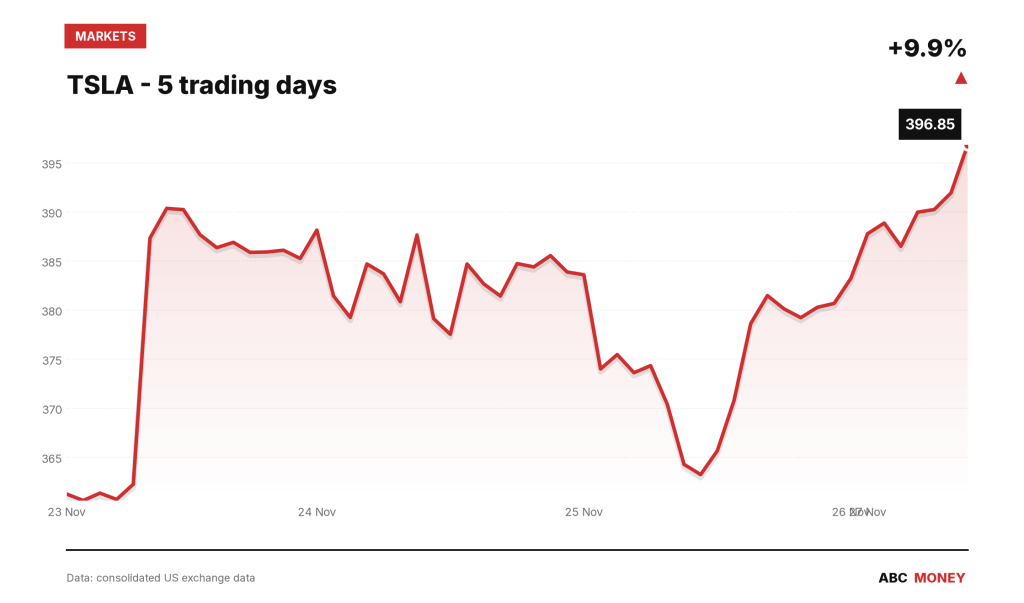
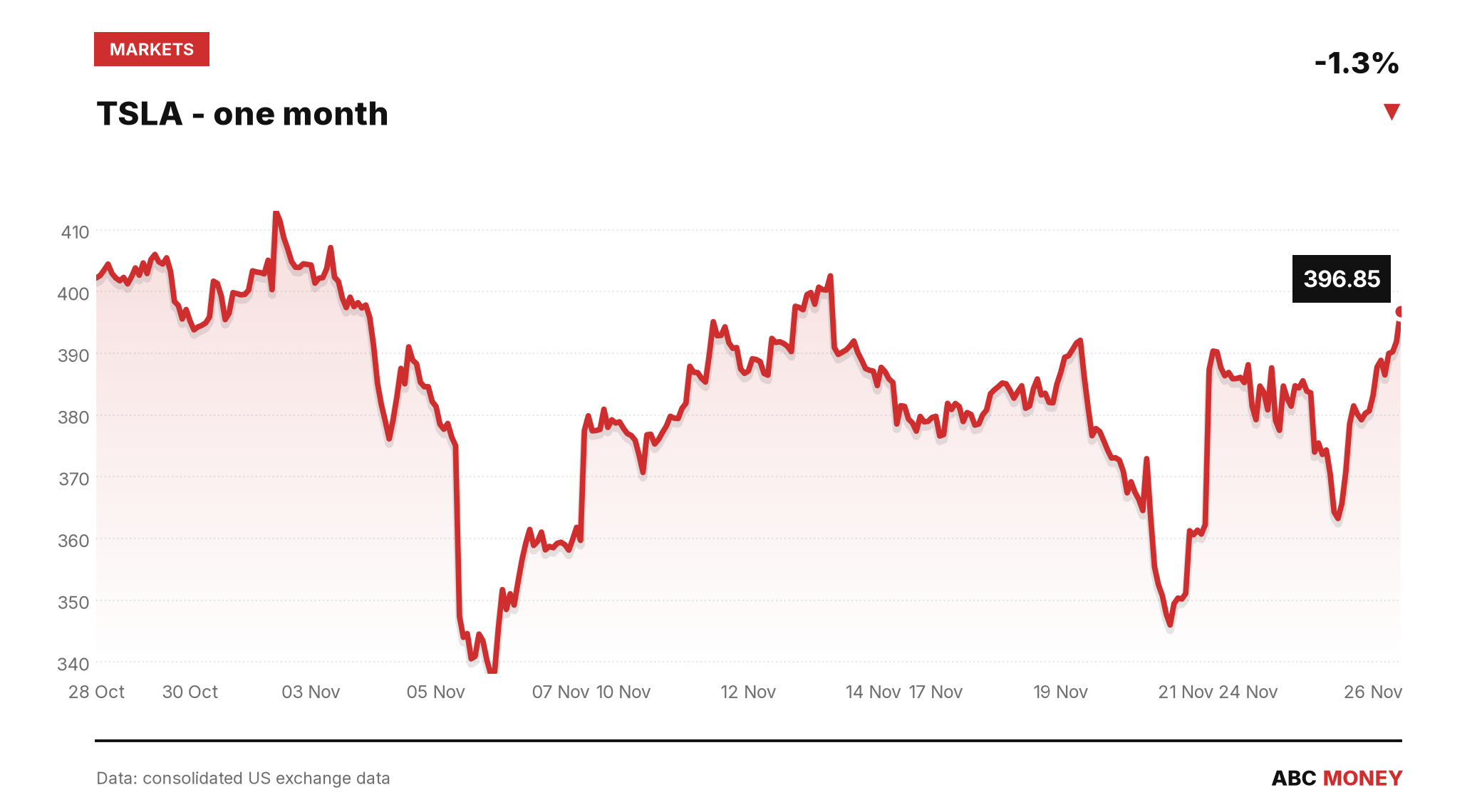
The stock, for its part, showed no sign of treating the news as decisive one way or the other. TSLA closed at $395.69 on 27 November 2026, up 3.25% on the day and 9.47% over the preceding 20 trading days, but on volume running at only 59% of its 20-day average – hardly the signature of a market repricing around a single filing. Short-sale activity tracked by FINRA showed a ratio of 0.61 on 25 November, sitting comfortably within the 0.50-to-0.62 band seen over the prior fortnight, with no spike suggesting short-sellers were caught off guard by the Emag news.
What’s left to confirm
Tesla has not detailed what it paid, nor spelled out publicly whether Optimus production is the end goal. Both would be the natural next disclosures to watch for – either in a future SEC filing referencing the transaction, or in commentary from Tesla executives at the next quarterly results. Until then, the honest description of what happened on 27 November 2026 is narrower than “Tesla buys German company”: a targeted asset purchase, a few hundred jobs, and a regulatory clock now running in Bonn.
This article is for information only and is not investment advice or a recommendation to buy or sell any asset. Markets move quickly; figures are correct as sourced at the time of writing. Always do your own research before making financial decisions.