Vertex stock falls ~7% on povetacicept FDA extension
A povetacicept FDA extension pushed Vertex's kidney-drug decision to February 2027, wiping ~7% off VRTX shares despite no safety red flag.
In this article 3 sections
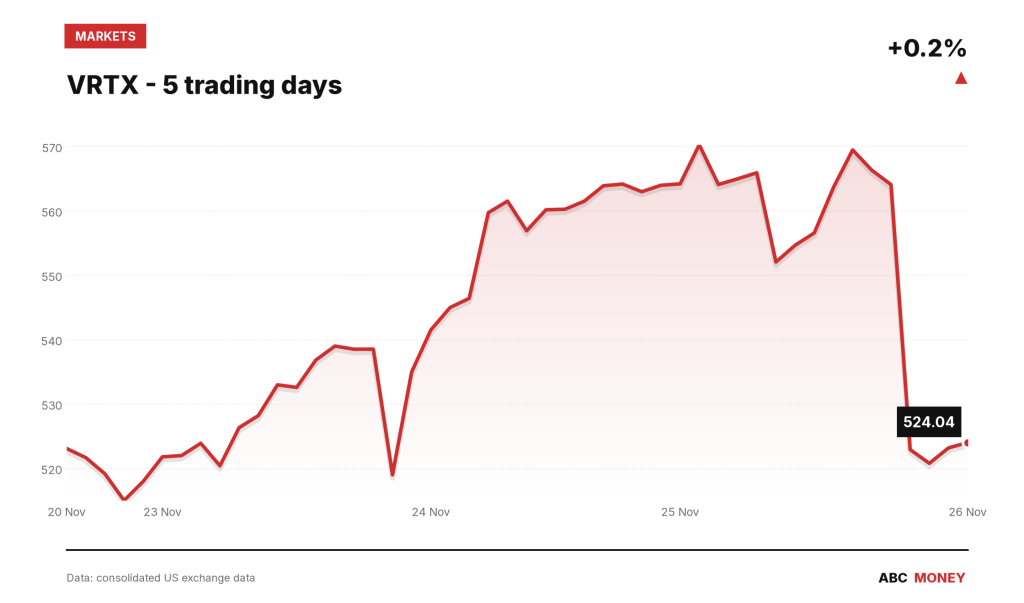
Vertex Pharmaceuticals (VRTX) shares fell sharply this week after a povetacicept FDA extension pushed back the regulator’s verdict date on the company’s experimental kidney-disease drug by up to three months. The stock closed at $524.04, down 7.03% on the day, according to consolidated exchange data, as investors recalibrated the timing – though not, crucially, the odds – of an approval.
The Food and Drug Administration had been due to rule on povetacicept, Vertex’s candidate for IgA nephropathy (IgAN, a progressive kidney disease caused by antibody deposits in the kidneys), by 30 November 2026. That deadline, known as a PDUFA date (the statutory target under the Prescription Drug User Fee Act by which the FDA aims to complete its review), has now been pushed to no later than 28 February 2027, as first reported by Investing.com.
A paperwork delay, not a rejection
The mechanics matter here. Vertex said the FDA notified it of the extension on 24 November 2026, after the agency made a late-cycle information request that it classified as a “major amendment” – regulatory shorthand for additional data or analysis that buys the reviewer more time, as described by TipRanks. Nothing in the disclosure points to a rejection, a Complete Response Letter (the FDA’s formal refusal-to-approve notice), or a new safety signal. Vertex had responded to the request before the extension was granted, suggesting the agency simply wants more runway to digest what it was sent.
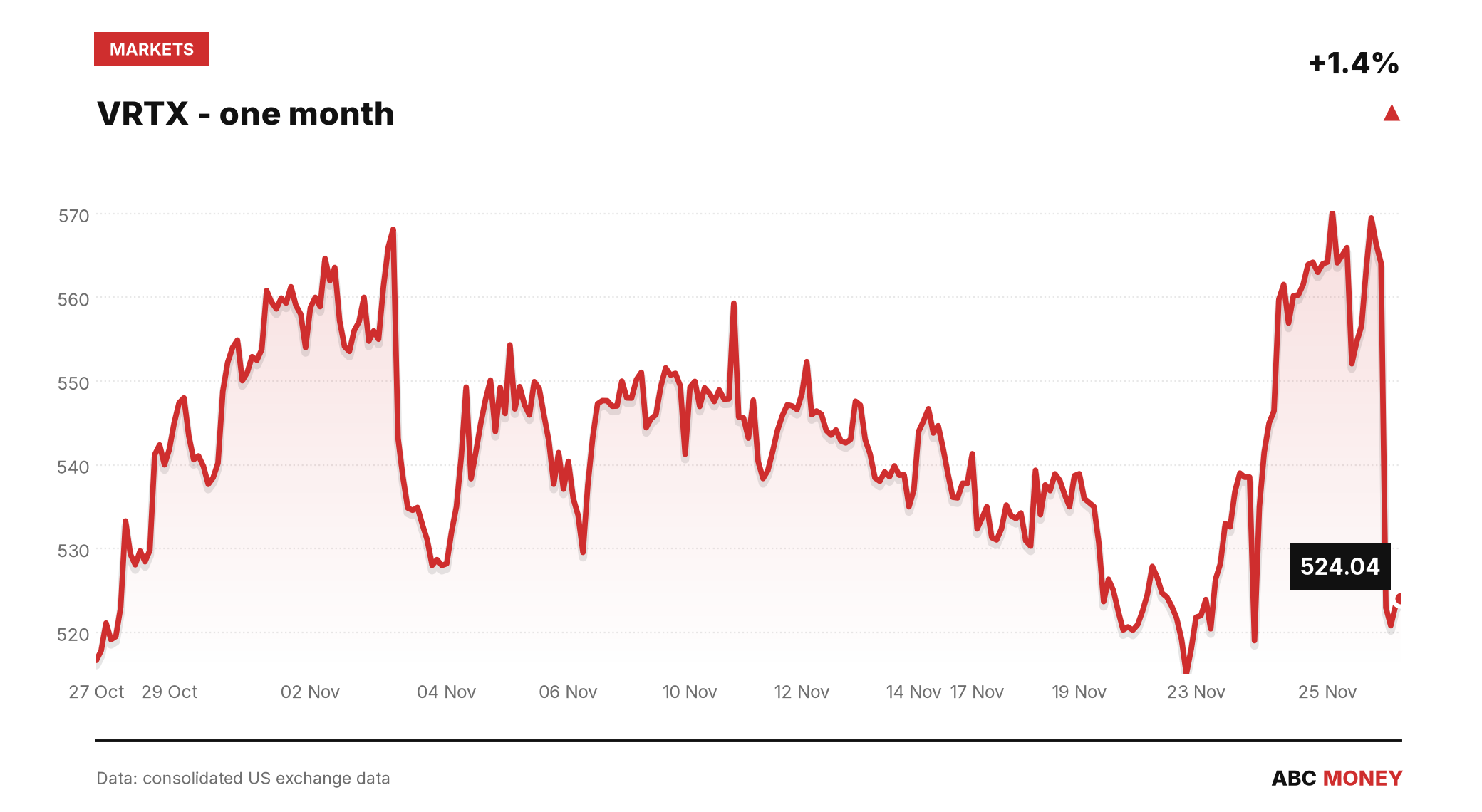
That distinction hasn’t stopped the market from treating the delay as a quasi-setback. The roughly 7-8% single-day drop logged across trading desks is a large repricing for a procedural timeline shift, and it came on volume 1.32 times the stock’s 20-day average, with the shares trading well below their 20-day high of $570.30. Short-sellers leaned in too: FINRA data show VRTX’s short-sale ratio (the share of daily volume sold short) jumped to 0.604 on 25 November from 0.477 the prior session, a sign some traders were betting on further downside rather than just closing positions.
The asymmetric reaction
What makes the move notable is the contrast next door. Vera Therapeutics (VERA), which is developing a rival treatment for the same kidney disease, surged more than 18% the same day, according to Investing.com, as investors weighed whether a delayed launch window for Vertex’s drug hands a competitor more room to establish itself first-to-market. It’s a reminder that in IgAN, as in most rare-disease categories, being early carries real commercial value – and the market priced Vertex’s three-month slip as a transfer of that advantage rather than a neutral scheduling change.
Povetacicept’s scientific case hasn’t changed. The drug is a dual inhibitor of two cytokines, BAFF and APRIL, that drive the antibody production underlying IgAN, and its original submission was built on positive interim data from the Phase 3 RAINIER trial, published in the New England Journal of Medicine and presented at ASN Kidney Week 2026. The FDA’s request for more time doesn’t retract that evidence; it simply means the agency wants longer to work through it, or through newer analyses Vertex supplied.
Why Vertex can absorb a three-month wait
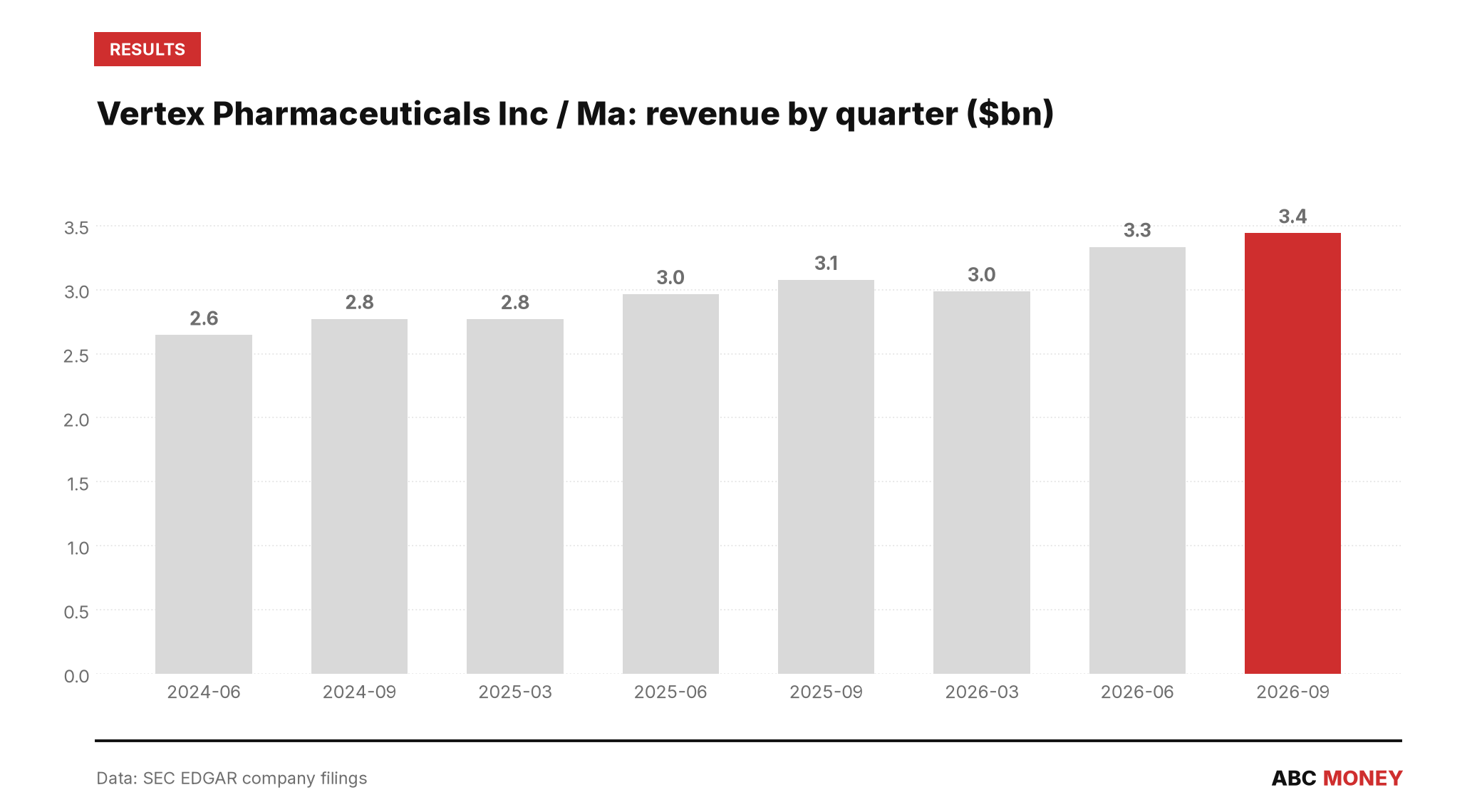
Unlike smaller biotechs where a single PDUFA date can make or break the balance sheet, Vertex’s commercial base doesn’t hinge on this one approval. The company reported third-quarter 2026 revenue of $3,440.8 million and net income of $653.6 million in its most recent quarterly filing, driven by its existing cystic fibrosis franchise and newer approved therapies – a base that has grown every quarter this year. Povetacicept is also not a one-shot bet: beyond IgAN, Vertex is running a Phase 2/3 trial (OLYMPUS) testing the drug in primary membranous nephropathy, another kidney condition, and a separate Phase 2 study in generalised myasthenia gravis, a neuromuscular disorder. A delay in one indication leaves two more shots on goal.
None of that guarantees the February decision goes Vertex’s way, and investors will be watching for any further FDA correspondence between now and the new target date. But the gap between a three-month administrative extension and an 18% swing in a rival’s share price is the kind of mismatch that tends to close one way or the other as the new PDUFA date approaches.
This article is for information only and is not investment advice or a recommendation to buy or sell any asset. Markets move quickly; figures are correct as sourced at the time of writing. Always do your own research before making financial decisions.