Palo Alto Networks sued by ex-executive over accounting fraud claim
Palo Alto Networks faces an accounting fraud lawsuit from a former executive; shares slipped after hours as the company denies the claims.
In this article 3 sections
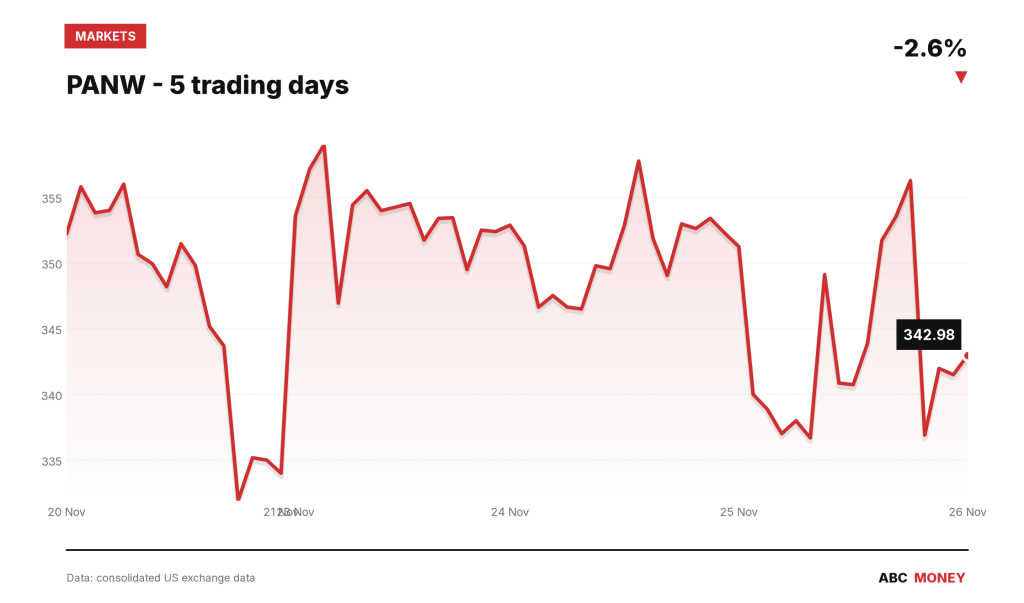
Palo Alto Networks (NASDAQ: PANW) is facing an accounting fraud lawsuit filed by a former executive, according to reports published on 25 November 2026. The security software giant’s shares slipped in after-hours trading once the news broke, though the stock closed the regular session little changed.
The allegations were first detailed by Seeking Alpha and Investor’s Business Daily, with Bloomberg separately reporting that Palo Alto Networks had been accused by a former executive of accounting fraud. None of the reports named the plaintiff, specified a court or case number, or put a dollar figure on the claim. The company has not filed an 8-K – the form used to disclose material corporate events to the US Securities and Exchange Commission – addressing the suit, and at least one outlet, Stocktwits, reported that Palo Alto Networks denies the allegations.
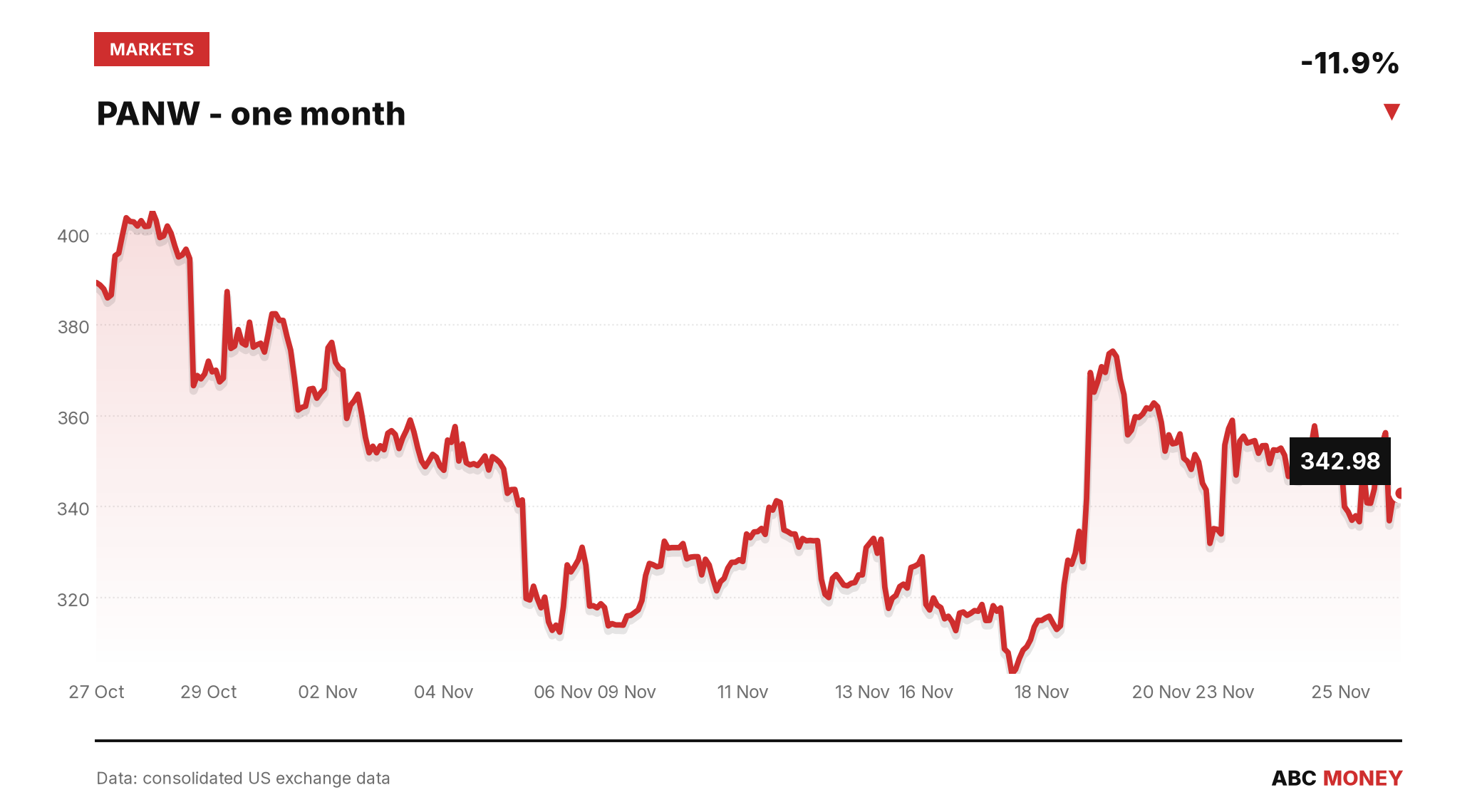
That gap between the headline and the detail matters for how investors should read the move. The “shares fall” framing used across several reports describes an after-the-close slide, as Benzinga noted, rather than a regular-session rout. Consolidated exchange data put PANW’s last price at $341.50 as of 25 November, up 0.22% over the prior 24 hours and down just 0.42% over 20 trading days – hardly the picture of a stock in freefall, even as the after-hours tape told a jumpier story.
What the filings show
A Form 4 – the form executives and major shareholders use to disclose share trades – was filed with the SEC on 24 November under the name Paul Josh D., the day before the lawsuit reports surfaced. The filing’s share and value fields are blank, and nothing publicly ties this filer to the plaintiff in the fraud claim. Readers should treat the timing as a coincidence worth noting rather than evidence of anything.
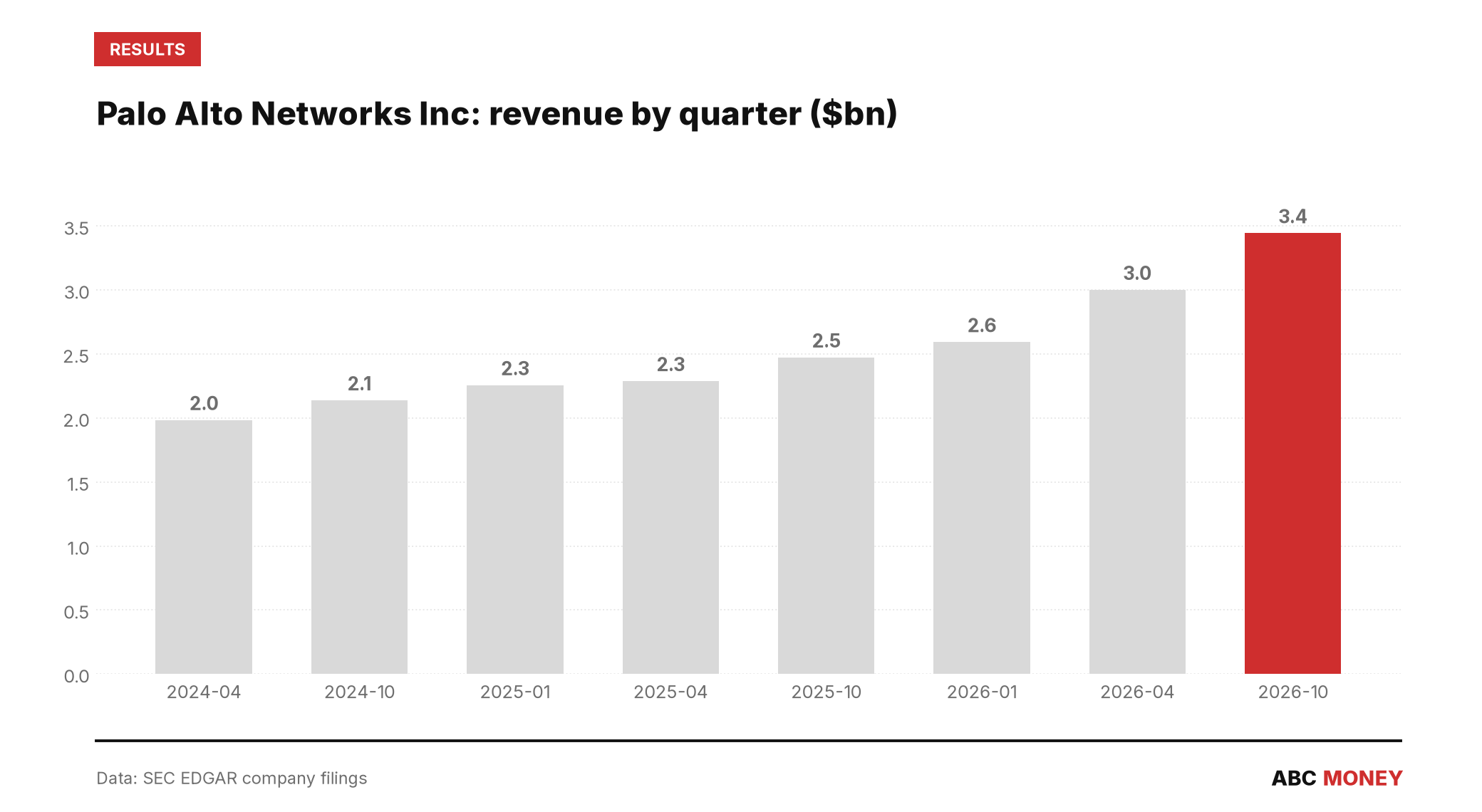
Palo Alto’s own quarterly numbers offer more concrete, if circumstantial, context. The company’s revenue has climbed every quarter for more than two years, from $1.9848bn in the quarter ended April 2024 to $3.445bn in the quarter ended October 2026, according to its 10-Q filings. Net income has mostly tracked that growth upward too – $278.8m, then $350.7m, $267.3m, $262.1m, $334.0m and $432.0m across successive quarters.
The one outlier sits in the quarter ended April 2026, when Palo Alto reported a net loss of $177.0m and diluted earnings per share of -$0.22, a sharp reversal against every other period in that run, per its 10-Q filing. By the following quarter, the one immediately preceding the lawsuit reports, the company was back to $482.0m in net income and $0.57 diluted EPS on $3.445bn of revenue. A single loss-making quarter amid otherwise steady growth is not proof of accounting irregularities, but it is the kind of swing that invites scrutiny once a fraud allegation is in the air.
Short interest and the wider backdrop
Positioning data from FINRA, the US brokerage regulator that publishes daily short-sale volume, shows the share of PANW trading tied to short sales – bets that the stock will fall – climbed from 0.371 on 16 November to 0.633 on 23 November, before easing to 0.554 on 25 November, the day the lawsuit reports landed. That build-up in the days ahead of the news suggests some traders were already positioning for weakness, though short-sale volume ratios can move for reasons unconnected to any single story.
The macro backdrop was unusually calm by comparison. The 10-year US Treasury yield stood at 4.91% on 24 November, barely changed from 4.92% previously, while the 2-year held flat at 4.63%, according to Federal Reserve data. The gap between the two – a widely watched signal of recession risk when it inverts – narrowed slightly to 0.24 percentage points from 0.28. None of that points to a market-wide risk-off move that could explain a PANW-specific share swing; whatever hit the stock after hours was specific to the company, not the tape.
What happens next
Until a complaint is unsealed or the company responds formally, the accounting fraud lawsuit remains a claim rather than a finding. Investors watching Palo Alto Networks will be looking for an SEC filing disclosing the suit’s details – plaintiff, court, and alleged damages – along with any formal company statement beyond the denial reported by Stocktwits. The firm’s next scheduled quarterly results would also give analysts a chance to press management directly on the April 2026 loss and on whatever bookkeeping questions the lawsuit raises, assuming it specifies any.
This article is for information only and is not investment advice or a recommendation to buy or sell any asset. Markets move quickly; figures are correct as sourced at the time of writing. Always do your own research before making financial decisions.