Workday Q3 earnings beat fails to stop ~9% share slide
Workday Q3 earnings topped revenue and adjusted EPS forecasts, yet shares fell ~9% as Q4 subscription guidance signalled slowing growth.
In this article 3 sections
Workday (WDAY)’s Q3 earnings beat the numbers Wall Street was watching, and the stock still fell nearly 10% anyway – a reminder that for software companies priced on growth, the guide matters more than the print.
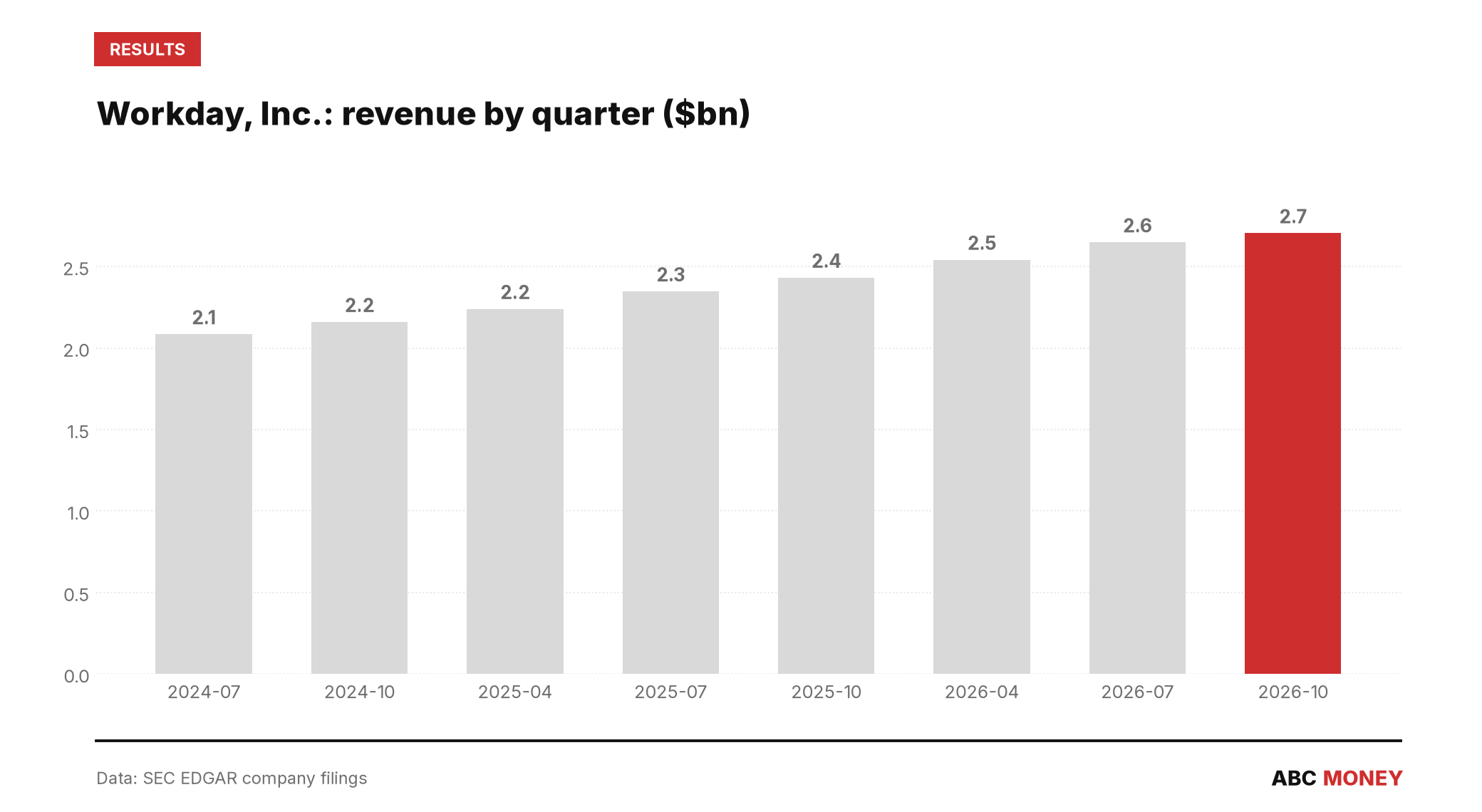
The human resources and finance software maker reported fiscal third-quarter revenue of $2.705 billion, up 11.2% year on year, ahead of the roughly $2.69 billion analysts had pencilled in. Adjusted earnings per share of $2.82 also cleared the $2.75 consensus estimate. On that basis, the headline claim holds: Workday beat on both lines it was expected to beat on.
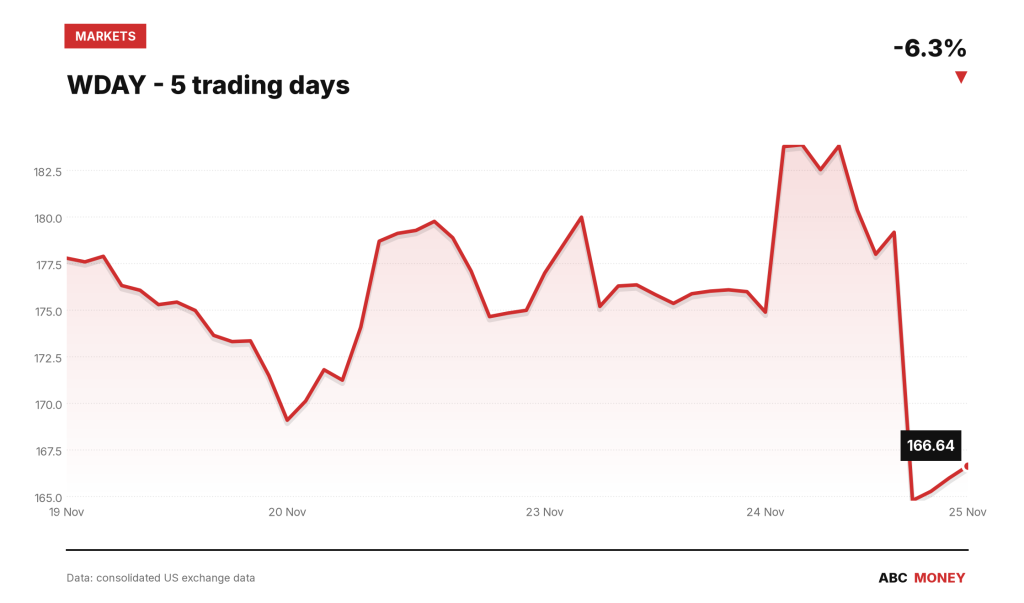
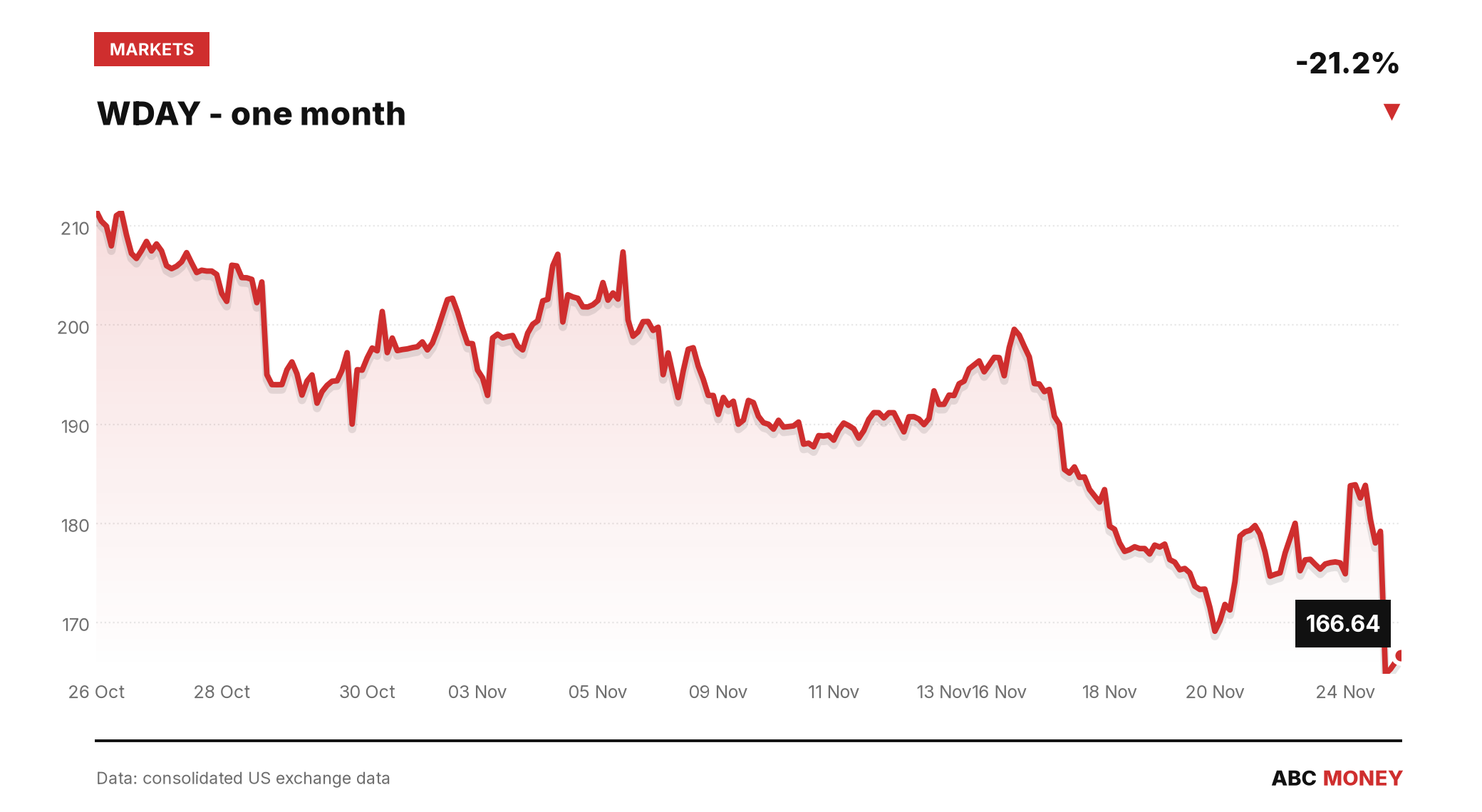
But the stock’s reaction tells a different story. Shares dropped 7.38% in after-hours trading from a $179.23 close, then extended the slide into the next session, falling as much as 10.3% in early trading. By the close, the stock was down 9.35% on the day and 16.35% over the prior 20 trading days, to $166.64 – well below its 20-day high of $207.39.
Why a clean beat still sold off
The gap between the headline and the share price comes down to guidance, not the quarter just reported. Workday’s subscription revenue grew 12.8% in the third quarter, but management’s outlook for the fourth quarter points to roughly $2.6 billion in subscription revenue, up only around 10%. For a stock that trades largely on the durability of its growth rate, a two-and-a-half-point deceleration is the number that moved the market, not the trailing beat.
There’s a wrinkle underneath that figure, too. Analysts flagged that this quarter’s backlog growth was flattered by early customer renewals that won’t repeat in future periods – meaning some of the strength investors saw in the headline backlog number was a timing effect rather than new demand.
Workday did raise its full-year subscription revenue guidance to $9.958 billion, implying 13% growth for the year – an upgrade that, in isolation, would usually be read as good news. That it wasn’t enough to offset the softer Q4 signal says something about how exacting the market has become with software names: a raise on the annual number didn’t outweigh a slowdown implied for the next ninety days.
The GAAP gap
There’s also a more technical reason the “beat” headline oversimplifies things. On a GAAP basis – the standard accounting measure that includes stock-based compensation and other items excluded from adjusted figures – Workday’s diluted earnings per share came in at $0.96, which missed a GAAP-basis estimate of $1.19 tracked by at least one data provider. Whether Workday “beat” or “missed” on earnings, in other words, depends entirely on which EPS measure you’re using – adjusted, which strips out costs like stock compensation, or GAAP, which doesn’t. That’s a distinction headline writers routinely flatten, and this quarter it mattered.
Positioning was already cautious
The options and short-selling market had been bracing for volatility well before the print. FINRA’s daily short-sale data – which tracks the share of trading volume attributable to short sales, where investors bet on a falling price – showed the short-volume ratio spiking to 0.74 on 13 November, roughly ten days ahead of results, and staying elevated through results week before settling back to 0.615 on the day the numbers landed. That pattern is more consistent with hedging into an uncertain event than with investors expecting a specific direction, but it underscores that the market wasn’t treating this as a routine print.
The broader backdrop offers little explanation for the move. The 10-year Treasury yield was flat at 4.92% into the print and the unemployment rate had ticked down to 4.1%, suggesting the selloff was specific to Workday’s own numbers rather than a reaction to shifting interest-rate or labour-market expectations.
Workday’s net income for the quarter was $237 million, continuing a run of positive quarterly profitability that stretches back across the past two fiscal years, according to the company’s quarterly filing. The next test for the stock will be whether that fourth-quarter subscription number – the one that triggered this week’s slide – comes in at or above the 10% guided pace when Workday next reports.
This article is for information only and is not investment advice or a recommendation to buy or sell any asset. Markets move quickly; figures are correct as sourced at the time of writing. Always do your own research before making financial decisions.