Coherent’s $20 Billion AI Deal Doesn’t Pay Off Until 2028
Coherent's $20 billion AI deal starts generating revenue only in 2028, filings show, even as capex surges and the stock slides twice in a month.
In this article 3 sections
Coherent Corp (NASDAQ: COHR) has confirmed a $20 billion AI deal that will reshape its revenue base – but not for another two years. The company’s own Q1 FY2027 earnings exhibit, filed with the US Securities and Exchange Commission, lays out a five-year “PhotonLink” supply agreement worth roughly $20 billion with an undisclosed major AI customer – and states plainly that revenue from it won’t begin ramping until early calendar 2028. For a stock that has already been marked down twice since the announcement, that timing gap is the whole story.
PhotonLink is Coherent’s optical-interconnect platform for AI data centres, and this new agreement is its second anchor customer, complementing a separate partnership and $2 billion equity investment from Nvidia struck in March 2026, according to Coherent’s annual report. Analysts at TIKR have pencilled the new contract out at roughly $4 billion a year once it is running – against a current annualised revenue base of around $9.5 billion, meaning it could eventually add more than 40% to today’s top line. That is the upside case. The catch, flagged by Futurum Group, is that none of it shows up until 2028, leaving two fiscal years in which Coherent has to build the capacity without the matching cash coming in.
A record quarter, and a cash drain to match
The underlying business is not waiting for 2028 to grow. Coherent’s quarter ended 30 September 2026 produced record revenue of $2.37 billion, up by roughly 56% from the prior year on the company’s own figures, alongside net income of $384.7 million and diluted earnings per share of $1.90, according to its 10-Q filing. That is a step up from the $1,581.4 million of revenue and far thinner profits the company reported a year earlier, when Coherent was still working through a run of loss-making and barely-profitable quarters in 2024 and early 2025.
The same quarter that delivered those records also showed the cost of chasing the PhotonLink opportunity. Capital expenditure jumped to $776 million and operating cash flow turned negative, according to Yahoo Finance – a reminder that building out manufacturing and interconnect capacity for a customer whose payments don’t start for two years has to be funded from somewhere in the meantime. Coherent’s chief executive has told investors that long-term agreements of this kind typically carry an upfront customer payment to help fund the capacity being built, a structural offset that Yahoo Finance reported from the company’s earnings call. Whether that upfront cash is enough to bridge two years of heavier spending is the question the market has been asking ever since.
Why the market keeps selling a beat-and-raise
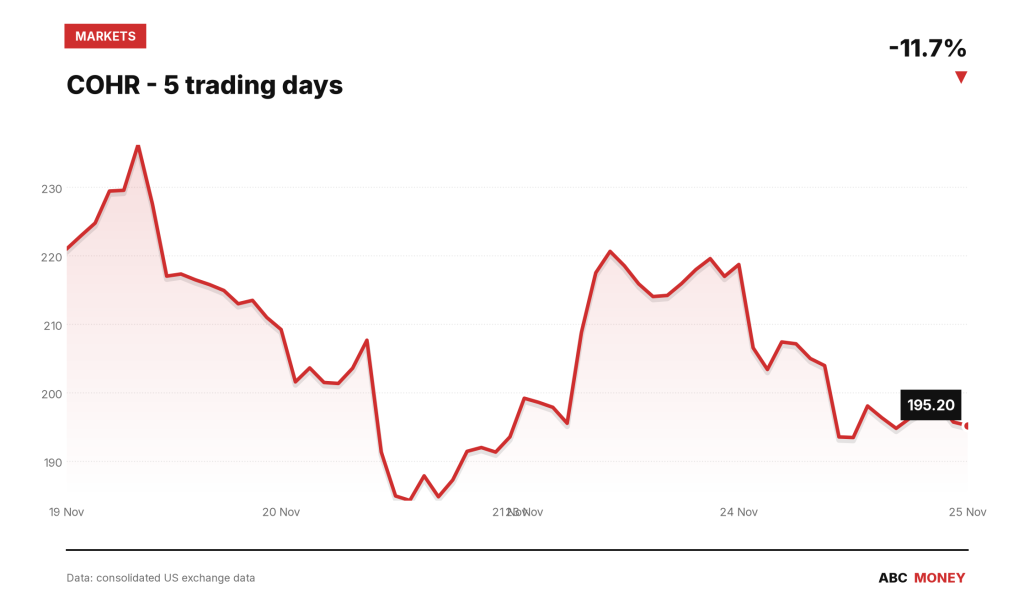
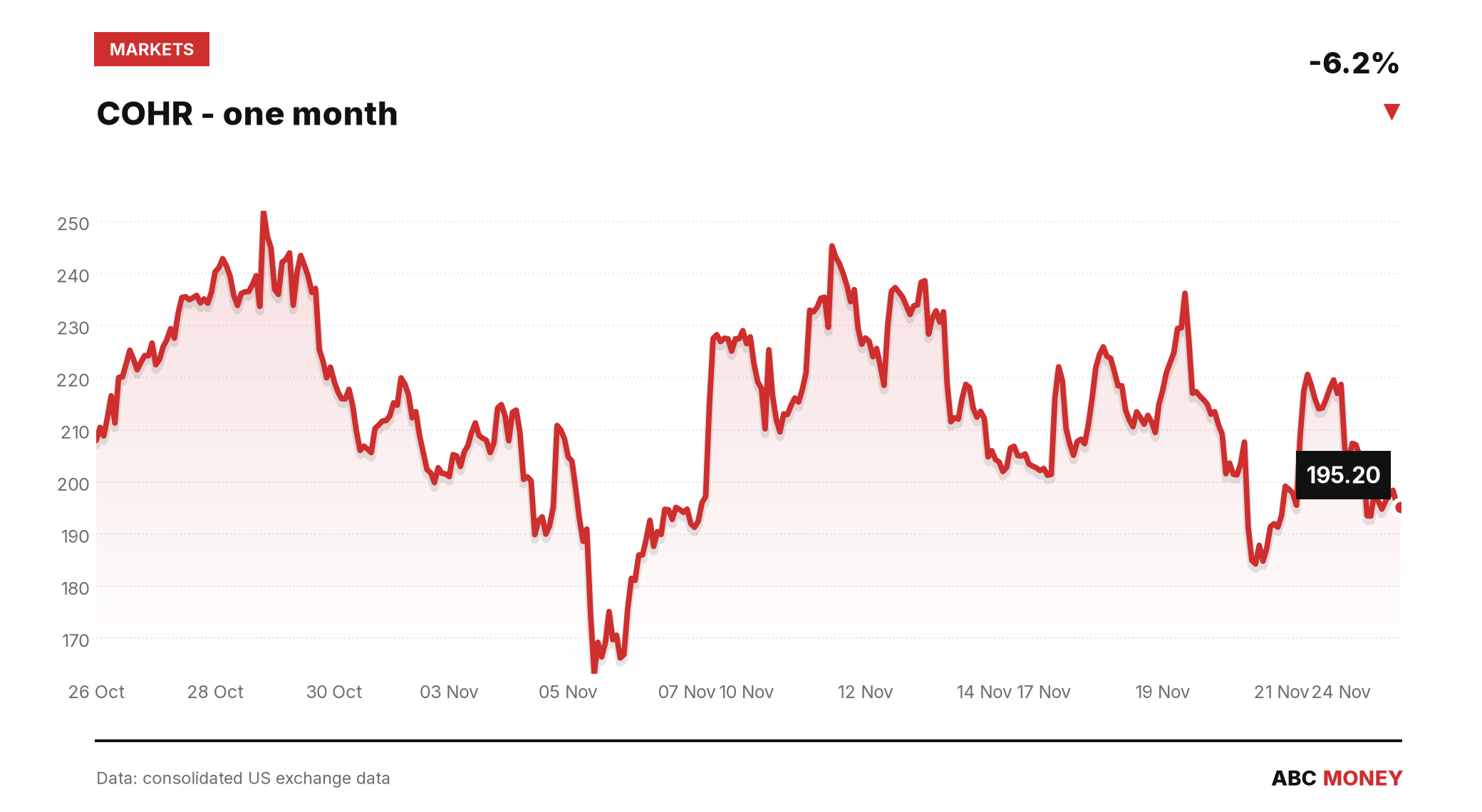
Twice in November, investors answered that question by selling. COHR fell 13.72% on the 4th and 5th of the month despite the beat-and-raise quarter, closing near $168-169, according to GuruFocus. A fortnight later, on 20 November, the shares dropped a further 13.9% to $185.63 amid a broader tech sector selloff, GuruFocus reported. By late November the stock was changing hands at $195.60, down 8.33% over the prior twenty trading days and well off its 52-week high of $440, a level set as recently as 3 June 2026, according to CNBC data.
That is not a short squeeze unwinding. Daily short-sale volume as a share of total trading – a measure of how much of the day’s turnover came from bets that the price would fall – ranged between roughly 0.30 and 0.65 across 11-24 November, according to FINRA data, well within normal bounds for the stock. The selling looks more like long-only investors reassessing how much they’re willing to pay today for cash flows that arrive in 2028, against a backdrop where the 10-year US Treasury yield sits near 4.92%, keeping the opportunity cost of waiting on growth stocks firmly in view.
The $20 billion AI deal as a funding problem, not a growth problem
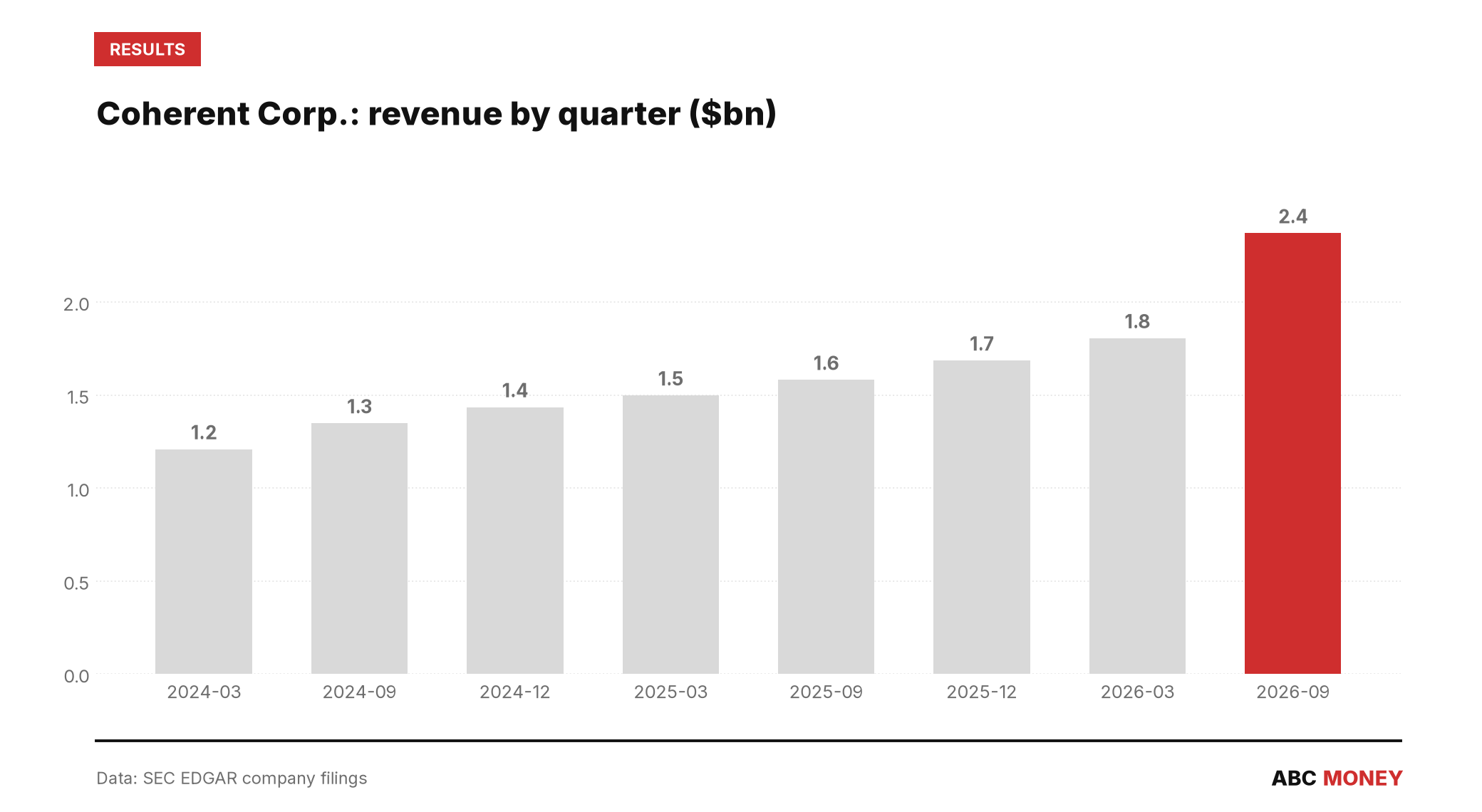
Nobody disputes that Coherent’s underlying demand is real: revenue has climbed every quarter for two years, and the PhotonLink pipeline now spans at least two large anchor customers. The tension the market is pricing is narrower and more mechanical – whether Coherent can fund roughly two years of elevated capex and negative operating cash flow before the $20 billion AI deal’s revenue starts landing, without diluting shareholders or taking on costly debt along the way. Coherent’s next few quarterly filings, and any detail the company gives on how the PhotonLink upfront payments are structured, are likely to be the clearest signal of how that gap gets bridged before 2028 arrives.
This article is for information only and is not investment advice or a recommendation to buy or sell any asset. Markets move quickly; figures are correct as sourced at the time of writing. Always do your own research before making financial decisions.