Dollar Tree Q3 results beat forecasts, shares jump ~8%
Dollar Tree Q3 results beat estimates on every metric, with traffic up 3.8% and guidance raised, sending shares roughly 8% higher.
In this article 3 sections
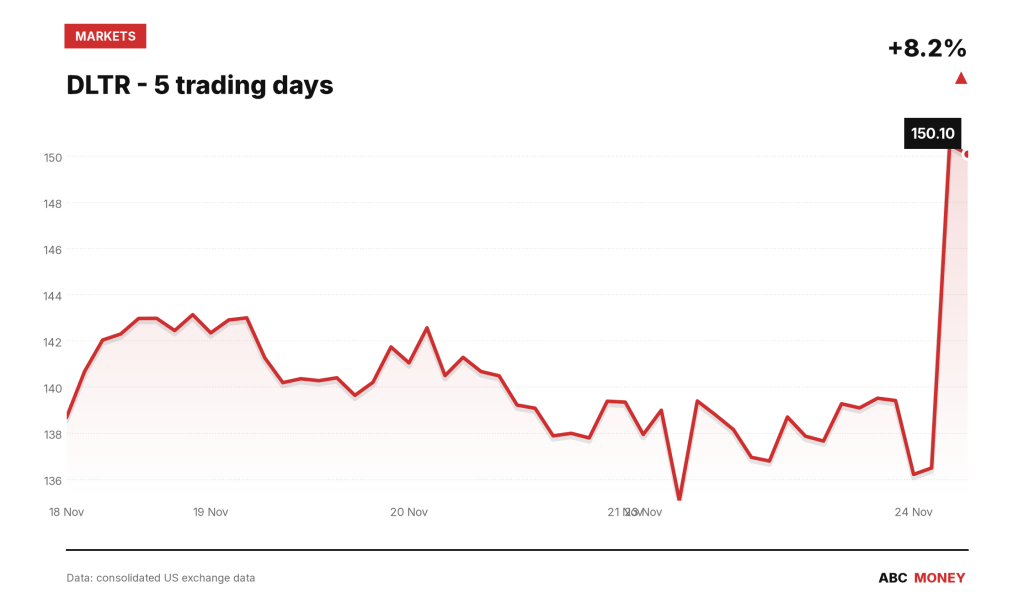
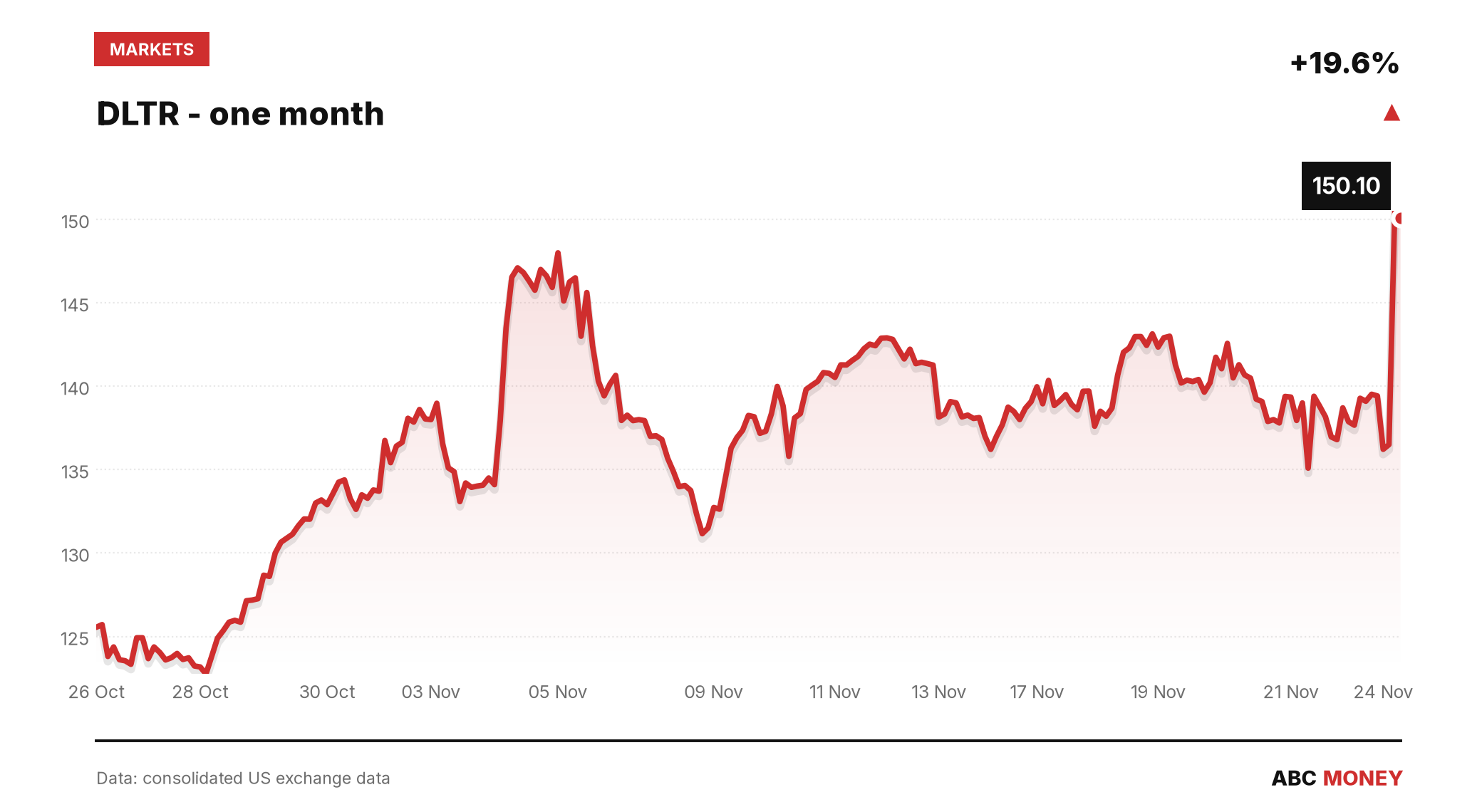
Dollar Tree’s Q3 results beat Wall Street’s expectations on nearly every line that matters, and the market rewarded it: shares in Dollar Tree (NASDAQ: DLTR) closed the session roughly 8% higher, finishing at $150.10, after the discount retailer reported comparable-store traffic accelerating to 3.8% and raised its full-year earnings outlook.
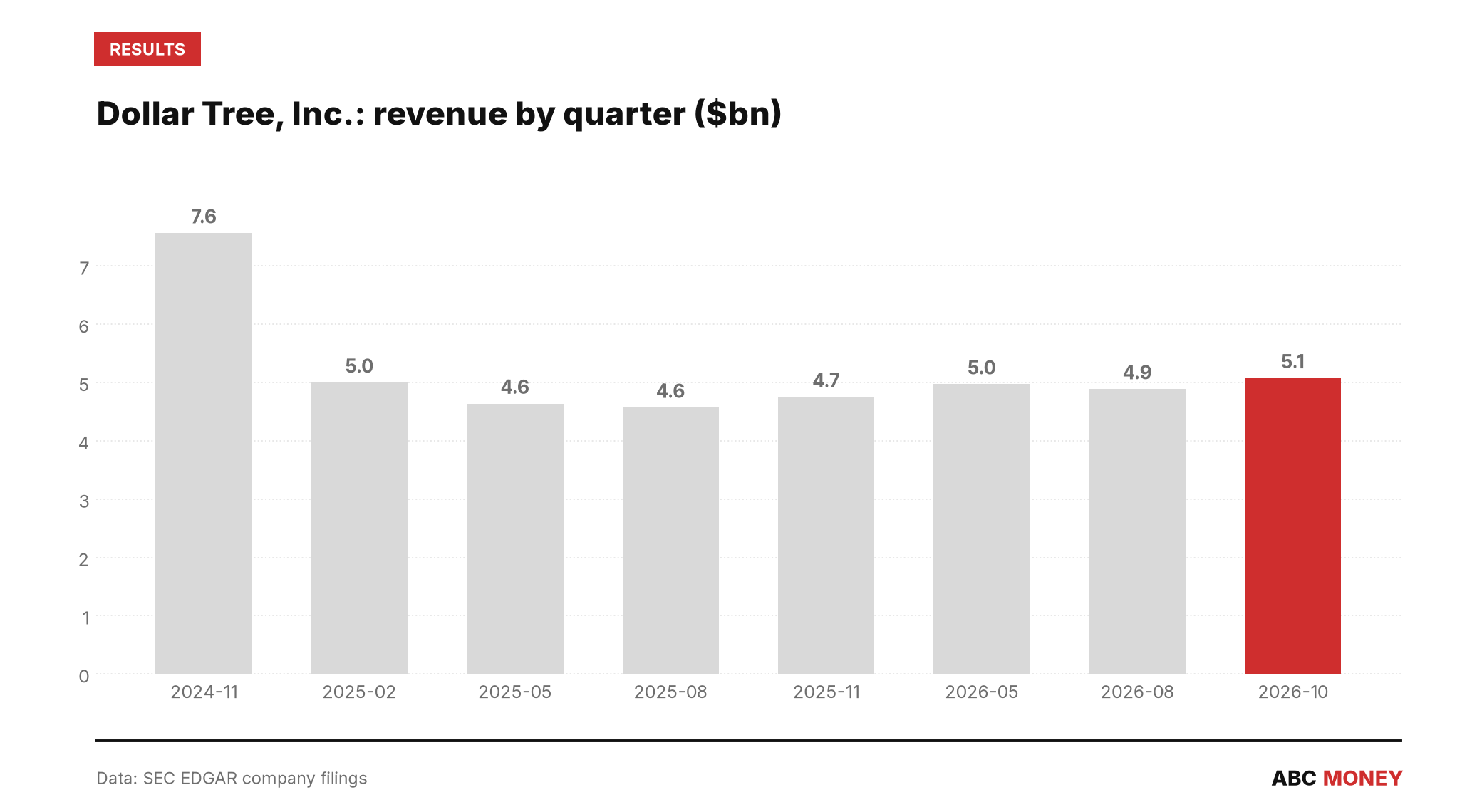
The quarter, covering the thirteen weeks to 31 October 2026, showed total revenue of $5.07bn, up 6.9% from $4.75bn a year earlier. Comparable-store net sales rose 4.6%, with that figure split between a 3.8% rise in customer traffic and a 0.8% uptick in average ticket size, according to the company’s earnings release filed with the SEC. Chief executive Mike Creedon put it plainly: “Comp traffic accelerated to 3.8% and drove comparable sales above the high end of our outlook.”
Dollar Tree Q3 results clear the bar on earnings too
Adjusted diluted earnings per share came in at $1.16, comfortably ahead of the $0.91 that FactSet-polled analysts had pencilled in, as first reported by Finimize. On a reported basis, diluted EPS was $1.24, a figure that includes $0.42 a share of costs tied to reinvesting tariff-related savings back into pricing and operations – a deliberate trade-off the company has been flagging for several quarters as it tries to keep shelf prices competitive.
Buoyed by the beat, Dollar Tree lifted its fiscal 2026 adjusted EPS guidance to a range of $8.05 to $8.25, with the midpoint of $8.15 sitting above the $7.93 that analysts had been expecting, Investing.com reported. For a retailer that spent much of the past two years managing the fallout from its Family Dollar divestiture and tariff uncertainty, a second consecutive guidance raise is a meaningful signal of operational traction.
The EPS beat masks a net income dip
Here’s the wrinkle that the headline numbers don’t show: Dollar Tree’s actual net income fell year-on-year, from $244.6m in the same quarter last year to $232.0m this time, even as revenue grew and EPS rose. The gap is explained by the share count. The company repurchased $205m of its own stock during the quarter, part of a buyback programme that has been steadily shrinking the number of shares outstanding. Fewer shares means the same – or even slightly smaller – profit pool gets divided more generously per share, which is exactly what happened: diluted EPS rose from $1.20 a year ago to $1.24 this quarter despite the dip in net income. It’s a legitimate way to grow EPS, and buybacks are standard capital-allocation practice, but it’s worth separating “the business earned more” from “shareholders got a bigger slice,” because this quarter it was mostly the latter doing the work.
A sharply different reception to Q2
What makes this quarter’s share-price reaction notable is the contrast with the one before it. Dollar Tree also beat estimates and raised guidance in its second quarter of fiscal 2026, yet shares actually slipped roughly 3.9% on the day of that release, according to Yahoo Finance. Investors evidently wanted more than a beat-and-raise back then – perhaps clearer evidence that traffic, not just pricing and cost control, was driving the improvement. This quarter’s 3.8% traffic acceleration appears to have supplied exactly that proof point, which may explain why the market’s response flipped from muted to enthusiastic despite a broadly similar set of headline metrics.
There’s little sign the rally was a short-covering squeeze – where traders who had bet against the stock are forced to buy back shares, amplifying a price move. FINRA’s daily short-sale data show the stock’s short ratio – the proportion of daily trading volume attributable to short sales – bouncing between roughly 0.47 and 0.76 in the ten sessions before the report, with no unusual build-up that would suggest a crowded short position was waiting to unwind. That points to the move being a genuine re-rating of the earnings story rather than a mechanical squeeze.
Shares traded within a 20-day range of $131.16 to $150.50 heading into the print, and the post-earnings close sat at the very top of that band. With trading volume running at 87% of the 20-day average on the day, the move looks to have been driven by conviction buying rather than a liquidity-starved spike. The next test for Dollar Tree is whether traffic gains hold up through the crucial holiday trading period, and whether the tariff-reinvestment costs that shaved $0.42 off this quarter’s per-share earnings start to ease as the year turns – a detail investors will be watching closely in the next quarterly filing.
This article is for information only and is not investment advice or a recommendation to buy or sell any asset. Markets move quickly; figures are correct as sourced at the time of writing. Always do your own research before making financial decisions.