HPE fourth quarter results beat forecasts, shares fall ~6%
HPE fourth quarter results smashed guidance with 50% revenue growth, yet the stock fell as investors questioned its stretched valuation.
In this article 3 sections
Hewlett Packard Enterprise’s (NYSE: HPE) fourth quarter results, announced on 23 November 2026, were the kind of print most finance chiefs dream of delivering: revenue up 50% year-on-year, earnings above the top of management’s own guidance, and a raised outlook for the year ahead. The shares fell anyway.
For the quarter ended 31 October 2026, HPE posted net revenue of $14,547 million, according to the company’s own filing with the Securities and Exchange Commission. Diluted earnings per share under US accounting rules came in at $1.26, per GuruFocus, while the adjusted figure HPE prefers to highlight – which strips out items such as restructuring costs and stock-based compensation – reached $1.43, above the company’s own $1.20-to-$1.30 guidance range, as QuantisNow reported.
Chief executive Antonio Neri called it “a defining year for HPE as we built a new networking industry leader and expanded our role in the AI infrastructure market.” Chief financial officer Marie Myers said the year closed on “disciplined execution” that produced “significant margin expansion, record operating profit, and free cash flow more than three times higher than last year,” according to the company’s filed release.
What the fourth quarter results showed
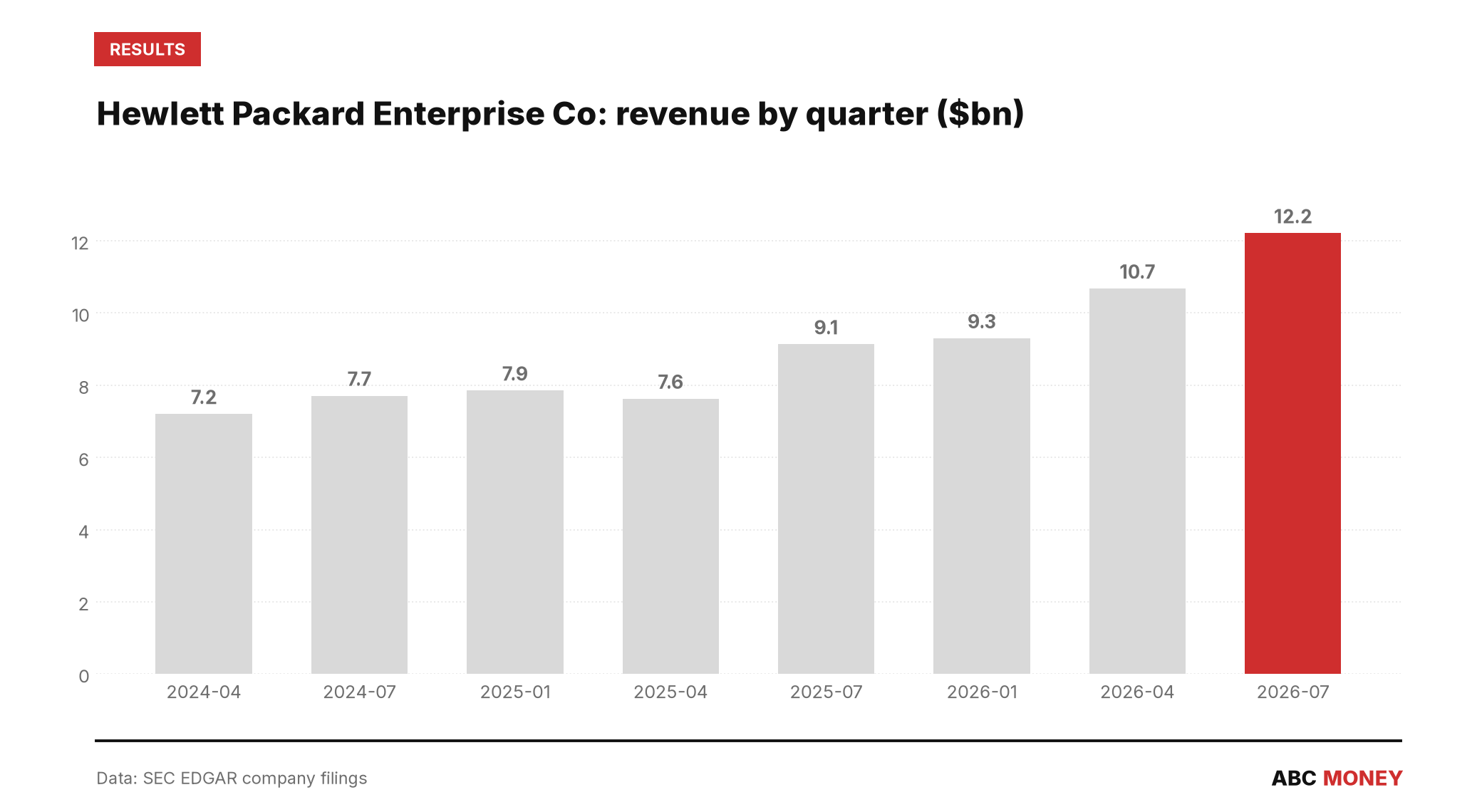
The scale of the acceleration is the real story beneath the headline figures. HPE’s quarterly revenue has roughly doubled over the past two years, climbing from $7.2 billion in the second quarter of fiscal 2024 to $9.1 billion a year later, then to $12.2 billion in the third quarter of fiscal 2026 – a figure confirmed in HPE’s own quarterly filing – and now $14.5 billion. Full fiscal-year 2026 net earnings attributable to HPE reached $4,433 million, or $3.07 a share on a diluted basis, up sharply from a year earlier, GuruFocus noted.
Management backed the momentum with a raised fiscal 2027 guidance range of $5.05 to $5.35 in adjusted diluted earnings per share, according to a reproduction of the release carried by Stockhouse. The board also approved a new $5 billion share buyback programme alongside the results, as Investing.com reported – a signal, typically, that a board is comfortable with its own cash generation and share price.
A beat that didn’t convince the market
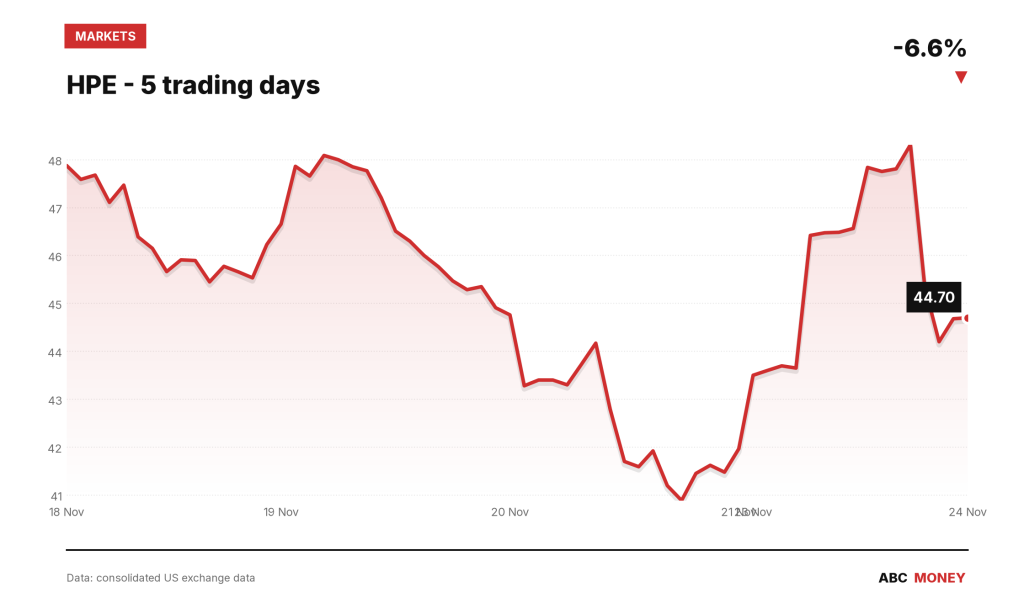
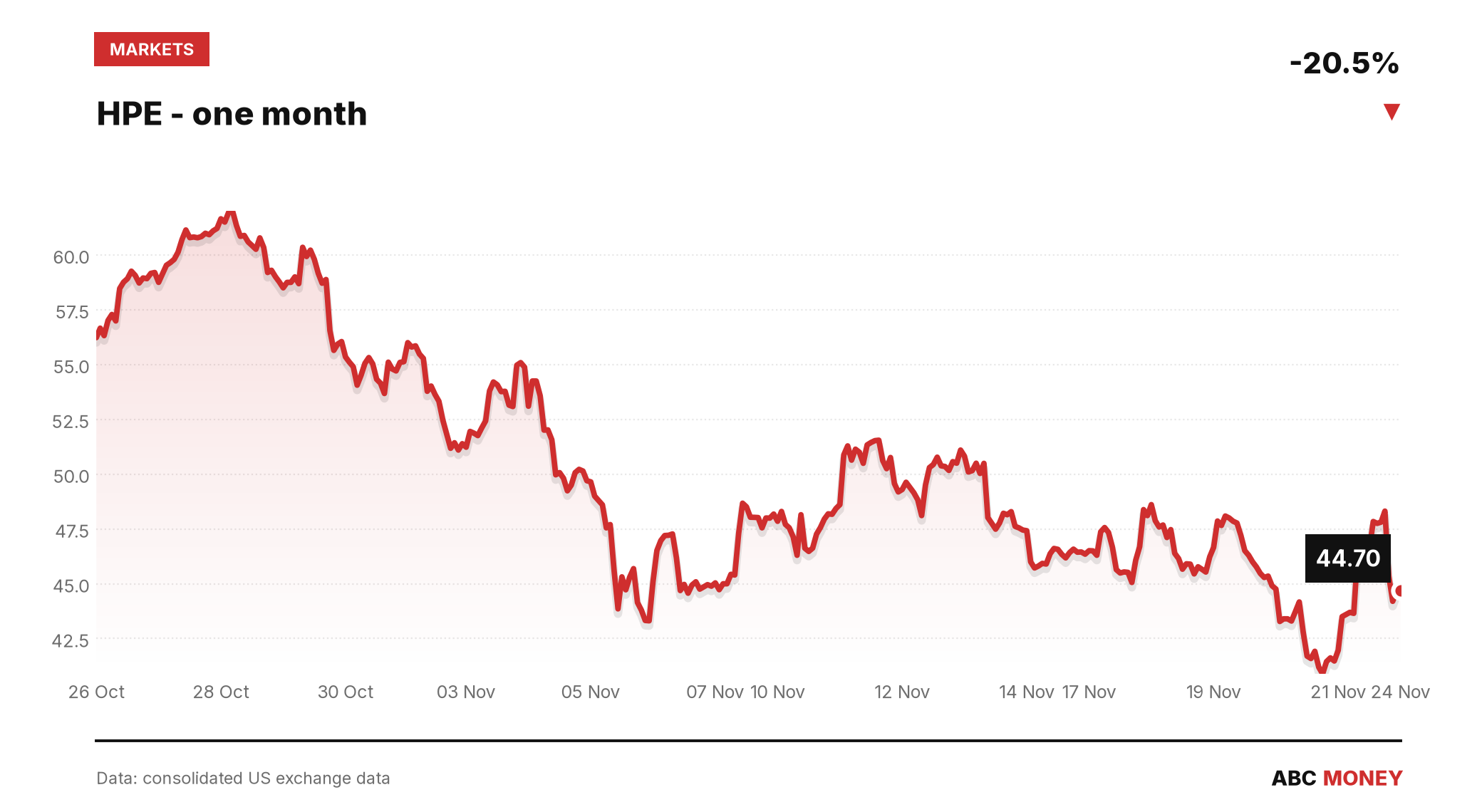
None of it stopped the stock from falling. Shares dropped in after-hours trading immediately following the release, as first reported by Seeking Alpha, and the slide extended through the following session: HPE closed 6.37% lower on the day, part of a 13.78% decline over the prior 20 trading days, on volume running at 3.46 times its 20-day average. That combination of a heavy sell-off and unusually high turnover points to a genuine repricing by a large number of holders rather than a thin, low-conviction move.
The likeliest explanation is valuation rather than substance. HPE’s trailing twelve-month price-to-earnings ratio stood at roughly 25 times, well above its five-year median of around 14.6 times, GuruFocus calculated – a gap that leaves little room for anything short of a flawless print once a stock has been bid up on AI-infrastructure enthusiasm. When the fundamentals arrive exactly as promised, or even slightly better, that can be treated by the market as confirmation to take profits rather than reason to pay more.
There was a separate, smaller data point in the run-up to results: a Form 4 filing, the document company insiders must lodge with the SEC when their holdings change, was submitted on HPE’s behalf on 20 November under the name Jennifer Nason, three days ahead of the earnings release. The filing itself does not specify whether it reflected a purchase or a disposal.
The macro backdrop
HPE’s print landed against a mixed rates picture. The 10-year US Treasury yield had eased to 4.92% by 20 November, down from 5.04% previously, while the 2-year yield slipped to 4.63% from 4.76%, according to Federal Reserve data. Lower long-term borrowing costs would ordinarily support richly valued growth names, including AI-infrastructure suppliers like HPE. That they didn’t cushion the fall this time suggests investors were reacting to company-specific valuation concerns rather than the broader rate environment.
The tension for HPE now is straightforward: the fourth quarter results prove the AI infrastructure build-out is translating into real revenue and profit growth, and management has put a credible number – the raised fiscal 2027 guidance – behind its confidence that this continues. Whether the market is willing to pay up for that growth at current multiples, rather than bank the gains, is the question the next few quarters of trading will answer.
This article is for information only and is not investment advice or a recommendation to buy or sell any asset. Markets move quickly; figures are correct as sourced at the time of writing. Always do your own research before making financial decisions.