Apollo, Goldman price $44bn SpaceX financing for GPU buildout
Apollo and Goldman Sachs priced a record $44bn SpaceX GPU financing for Nvidia Vera Rubin chips, oversubscribed and anchored by BlackRock and KKR.
In this article 3 sections
Apollo Global Management and Goldman Sachs (NYSE: GS) have priced roughly $44bn (£34.7bn) of senior and subordinated notes to bankroll SpaceX’s push into terrestrial computing, the largest GPU-focused financing completed to date, according to Apollo’s own announcement. The deal, confirmed independently by Reuters, will fund SpaceX’s purchase of Nvidia’s next-generation Vera Rubin chips, with lease schedules on the hardware due to start once deliveries begin in the first half of 2027.
The SpaceX GPU financing was oversubscribed and upsized on the back of strong investor demand, a detail corroborated by Markets Media’s coverage of the pricing. It also builds on an earlier framework: TechCrunch had reported SpaceX locking in an initial $40bn GPU financing arrangement with Apollo back on 26 October 2026, meaning the final print came in some $4bn above that original target.
Anchor commitments came from funds managed by BlackRock (NYSE: BLK), Goldman Sachs Asset Management, and accounts advised by KKR (NYSE: KKR), underlining how comfortably private credit’s biggest balance sheets absorbed a deal of this size. Apollo Global Securities and Goldman Sachs served as co-global coordinators, with Goldman acting as sole structuring agent, according to StreetInsider.
Why a space company needs $44bn for chips
SpaceX (NASDAQ: SPCX) is barely five months removed from its own milestone: the company’s 12 June 2026 initial public offering priced at $135 a share and valued the business at roughly $1.77tn, the largest listing on record, per CNBC’s coverage at the time. That a freshly listed issuer of that scale can now layer on a $44bn private debt deal says something about how quickly “terrestrial compute buildout” – jargon for building data centres and GPU clusters on the ground, as opposed to SpaceX’s satellite and launch businesses – has become central to the investment case.
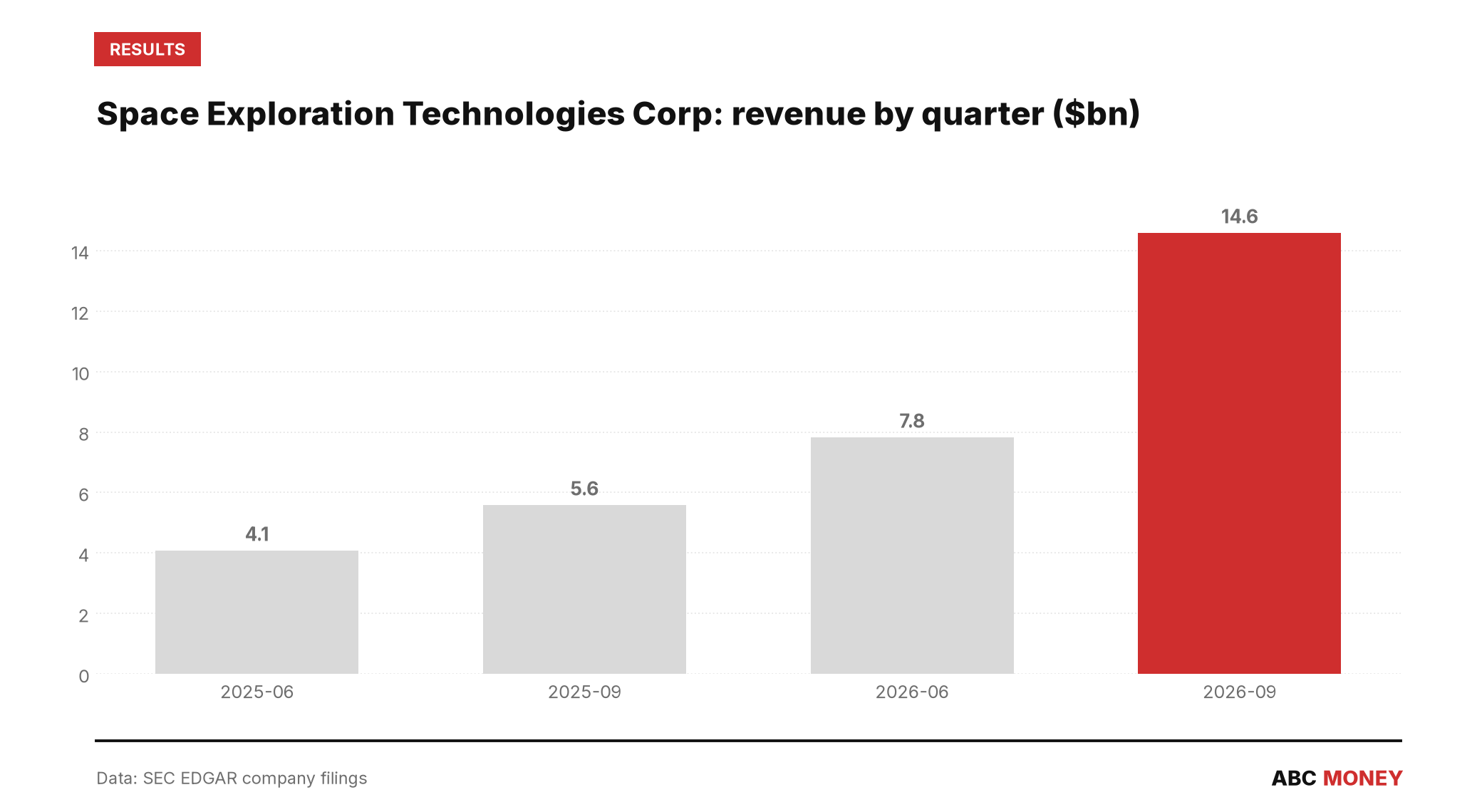
The revenue trend helps explain the appetite. SpaceX reported quarterly revenue of $7.814bn for the quarter ended 30 June 2026, which nearly doubled to $14.575bn in the quarter ended 30 September 2026, according to the company’s 10-Q filing with the SEC. That trajectory is the kind of growth story private credit investors have been chasing across the AI infrastructure complex, and it gives lenders comfort that a compute-heavy capital programme can be serviced.
Shares have drifted even as the deal landed
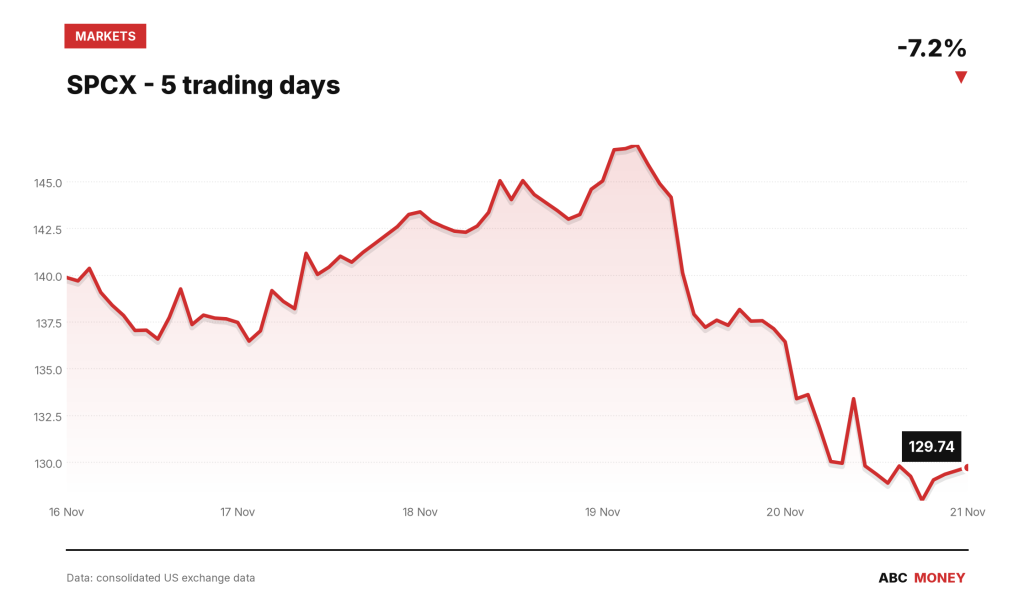
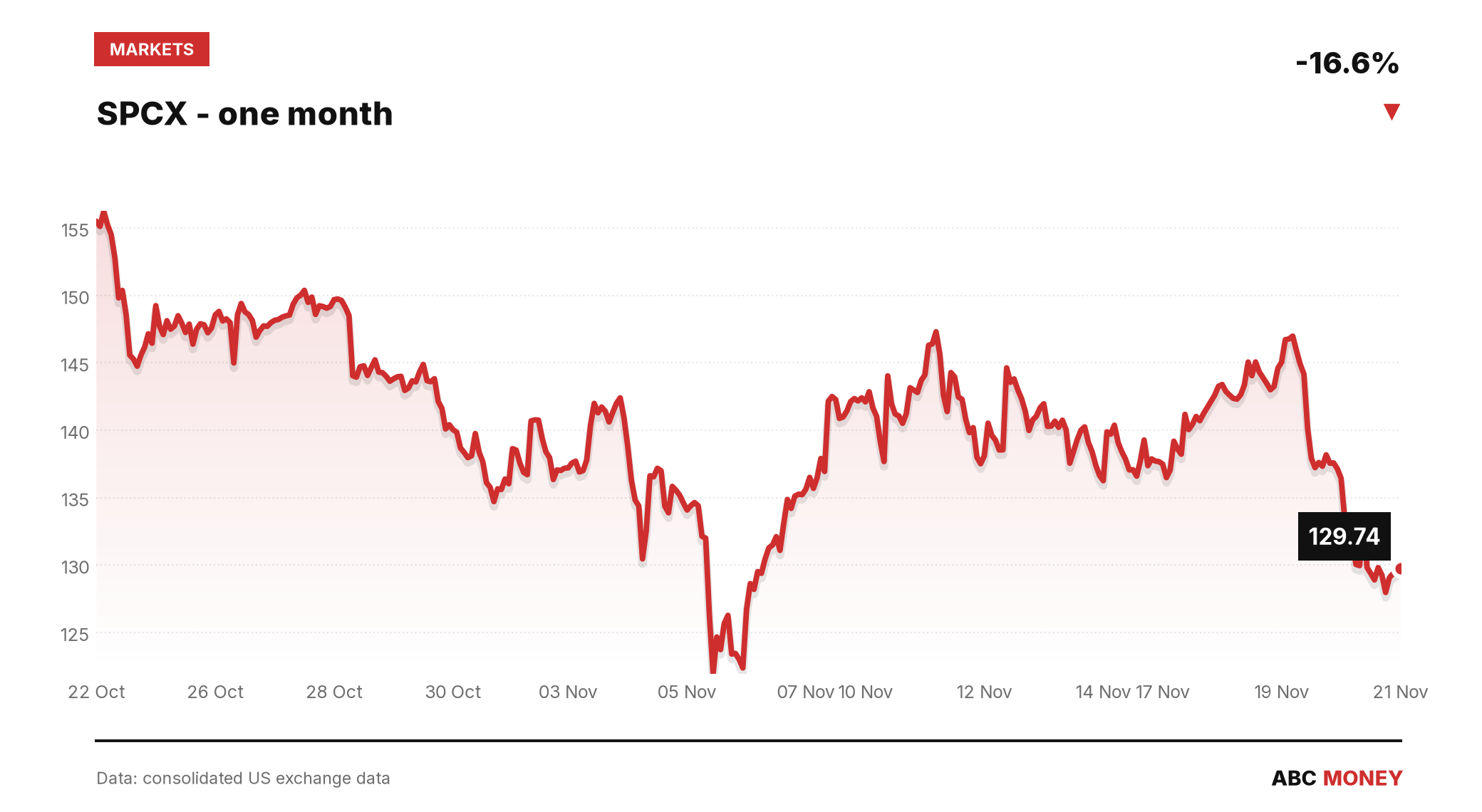
SPCX shares closed at $129.54 as of 21 November 2026, down 6.56% over the preceding 20 trading days even as the financing was being finalised, per consolidated US exchange data. The stock has traded in a $121.92-to-$147.30 range over that stretch, and volume on the session ran about 21% above the 20-day average – a pickup consistent with investors repositioning around the financing news rather than panic selling.
Short-sale activity, tracked daily by the Financial Industry Regulatory Authority, gives little sign of bearish conviction building against the stock: the FINRA short-volume ratio for SPCX ran between roughly 0.50 and 0.60 across the ten sessions bracketing the announcement, a range that suggests ordinary market-making flow rather than a build-up of bearish positioning.
Some of the share-price softness has local roots rather than financial ones. SpaceX has faced resistance to a proposed Texas data centre even as several analysts flagged upside from expanding compute capacity, according to Yahoo Finance – a reminder that the physical buildout behind this financing still has to clear planning and community hurdles state by state, separate from whatever Wall Street is willing to lend against it.
The broader credit backdrop
The pricing also lands against a relatively settled rates backdrop. The 10-year US Treasury yield stood at 5.04% as of 19 November 2026, barely changed from 5.07% a few sessions earlier, while the 2-year yield sat at 4.76%, according to Federal Reserve data. With the 10-year/2-year spread holding near 0.29 percentage points, the yield curve has stayed modestly upward-sloping – a backdrop that has generally supported investor willingness to extend duration into large structured-credit deals like this one rather than demand steep premiums for the risk.
Whether $44bn in asset-backed notes becomes a template other space and defence-adjacent companies reach for to fund AI-scale capex, rather than tapping public equity or straight corporate bonds, is likely to be the next question money managers watching this deal ask. For now, the scale of the SpaceX GPU financing – and the roster of names willing to anchor it – marks out private credit as the preferred route for funding the physical infrastructure behind next-generation compute, with the first lease payments not due until hardware starts arriving in 2027.
This article is for information only and is not investment advice or a recommendation to buy or sell any asset. Markets move quickly; figures are correct as sourced at the time of writing. Always do your own research before making financial decisions.