Williams-Sonoma’s Long-Term Guidance Removal Rattles Investors
Williams-Sonoma's long-term guidance removal from its Q3 release triggered price-target cuts, but management says the outlook itself hasn't changed.
In this article 3 sections
Williams-Sonoma’s long-term guidance removal from its third-quarter earnings release has set off a fresh round of price-target cuts this week, even as the kitchenware and furniture retailer’s own executives insist nothing about its outlook has actually changed.
The facts behind the fuss are narrow but real. For two straight quarters this year, Williams-Sonoma (NYSE: WSM) closed its earnings statements with a stock sentence: that it expected “mid-to-high single-digit annual net revenue growth with an operating margin in the mid-to-high teens” over the long term. That line appeared in both the Q1 and Q2 FY2026 releases. In the Q3 release, filed with the SEC on 19 November 2026, it was gone – replaced with a note that the company would provide fiscal 2027 guidance in March, “per our usual cadence.”
RBC was first to flag the omission publicly the following day, telling clients the change raised questions about Williams-Sonoma’s 2027 positioning, a view reported by MarketScreener. By then the stock had already done most of its damage for reasons that had little to do with a missing sentence.
What the long-term guidance removal actually says
On the earnings call itself, chief executive Laura Alber pushed back directly on the idea that anything structural had shifted, stating that “our long-term guidance algorithm has not changed,” according to a transcript carried by Investing.com. Chief financial officer Jeff Howie went further, telling analysts the company was “simply trying not to give 2027 guidance” and that investors were “reading too much into it,” per a transcript published by The Motley Fool. In the same release, Williams-Sonoma reiterated – rather than raised or cut – its full-year fiscal 2026 targets of 4.7% to 7.2% net revenue growth and a non-GAAP operating margin of 17.8% to 18.2%.
That reiteration matters, because it undercuts the cleanest version of the story: a company doesn’t typically repeat its near-term numbers unchanged while quietly signalling a structural retreat in the paragraph just above them.
The number that actually moved the stock
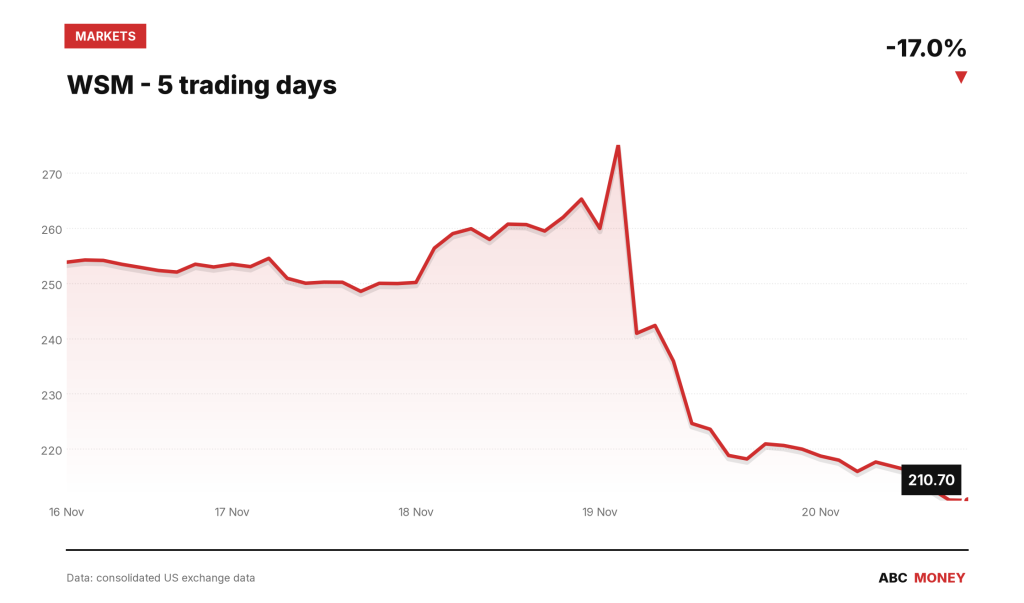
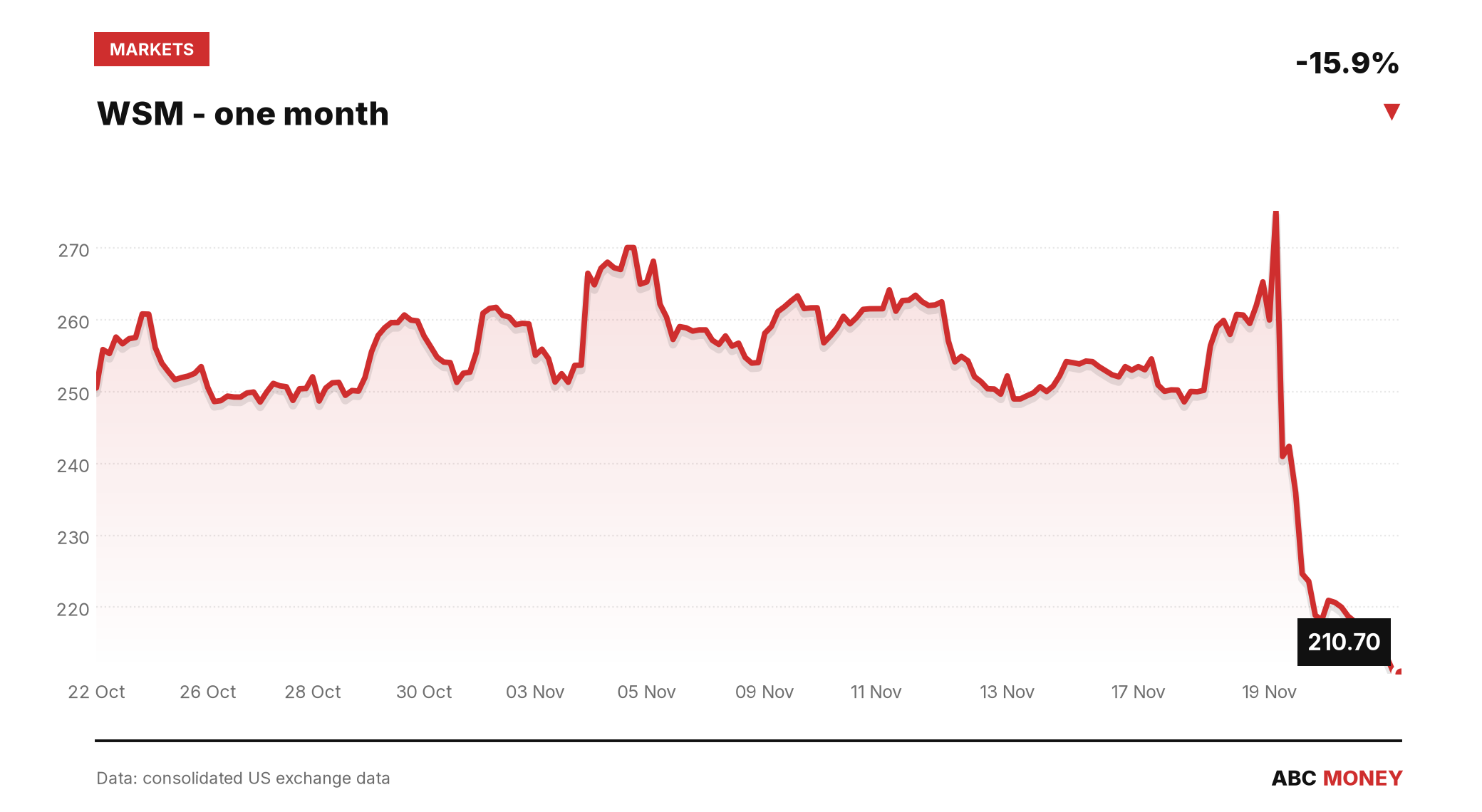
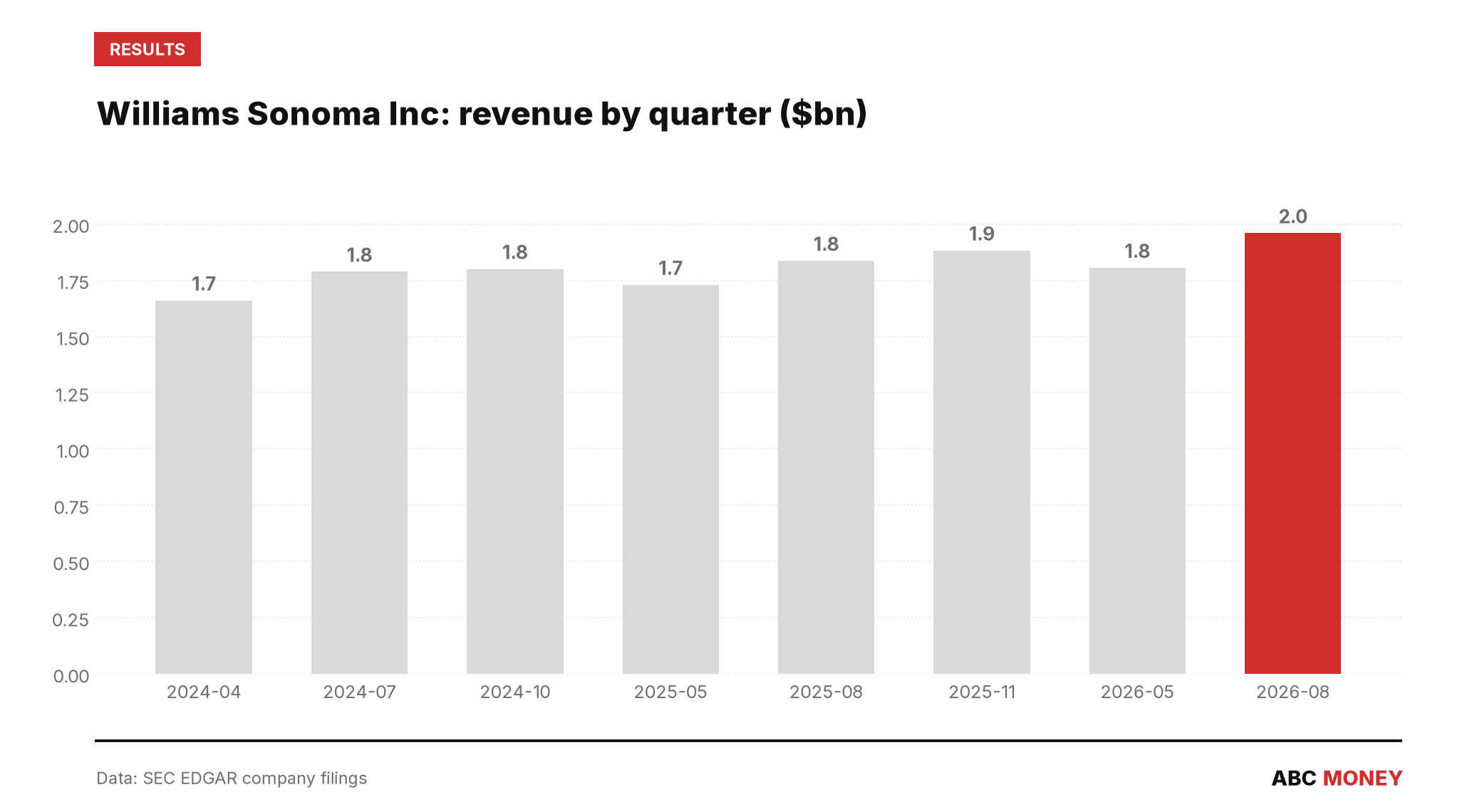
What did move the shares was the quarter itself. Williams-Sonoma posted non-GAAP earnings per share of $2.19, a hair above the $2.18 consensus, but revenue of $1.991bn landed just short of the $1.998bn analysts had pencilled in, according to Benzinga. For a retailer trading at a premium multiple on the strength of a multi-year streak of outgrowing the sector, even a marginal miss on the top line was enough to unsettle holders. The stock fell roughly 15% on the day to close at $220.66, down from $260.09 the prior session, and kept sliding into the following day, last changing hands at $210.70 – down 17.5% over twenty trading sessions and on volume more than double its recent average.
Management has attributed part of the margin pressure to higher diesel and transportation costs rather than softer demand, framing a pullback in promotional markdowns as a deliberate choice to protect profitability rather than a sign of strategic retreat, according to call highlights compiled by GuruFocus.
Wall Street trims targets, keeps the faith
The analyst response has been more a recalibration than a rout. Jefferies cut its price target to $261 from $275, per MarketScreener, while UBS trimmed its target to $250 from $265 but kept a Neutral rating, as reported by the Daily Political wire. Baird, Stifel, Evercore ISI and TD Cowen also lowered their targets after the print, with most retaining positive ratings, according to a roundup from Benzinga – a pattern more consistent with trimming near-term estimates than with abandoning the long-term thesis.
Separately, chief executive Laura Alber filed a Form 4 with the SEC on 17 November disclosing a stock sale executed under a pre-arranged Rule 10b5-1 trading plan – the kind of scheduled disposal set up well in advance and unrelated to the timing of the earnings release two days later.
The broader backdrop isn’t helping sentiment either. The 10-year US Treasury yield stood at 5.04% as of 19 November, according to FRED data from the Federal Reserve Bank of St. Louis – a level of long-term borrowing costs that keeps pressure on valuations across consumer discretionary and housing-linked names, Williams-Sonoma among them, even when the underlying business is holding up.
The company’s next scheduled test of its own words comes in March, when it is due to issue fiscal 2027 guidance on what it describes as its usual cadence. Until then, the gap between a disclosure tweak and a change in substance is likely to stay the central question for anyone pricing the stock.
This article is for information only and is not investment advice or a recommendation to buy or sell any asset. Markets move quickly; figures are correct as sourced at the time of writing. Always do your own research before making financial decisions.