The ‘Digital Gold’ Myth: Why Bitcoin is Behaving Like a High-Risk Tech Stock

Bitcoin reached $126,000 at the beginning of October 2025. The devout were overjoyed. As always, the halving cycle had produced results. Institutional capital was being drawn to the spot ETFs. Compared to previous White Houses, the Trump administration was the most pro-crypto. In summary, the situation was as favorable as it could be.
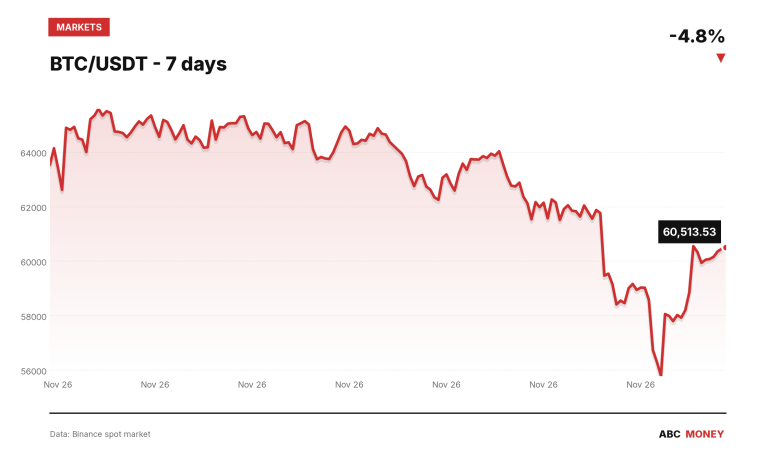
Bitcoin dropped to less than $63,000 by February 2026. That represents a 50% decline in less than four months—during a time when gold was reaching all-time highs above $5,500 per ounce, the U.S. dollar was declining, and geopolitical tension was increasing. This was the perfect opportunity to demonstrate that Bitcoin acts like virtual gold. Rather, it acted as though someone had neglected to hedge a leveraged Nasdaq position.
It is not a footnote to that contrast. It’s the narrative. The digital gold thesis was based on two claims: first, that despite short-term volatility, Bitcoin stores value across cycles; and second, that it serves as a safe haven during crises, rising or at least remaining stable when fiat currencies decline, inflation increases, and institutional trust erodes.
Bitcoin vs Gold — The ‘Digital Gold’ Myth: Key Data 2025–2026
| Bitcoin Peak (Oct 2025) | $126,000 per coin |
| Bitcoin Low (Feb 2026) | ~$60,000 — a 50%+ drawdown in under four months |
| Gold Price (same period) | Surged above $5,500/oz — record high while BTC fell |
| BTC–Gold Rolling Correlation | –0.03 (effectively zero — no meaningful relationship) |
| BTC–Nasdaq 100 Correlation | +0.35 to +0.6 in 2025–2026 · peaked at +0.78 in 2025 |
| BTC–USD Dollar Index Correlation | Near zero in 2025–26 (was –0.4 in 2022–23 when hedge theory held) |
| ETF Net Outflows (2026 YTD) | ~$4.5 Billion — longest sustained outflow streak since early 2025 |
| Leveraged Liquidations (1 day, Feb 2026) | $279M liquidated · $170M in long positions alone |
| US Dollar Index (DXY) | Down 10%+ from 2025 peak — conditions ideal for “digital gold” thesis. Bitcoin still fell. |
| Fed Balance Sheet Drawdown | $2.8 Trillion drained peak to late 2025 — tightening crushed liquidity-sensitive BTC |
| Academic Finding | Bitcoin is 2nd riskiest asset in multi-asset studies — more comparable to crude oil than gold |
Even though it necessitates a long time horizon and a strong stomach, the first claim has some historical support. Now that the second claim has been put to the test under almost perfect circumstances, the outcome is clear. As of early 2026, the rolling correlation between gold and Bitcoin is roughly negative 0.03. Practically speaking, that is zero. No deep connection. The two assets are not moving in tandem, and during this specific period of market history, they moved in diametrically opposed directions while the macroeconomic climate was favorable to gold appreciation.
In the meantime, Bitcoin’s correlation with the Nasdaq 100, especially with high-beta leveraged tech proxies, reached a peak of 0.78 in 2025 and stayed between 0.35 and 0.6 until early 2026. That isn’t a statistical artifact or a coincidence. It sums up what Bitcoin has evolved into: an asset that increases when risk appetite is high, liquidity is plentiful, and tech multiples are growing, and decreases when any of those circumstances change. According to FXStreet, it is a “high-beta tech asset, driven by liquidity, growth expectations, and valuation cycles within the software market.” This framing is true, and it has a significant impact on how Bitcoin should be held, valued, and comprehended in a portfolio.
Because it captures a structurally significant aspect of the 2026 crash, the ETF story merits special attention. Bulls hailed the introduction of spot Bitcoin ETFs in the US as evidence that Bitcoin had become a legitimate asset class. And the inflows were extraordinary for a while. U.S. Bitcoin ETFs received $1.2 billion in just the first two trading days of 2026.
Then the mood changed. By January 6, ETF flows were negative. Analysts were monitoring $4.5 billion in net outflows by February, which was the longest period of consistent selling since early 2025. By design, the system that was commended for attracting institutional capital to Bitcoin also made it possible for institutional capital to leave. The fund must sell underlying Bitcoin in order to cover share redemptions made by ETF holders. Compared to traditional assets, the selling is large-scale, non-discretionary, and occurs in a market with less spot liquidity. Instead of stabilizing Bitcoin, institutionalization made it easier for fear to spread.
It’s difficult to ignore the particular sadness surrounding the demise of Michael Saylor’s Strategy, formerly known as MicroStrategy, which had grown to be the closest thing in cryptocurrency to a single institutional champion of the digital gold thesis.
Retail investors discussed Saylor’s strategy as though he had found a financial perpetual motion machine, and for a while, Strategy shares traded at a considerable premium to the net value of its Bitcoin holdings. The premium had become a discount by February 2026. Technically, Strategy’s Bitcoin position was underwater. The “infinite money glitch” had turned into a warning about using narrative risk and leverage in the same portfolio.
It seems like Bitcoin is more misbranded than broken as all of this is happening. Over time, the asset has shown that patient holders who enter early in a cycle and endure the volatility can earn enormous returns. That property is real and not insignificant.
However, it is a feature of a high-risk, high-reward speculative instrument that increases the Nasdaq’s gains when it rises and its losses when it falls. That is not a hedge; rather, it is a description of a position. While central banks were purchasing gold for precisely the same reasons that people predicted Bitcoin would be purchased, gold reached $5,500. Bitcoin dropped 50%. The hypothesis was put to the test. The thesis was unsuccessful. Right now, there isn’t much disagreement over the data.